


ATR kinase is required for global genomic nucleotide excision repair exclusively during S phase in human cells
- PMID: 19004803
- PMCID: PMC2584713
- DOI: 10.1073/pnas.0801585105
ATR kinase is required for global genomic nucleotide excision repair exclusively during S phase in human cells
Abstract
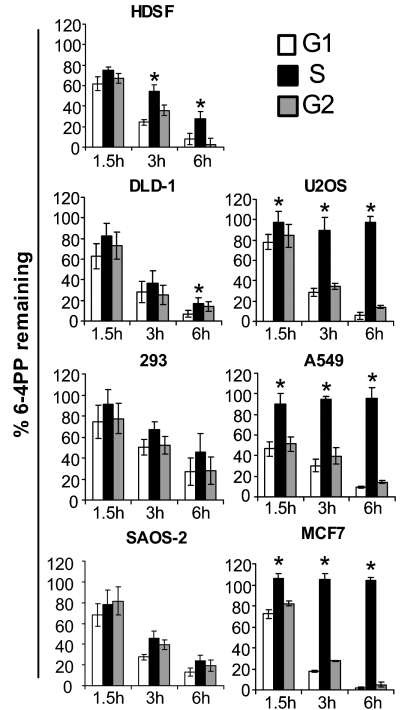
Global-genomic nucleotide excision repair (GG-NER) is the only pathway available to humans for removal, from the genome overall, of highly genotoxic helix-distorting DNA adducts generated by many environmental mutagens and certain chemotherapeutic agents, e.g., UV-induced 6-4 photoproducts (6-4PPs) and cyclobutane pyrimidine dimers (CPDs). The ataxia telangiectasia and rad-3-related kinase (ATR) is rapidly activated in response to UV-induced replication stress and proceeds to phosphorylate a plethora of downstream effectors that modulate primarily cell cycle checkpoints but also apoptosis and DNA repair. To investigate whether this critical kinase might participate in the regulation of GG-NER, we developed a novel flow cytometry-based DNA repair assay that allows precise evaluation of GG-NER kinetics as a function of cell cycle. Remarkably, inhibition of ATR signaling in primary human lung fibroblasts by treatment with caffeine, or with siRNA specifically targeting ATR, resulted in total inhibition of 6-4PP removal during S phase, whereas cells repaired normally during either G(0)/G(1) or G(2)/M. Similarly striking S-phase-specific defects in GG-NER of both 6-4PPs and CPDs were documented in ATR-deficient Seckel syndrome skin fibroblasts. Finally, among six diverse model human tumor strains investigated, three manifested complete abrogation of 6-4PP repair exclusively in S-phase populations. Our data reveal a highly novel role for ATR in the regulation of GG-NER uniquely during S phase of the cell cycle, and indicate that many human cancers may be characterized by a defect in this regulation.
Conflict of interest statement
The authors declare no conflict of interest.
Figures
References
-
- Melnikova VO, Ananthaswamy HN. Cellular and molecular events leading to the development of skin cancer. Mutat Res. 2005;571:91–106. - PubMed
-
- Kraemer KH, Lee MM, Scotto J. DNA repair protects against cutaneous and internal neoplasia: Evidence from xeroderma pigmentosum. Carcinogenesis. 1984;5:511–514. - PubMed
-
- Gillet LC, Scharer OD. Molecular mechanisms of mammalian global genome nucleotide excision repair. Chem Rev. 2006;106:253–276. - PubMed
-
- Fousteri M, Mullenders LH. Transcription-coupled nucleotide excision repair in mammalian cells: Molecular mechanisms and biological effects. Cell Res. 2008;18:73–84. - PubMed
-
- Paulsen RD, Cimprich KA. The ATR pathway: Fine-tuning the fork. DNA Repair. 2007;6:953–966. - PubMed
Publication types
MeSH terms
Substances
LinkOut - more resources
Full Text Sources
Research Materials
Miscellaneous
