. 2009 Jan;20(1):41-7.
doi: 10.1681/ASN.2008020238. Epub 2008 Nov 12.

HNF-1beta regulates transcription of the PKD modifier gene Kif12

Affiliations

HNF-1beta regulates transcription of the PKD modifier gene Kif12

Yimei Gong et al. J Am Soc Nephrol. 2009 Jan.

Abstract

Hepatocyte nuclear factor-1beta (HNF-1beta) is a transcription factor that regulates gene expression in the kidney, liver, pancreas, and other epithelial organs. Mutations of HNF-1beta lead to a syndrome of inherited renal cysts and diabetes and are also a common cause of sporadic renal dysplasia. The full complement of target genes responsible for the functions of HNF-1beta, however, is incompletely defined. Using a functional genomics approach involving chromatin immunoprecipitation and promoter arrays, combined with gene expression profiling, we found that an HNF-1beta target gene in the kidney is kinesin family member 12 (Kif12), a gene previously identified as a candidate modifier gene in the cpk mouse model of polycystic kidney disease. Mutations of HNF-1beta inhibited Kif12 transcription in both cultured cells and knockout mice by altering co-factor recruitment and histone modification. Because kinesin-12 family members participate in orienting cell division, downregulation of Kif12 may underlie the abnormal planar cell polarity observed in cystic kidney diseases.


Figures
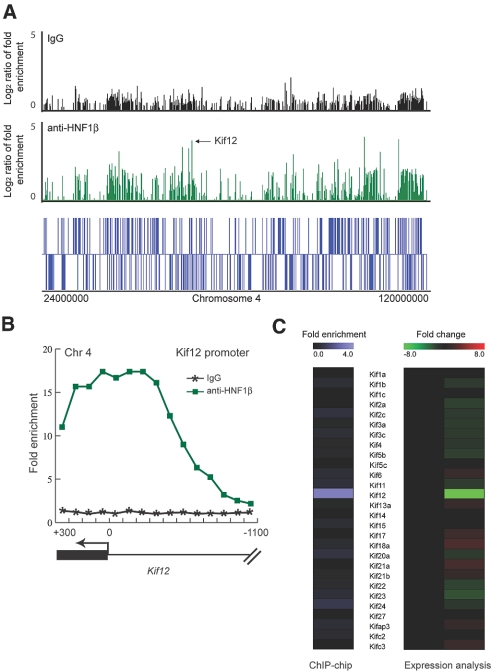
Figure 1.
Figure 1.
Identification of Kif12 as an HNF-1β target gene by combinatorial functional genomics analysis. (A) ChIP-chip enrichment of promoters on chromosome 4. The log2 ratios indicate the intensities of hybridization signals produced by genomic fragments immunoprecipitated with anti–HNF-1β antibody (green) or isotype IgG (black). (Bottom) Positions of annotated genes on chromosome 4. Arrow indicates the position of the Kif12 gene. (B) ChIP-chip enrichment of sequences bound to HNF-1β along the mouse Kif12 promoter. The hybridized genomic fragments were immunoprecipitated with anti–HNF-1β antibody (green) or isotype IgG (black). (C) Comparison between the ChIP-chip enrichment of genes in the kinesin family (left) and expression microarrays (right) identified significant changes exclusively in Kif12 mRNA levels after expression of the HNF-1βΔC mutant.
Figure 2.
Figure 2.
The Kif12 promoter contains a consensus HNF-1β binding site that is highly conserved among different mammalian species. (A) Alignment of Kif12 promoter sequences from mouse, rat, dog, and human showing evolutionarily conserved regions. The HNF-1β binding site identified by ChIP-chip (bar) was located within a conserved region 150 bp upstream from the translation start site. (B) Sequence alignment of the highly conserved region in the Kif12 promoter revealed a consensus sequence for an HNF-1β binding site. (C) Locations of consensus transcription factor binding sites on the mouse Kif12 promoter.
Figure 3.
Figure 3.
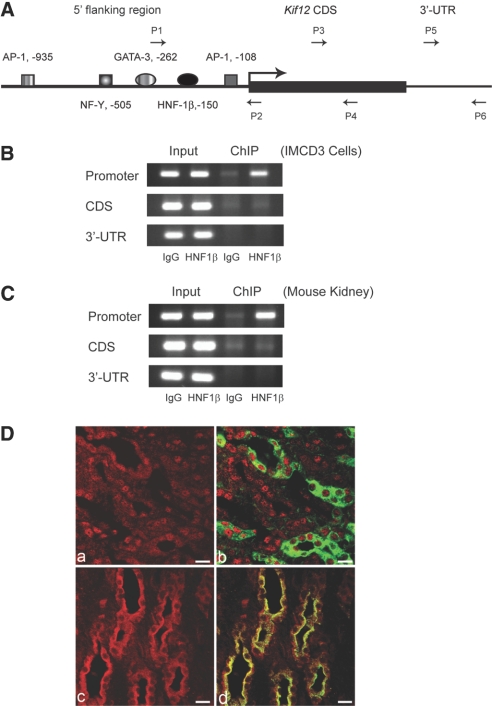
Validation of the in vivo association of HNF-1β with the Kif12 promoter. (A) Schematic diagram of the mouse Kif12 promoter. Arrows indicate primers that were used for ChIP assays of the promoter (P1 and P2), coding sequence (P3 and P4), and 3′-untranslated region (P5 and P6). (B) Occupancy of the Kif12 promoter by endogenous HNF-1β in chromatin from mIMCD3 cells was verified by ChIP assay. (C) In vivo association of HNF-1β and the Kif12 promoter in chromatin from mouse kidney was confirmed by ChIP assay. (D) Kidney sections from adult mice were co-stained with antibodies against HNF-1β (red, a and b) or Kif12 (red, c and d) and DBA (green, b and d). HNF-1β was localized in the nuclei and Kif12 was localized in the cytosol of DBA-positive collecting duct cells. Bars = 10 μm.
Figure 4.
Figure 4.
HNF-1β is required for the expression of Kif12 in mIMCD3 cells and mouse kidney. (A) Schematic diagram of wild-type mouse HNF-1β (top) and the dominant negative HNF-1βΔC mutant. Boxes indicate Flag (red) and EGFP (green) epitope tags. (B) Expression of the HNF-1βΔC mutant was confirmed by immunoblot analysis of lysates from mIMCD3 cells induced with mifepristone (Mif). (C) The in vivo association of the HNF-1βΔC mutant with the Kif12 promoter was confirmed by ChIP assay using an anti-Flag antibody in transfected mIMCD3 cells (n = 3). (D) Induction of the HNF-1βΔC mutant in mIMCD3 cells resulted in decreased expression of endogenous Kif12 mRNA (n = 6). (E) Treatment of parental mIMCD3 cells with mifepristone had no effect on the expression of Kif12 mRNA. (F) Kif12 mRNA expression was decreased in cystic kidneys from P8 kidney-specific HNF-1β knockout mice compared with wild-type controls. Error bars indicate SD (n = 3).
Figure 5.
Figure 5.
HNF-1β is essential for transcription of the Kif12 gene. (A) Induction of the HNF-1βΔC mutant in mIMCD3 cells resulted in decreased activity of the Kif12 promoter. (B) Site-directed mutation of the HNF-1β binding site in the Kif12 promoter inhibited promoter activity in wild-type mIMCD3 cells. (C) Transfection of HeLa cells with increasing amounts of plasmids encoding wild-type HNF-1β (0.00, 0.25, and 0.50 μg) stimulated Kif12 promoter activity, whereas transfection of the HNF-1βΔC mutant failed to increase activity compared with empty pcDNA3. (D) Induction of the HNF-1βΔC mutant decreased acetylation of histones H3 and H4 on the Kif12 promoter as revealed by ChIP assays. Acetylation of H3 K9 was decreased after expression of the HNF-1βΔC mutant, whereas monomethyl-H3K9 and trimethyl-H3K9 were increased. Binding of CBP on the Kif12 promoter was decreased after expression of the HNF-1βΔC mutant. Error bars indicate SD.

References

    1. Igarashi P, Shao X, McNally BT, Hiesberger T: Roles of HNF-1β in kidney development and congenital cystic diseases. Kidney Int 68: 1944–1947, 2005 - PubMed
    1. Rey-Campos J, Chouard T, Yaniv M, Cereghini S: vHNF1 is a homeoprotein that activates transcription and forms heterodimers with HNF1. EMBO J 10: 1445–1457, 1991 - PMC - PubMed
    1. Hiesberger T, Shao X, Gourley E, Reimann A, Pontoglio M, Igarashi P: Role of the hepatocyte nuclear factor-1β (HNF-1β) C-terminal domain in Pkhd1 (ARPKD) gene transcription and renal cystogenesis. J Biol Chem 280: 10578–10586, 2005 - PubMed
    1. Blumenfeld M, Maury M, Chouard T, Yaniv M, Condamine H: Hepatic nuclear factor 1 (HNF1) shows a wider distribution than products of its known target genes in developing mouse. Development 113: 589–599, 1991 - PubMed
    1. Ott MO, Rey-Campos J, Cereghini S, Yaniv M: vHNF1 is expressed in epithelial cells of distinct embryonic origin during development and precedes HNF1 expression. Mech Dev 36: 47–58, 1991 - PubMed

Publication types

LinkOut - more resources