


Review
doi: 10.1523/JNEUROSCI.3860-08.2008.
Modes and mishaps of neuronal migration in the mammalian brain
Affiliations
- PMID: 19005035
- PMCID: PMC2713018
- DOI: 10.1523/JNEUROSCI.3860-08.2008
Item in Clipboard
Review
Modes and mishaps of neuronal migration in the mammalian brain
J Neurosci.
.
Abstract
The ability of neurons to migrate to their appropriate positions in the developing brain is critical to brain architecture and function. Recent research has elucidated different modes of neuronal migration and the involvement of a host of signaling factors in orchestrating the migration, as well as vulnerabilities of this process to environmental and genetic factors. Here we discuss the role of cytoskeleton, motor proteins, and mechanisms of nuclear translocation in radial and tangential migration of neurons. We will also discuss how these and other events essential for normal migration of neurons can be disrupted by genetic and environmental factors that contribute to neurological disease in humans.
Figures
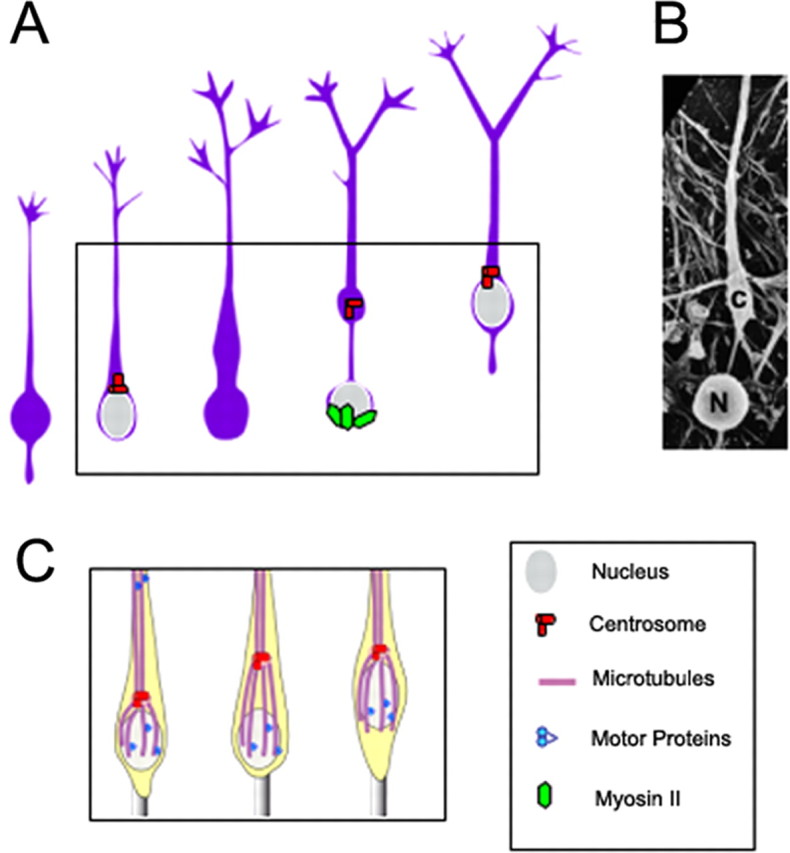
A, In tangentially migrating cells derived from the medial ganglionic eminence (MGE) of the basal forebrain, a centrosome (red) is located at some distance from the resting nucleus (gray). As the cell initiates migration (boxed area), the centrosome (along with Golgi apparatus, not shown) stabilizes in a rostral swelling. Nuclear movement toward the rostral swelling requires actomyosin activity (green). [This panel was modified with permission from Bellion et al. (2005), their Fig. 6.] B, A scanning electron micrograph of a migrating MGE cell showing nuclear (N)–centrosomal (c) dissociation (courtesy of J. P. Baudoin and C. Métin, Institut du Fer à Moulin, Inserm Unité Mixte de Recherche-S 839, Paris, France, used with permission). C, Classical model of centrosomal and nuclear movements in a radially migrating neuron. The centrosome (red) controls the formation of a microtubule network (purple) that surrounds the nucleus, the so-called perinuclear cage, establishing a physical link between centrioles (red) and nuclear membrane. During migration, the forward movement of centrioles leads to deformation of the perinuclear cage, which together with microtubule-associated motor complex (blue) activity pull the nucleus forward.
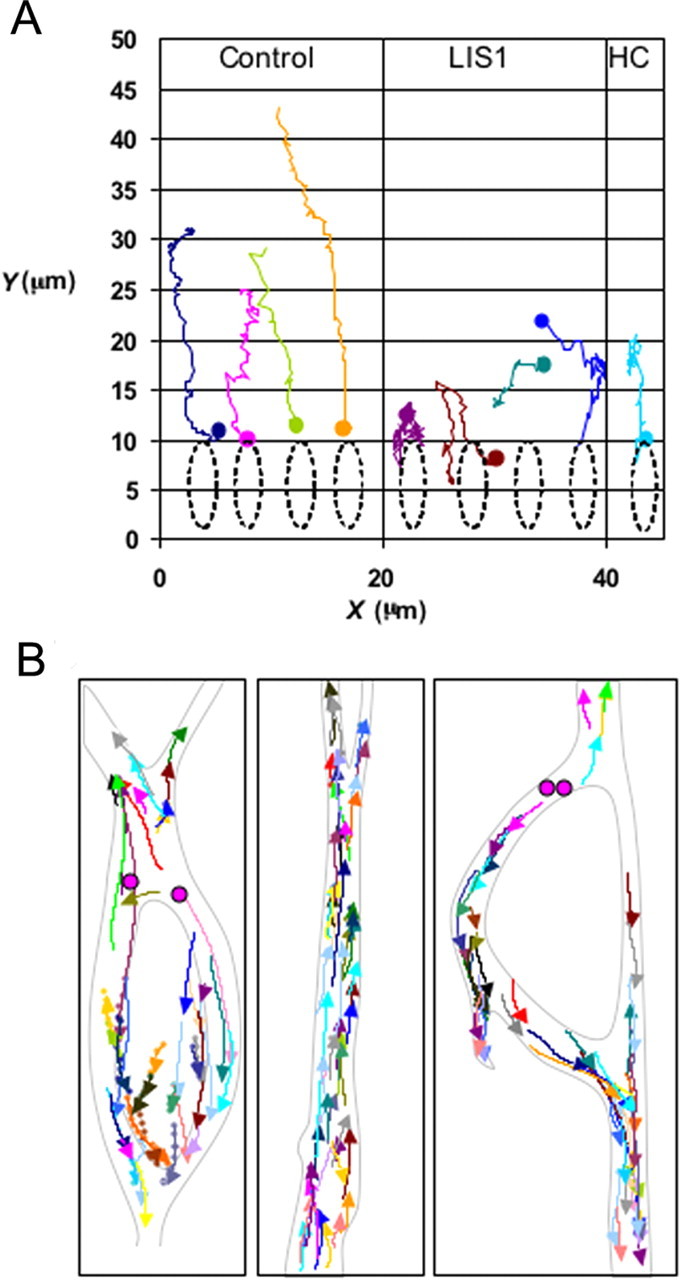
A, X–Y tracing of centrosomal movement in radially migrating neural precursor cells monitored in live brain slice culture for up to 3 h (Tsai et al., 2007). Centrosomes (initial position indicated by colored dots) exhibited long-range directed travel, which was inhibited by LIS1 or cytoplasmic dynein heavy chain (HC) RNAi. B, Behavior of the microtubule plus end-tracking protein GFP-EB3 was monitored for 2 min. Traces representing all growing microtubule plus ends within a given video field (arrowheads) are shown for the cell body region, the leading “migratory” process (middle panel), and the trailing axon (seen in right panel). [Tsai et al. (2007), their Fig. 3, modified with permission].
References
-
- Algan O, Rakic P. Radiation-induced, lamina-specific deletion of neurons in the primate visual cortex. J Comp Neurol. 1997;381:335–352. - PubMed
-
- Anderson SA, Eisenstat DD, Shi L, Rubenstein JLR. Interneuron migration from basal forebrain to neocortex: dependence on Dlx genes. Science. 1997;278:474–476. - PubMed
-
- Baudoin JP, Alvarez C, Gaspar P, Métin C. Nocodazole-induced changes in microtubule dynamics impair the morphology and directionality of migrating medial ganglionic eminence cells. Dev Neurosci. 2008;30:132–143. - PubMed
Publication types
MeSH terms
Substances
Grants and funding
LinkOut - more resources
Full Text Sources
