


Adaptation of firing rate and spike-timing precision in the avian cochlear nucleus
- PMID: 19005056
- PMCID: PMC2693385
- DOI: 10.1523/JNEUROSCI.3827-08.2008
Adaptation of firing rate and spike-timing precision in the avian cochlear nucleus
Abstract
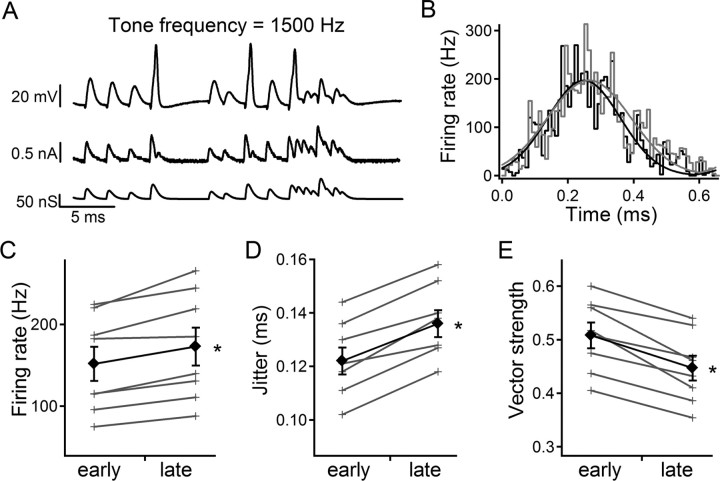
Adaptation is commonly defined as a decrease in response to a constant stimulus. In the auditory system such adaptation is seen at multiple levels. However, the first-order central neurons of the interaural time difference detection circuit encode information in the timing of spikes rather than the overall firing rate. We investigated adaptation during in vitro whole-cell recordings from chick nucleus magnocellularis neurons. Injection of noisy, depolarizing current caused an increase in firing rate and a decrease in spike time precision that developed over approximately 20 s. This adaptation depends on sustained depolarization, is independent of firing, and is eliminated by alpha-dendrotoxin (0.1 microM), implicating slow inactivation of low-threshold voltage-activated K+ channels as its mechanism. This process may alter both firing rate and spike-timing precision of phase-locked inputs to coincidence detector neurons in nucleus laminaris and thereby adjust the precision of sound localization.
Figures


References
-
- Bacci A, Huguenard JR. Enhancement of spike-timing precision by autaptic transmission in neocortical inhibitory interneurons. Neuron. 2006;49:119–130. - PubMed
Publication types
MeSH terms
Substances
Grants and funding
LinkOut - more resources
Full Text Sources
