Review
. 2008 Dec;17 Suppl 4(Suppl 4):432-40.
doi: 10.1007/s00586-008-0744-4. Epub 2008 Nov 13.

Quantitative MRI as a diagnostic tool of intervertebral disc matrix composition and integrity

Affiliations
Review

Quantitative MRI as a diagnostic tool of intervertebral disc matrix composition and integrity

Fackson Mwale et al. Eur Spine J. 2008 Dec.

Abstract

Degenerative disc disease has been implicated as a major component of spine pathology. The current major clinical procedures for treating disc degeneration have been disappointing, because of altered spinal mechanics leading to subsequent degeneration at adjacent disc levels. Disc pathology treatment is shifting toward prevention and treatment of underlying etiologic processes at the level of the disc matrix composition and integrity and the biomechanics of the disc. The ability to perform such treatment relies on one's ability to accurately and objectively assess the state of the matrix and the effectiveness of treatment by a non-invasive technique. In this review, we will summarize our advances in efforts to develop an objective, accurate, non-invasive diagnostic tool (quantitative MRI) in the detection and quantification of matrix composition and integrity and of biomechanical changes in early intervertebral disc degeneration.


Figures
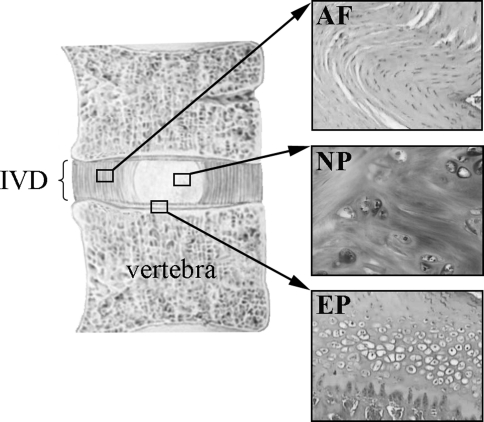
Fig. 1
Fig. 1
The intervertebral disc. The intervertebral disc (IVD) is composed of three components: The annulus fibrosus (AF) is a fibrocartilage organized with the fibroblast-like cells in dense concentric lamellae. The nucleus pulposus (NP) is a less structured gelatinous substance with chondrocyte-like cells. The IVD lies between cartilaginous endplates (EP)
Fig. 2
Fig. 2
Schematic representation of the extracellular matrix of the annulus fibrosus and nucleus pulposus. The annulus fibrosus is composed predominantly of type I collagen organized in dense concentric lamellae forming a fibrous collagen network that maintain the disc shape. The nucleus pulposus is rich in proteoglycans and in a type II collagen. In both structures, proteoglycans interact with hyaluronic acid to form proteoglycan aggregates that are designed to resist compressive loads
Fig. 3
Fig. 3
Matrix turnover phases in IVD degeneration. Three matrix turnover phases related to age were identified in human discs as illustrated by collagen II synthesis (pro type II collagen) and matrix degradation (denaturated type II collagen)
Fig. 4
Fig. 4
Relaxation times in the assessment of degenerative disc disease. Relaxation times T1 and T2 were measured in human NPs of IVDs with different Thompson grades of degeneration. *P < 0.05 versus grade 2
Fig. 5
Fig. 5
Apparent diffusion coefficient in the assessment of degenerative disc disease. Apparent diffusion coefficient (ADC) was measured in NPs of human IVDs with different Thompson grades of degeneration and compared to water (H2O) and proteoglycans (GAG) contents
Fig. 6
Fig. 6
MRI setup for paraffin-embedded disc segments for the study of enzyme-induced disc degeneration. Disc segments were embedded in paraffin and placed in a specially designed Plexiglass container that fits in the MRI head coil array. Note that the vials of standards are situated below one of the disc segments
Fig. 7
Fig. 7
Effect of enzyme treatment on relaxation times. Bovine NPs were injected with collagenase (Coll.), hyaluronidase (HA), and trypsin, and disc segments were analyzed by MRI as illustrated in Fig. 6. *P < 0.05 versus control (Ctl) untreated discs
Fig. 8
Fig. 8
Disc segment setup for the analysis of cyclic compression loading effect on IVD properties. Both ends of the segment are potted in PMMA and mounted on a MTS-858 Mini Bionix system (MTS Systems Corporation, Eden Prairie, MN, USA). The three-ball bearings are equally positioned around the disc segments to prevent buckling while minimizing axial friction
Fig. 9
Fig. 9
Effect of cyclic compression loading on the MRI properties of IVDs. Bovine IVDs were subjected to 16-h compression loading as illustrated in Fig. 8 and the MRI properties of the NPs were evaluated as illustrated in Fig. 6. *P < 0.05 versus unloaded segments
Fig. 10
Fig. 10
Effect of trypsin on the compressive properties of IVDs. Bovine NPs were injected with trypsin and their compressive properties were analyzed in a nonpermeable confined compression chamber. Psw = swelling pressure; HA = compressive modulus; k = hydraulic permeability. *P < 0.05 versus control (Ctl) untreated discs

References

    1. An HS, Anderson PA, Haughton VM, Iatridis JC, Kang JD, Lotz JC, Natarajan RN, Oegema TR, Jr, Roughley P, Setton LA, Urban JP, Videman T, Andersson GB, Weinstein JN. Introduction: disc degeneration: summary. Spine. 2004;29:2677–2678. doi: 10.1097/01.brs.0000147573.88916.c6. - DOI - PubMed
    1. Antoniou J, Demers CN, Beaudoin G, Goswami T, Mwale F, Aebi M, Alini M. Apparent diffusion coefficient of intervertebral discs related to matrix composition and integrity. Magn Reson Imaging. 2004;22:963–972. doi: 10.1016/j.mri.2004.02.011. - DOI - PubMed
    1. Antoniou J, Mwale F, Demers CN, Beaudoin G, Goswami T, Aebi M, Alini M. Quantitative magnetic resonance imaging of enzymatically induced degradation of the nucleus pulposus of intervertebral discs. Spine. 2006;31:1547–1554. doi: 10.1097/01.brs.0000221995.77177.9d. - DOI - PubMed
    1. Antoniou J, Nelson F, Steffen T, Winterbottom N, Hollander AP, Poole RA, Aebi M, Alini M. The human lumbar intervertebral disc: evidence for changes in the biosynthesis and denaturation of the extracellular matrix with growth, maturation, ageing, and degeneration. J Clin Invest. 1996;98:996–1003. doi: 10.1172/JCI118884. - DOI - PMC - PubMed
    1. Antoniou J, Pike GB, Steffen T, Baramki H, Poole AR, Aebi M, Alini M. Quantitative magnetic resonance imaging in the assessment of degenerative disc disease. Magn Reson Med. 1998;40:900–907. doi: 10.1002/mrm.1910400616. - DOI - PubMed

Publication types

MeSH terms
