Review
. 2009 Jan;27(1):53-61.
doi: 10.1016/j.tibtech.2008.09.004. Epub 2008 Nov 12.

Applications of microarrays in pathogen detection and biodefence

Affiliations
Review

Applications of microarrays in pathogen detection and biodefence

Mahesh Uttamchandani et al. Trends Biotechnol. 2009 Jan.

Abstract

The microarray is a platform with wide-ranging potential in biodefence. Owing to the high level of throughput attainable through miniaturization, microarrays have accelerated the ability to respond in an epidemic or crisis. Extending beyond diagnostics, recent studies have applied microarrays as a research tool towards understanding the etiology and pathogenicity of dangerous pathogens, as well as in vaccine development. The original emphasis was on DNA microarrays, but the range now includes protein, antibody and carbohydrate microarrays, and research groups have exploited this diversity to further extend microarray applications in the area of biodefence. Here, we discuss the impact and contributions of the growing range of microarrays and emphasize the concepts that might shape the future of biodefence research.


Figures
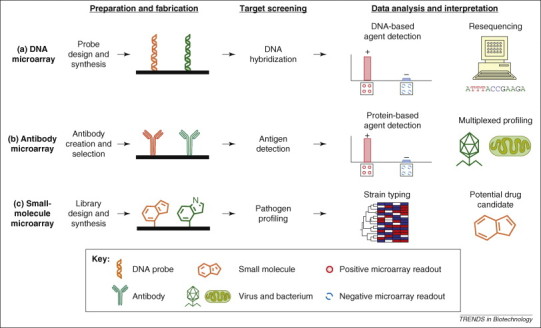
Figure 1
Figure 1
Overview of microarray applications in pathogen detection and biodefence. The main stages of a microarray experiment consist of preparation, fabrication, screening and analysis. Microarrays are distinguished by the type of molecules immobilized in the array; this might include DNA-probe libraries (a), antibody panels (b) or small-molecule libraries (c). (a) As discussed in this article, DNA microarrays can be applied to test for DNA from pathogenic organisms or for the resequencing of pathogen genomes. (b) Antibody microarrays can be used to detect pathogen proteins or antigens that might be present in environmental samples as an indication of contamination or for diagnostic purposes to determine pathogen infection in human tissues. (c) Small-molecule microarrays offer novel approaches for differentiating between pathogens, for example by clustering the binding signatures obtained for each pathogen. They can also be used to identify therapeutics that could potentially disrupt the infection cycle.
Figure 2
Figure 2
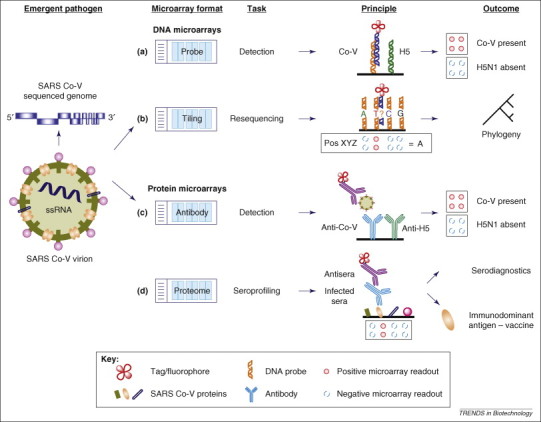
The use of microarrays for studying emergent pathogens, exemplified by severe acute respiratory syndrome (SARS)-associated coronavirus and avian influenza (H5N1). Various approaches have been developed for detection and diagnostics with DNA and protein microarrays. (a) Specific DNA probes, for instance Co-V (orange) for SARS and H5 (green) for H5N1, can be used to detect the presence of pathogen DNA or RNA using PCR or reverse transcriptase (RT)-PCR, thus enabling multiple pathogens to be detected simultaneously . (b) Tiling arrays can be used to resequence pathogens so that any mutations in evolving pathogens can be rapidly detected and tracked. As illustrated, four probes, one for each nucleotide base, are used to determine the genotype at a given loci. A set of probes designed for an arbitrary position XYZ is shown to reveal the unknown base to be adenine (A). Multiple probe sets are ‘tiled’ across the whole pathogen genome and, upon hybridization and analysis, can confer the complete sequence information of the pathogen with great accuracy , , . (c) Antibody arrays make use of the sandwich immunoassay to screen for the presence of a pathogen. As depicted, the pathogen sample is first applied to the microarray, followed by the reporter antibody. As a result, the pathogen is sandwiched in between two antibodies – an immobilized antibody (blue) and a tagged antibody (purple) capable of reporting the presence of a pathogen on the microarray , . (d) Proteome microarrays, which contain immobilized proteins from the target pathogen, can be screened against sera obtained from infected individuals. If the individual has been exposed to the pathogen, the sera will contain antibodies (blue) against specific antigens of the pathogens that will react with the immobilized protein and that can be detected using tagged secondary antibodies (purple) . This procedure also facilitates the identification of specific immunodominant antigens present in the pathogen proteome. These proteins are considered to be largely responsible for triggering the host immune response and thus have a high potential for the development of vaccines against this particular pathogen.

References

    1. Chinese SARS Molecular Epidemiology Consortium Molecular evolution of the SARS coronavirus during the course of the SARS epidemic in China. Science. 2004;303:1666–1669. - PubMed
    1. Demirev P.A. Chemical and biological weapons: current concepts for future defenses. Johns Hopkins APL Tech. Dig. 2005;26:321–333.
    1. Trull M.C. Turning biodefense dollars into products. Nat. Biotechnol. 2007;25:179–184. - PMC - PubMed
    1. Lim D.V. Current and developing technologies for monitoring agents of bioterrorism and biowarfare. Clin. Microbiol. Rev. 2005;18:583–607. - PMC - PubMed
    1. Venkatasubbarao S. Microarrays – status and prospects. Trends Biotechnol. 2004;22:630–637. - PubMed

Publication types

MeSH terms

Substances