


Improving the performance of the amblyopic visual system
- PMID: 19008199
- PMCID: PMC2674474
- DOI: 10.1098/rstb.2008.0203
Improving the performance of the amblyopic visual system
Abstract
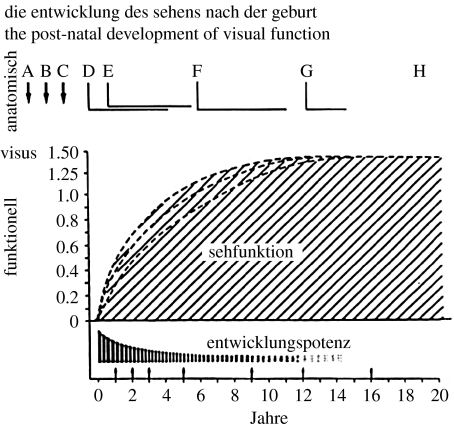
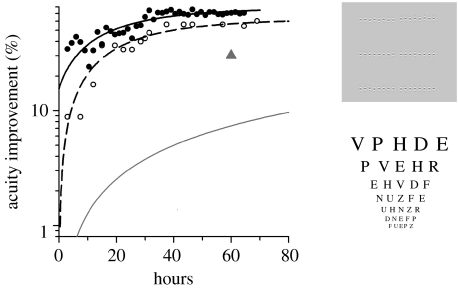
Experience-dependent plasticity is closely linked with the development of sensory function; however, there is also growing evidence for plasticity in the adult visual system. This review re-examines the notion of a sensitive period for the treatment of amblyopia in the light of recent experimental and clinical evidence for neural plasticity. One recently proposed method for improving the effectiveness and efficiency of treatment that has received considerable attention is 'perceptual learning'. Specifically, both children and adults with amblyopia can improve their perceptual performance through extensive practice on a challenging visual task. The results suggest that perceptual learning may be effective in improving a range of visual performance and, importantly, the improvements may transfer to visual acuity. Recent studies have sought to explore the limits and time course of perceptual learning as an adjunct to occlusion and to investigate the neural mechanisms underlying the visual improvement. These findings, along with the results of new clinical trials, suggest that it might be time to reconsider our notions about neural plasticity in amblyopia.
Figures
References
-
- Ahissar M., Hochstein S. Attentional control of early perceptual learning. Proc. Natl Acad. Sci. USA. 1993;90:5718–5722. doi:10.1073/pnas.90.12.5718 - DOI - PMC - PubMed
-
- Baker D.H., Meese T.S., Hess R.F. Contrast masking in strabismic amblyopia: attenuation, noise, interocular suppression and binocular summation. Vision Res. 2008;48:1625–1640. doi:10.1016/j.visres.2008.04.017 - DOI - PubMed
-
- Banks M.S., Aslin R.N., Letson R.D. Sensitive period for the development of human binocular vision. Science. 1975;190:675–677. doi:10.1126/science.1188363 - DOI - PubMed
-
- Barrett B.T., Bradley A., McGraw P.V. Understanding the neural basis of amblyopia. Neuroscientist. 2004;10:106–117. doi:10.1177/1073858403262153 - DOI - PubMed
-
- Berardi N., Pizzorusso T., Maffei L. Critical periods during sensory development. Curr. Opin. Neurobiol. 2000;10:138–145. doi:10.1016/S0959-4388(99)00047-1 - DOI - PubMed
Publication types
MeSH terms
Grants and funding
LinkOut - more resources
Full Text Sources
Medical
