


The timing of feedback to early visual cortex in the perception of long-range apparent motion
- PMID: 19008460
- PMCID: PMC2693618
- DOI: 10.1093/cercor/bhn192
The timing of feedback to early visual cortex in the perception of long-range apparent motion
Abstract
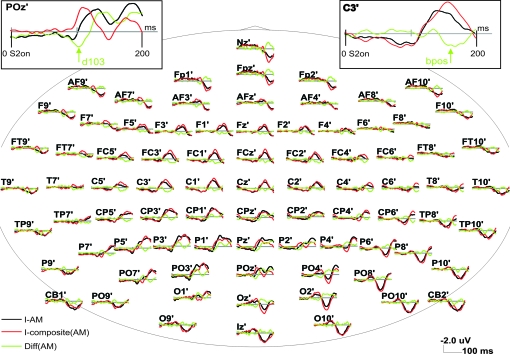
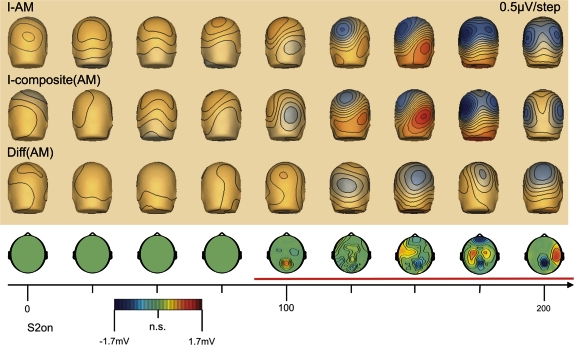
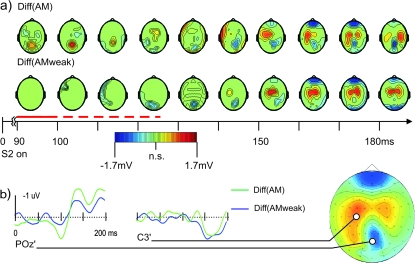
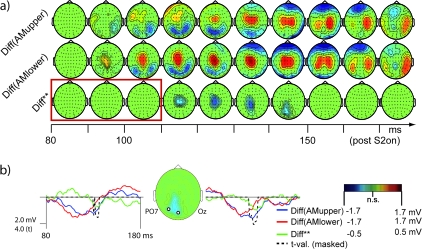
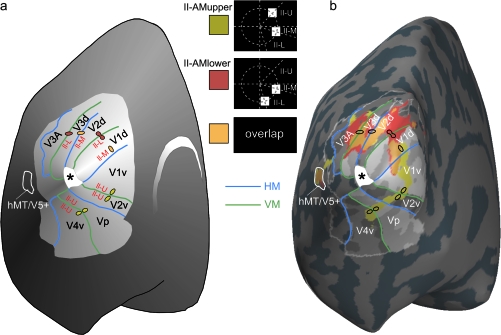
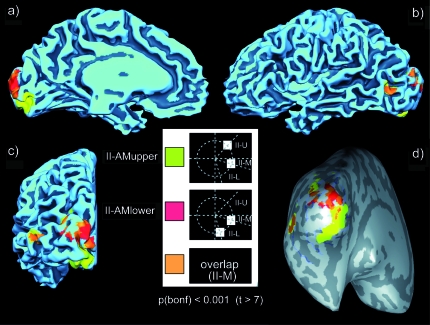
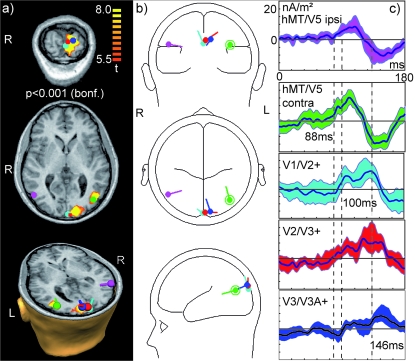
When 2 visual stimuli are presented one after another in different locations, they are often perceived as one, but moving object. Feedback from area human motion complex hMT/V5+ to V1 has been hypothesized to play an important role in this illusory perception of motion. We measured event-related responses to illusory motion stimuli of varying apparent motion (AM) content and retinal location using Electroencephalography. Detectable cortical stimulus processing started around 60-ms poststimulus in area V1. This component was insensitive to AM content and sequential stimulus presentation. Sensitivity to AM content was observed starting around 90 ms post the second stimulus of a sequence and most likely originated in area hMT/V5+. This AM sensitive response was insensitive to retinal stimulus position. The stimulus sequence related response started to be sensitive to retinal stimulus position at a longer latency of 110 ms. We interpret our findings as evidence for feedback from area hMT/V5+ or a related motion processing area to early visual cortices (V1, V2, V3).
Figures
References
-
- Antal A, TsZ Kincses, Nitsche MA, Paulus W. Modulation of moving phosphene thresholds by transcranial direct current stimulation of V1 in human. Neuropsychologia. 2003;41:1802–1807. - PubMed
-
- Bledowski C, Linden D, Wibral M. Combining electrophysiology and functional imaging—different methods for different questions. Trends Cogn Sci. 2007;11:500–502. - PubMed
