. 2008 Nov;4(11):e1000254.
doi: 10.1371/journal.pgen.1000254. Epub 2008 Nov 14.

Genetic control of variegated KIR gene expression: polymorphisms of the bi-directional KIR3DL1 promoter are associated with distinct frequencies of gene expression

Affiliations

Genetic control of variegated KIR gene expression: polymorphisms of the bi-directional KIR3DL1 promoter are associated with distinct frequencies of gene expression

Hongchuan Li et al. PLoS Genet. 2008 Nov.

Abstract

Natural killer (NK) cells play an important role in the detection and elimination of tumors and virus-infected cells by the innate immune system. Human NK cells use cell surface receptors (KIR) for class I MHC to sense alterations of class I on potential target cells. Individual NK cells only express a subset of the available KIR genes, generating specialized NK cells that can specifically detect alteration of a particular class I molecule or group of molecules. The probabilistic behavior of human KIR bi-directional promoters is proposed to control the frequency of expression of these variegated genes. Analysis of a panel of donors has revealed the presence of several functionally relevant promoter polymorphisms clustered mainly in the inhibitory KIR family members, especially the KIR3DL1 alleles. We demonstrate for the first time that promoter polymorphisms affecting the strength of competing sense and antisense promoters largely explain the differential frequency of expression of KIR3DL1 allotypes on NK cells. KIR3DL1/S1 subtypes have distinct biological activity and coding region variants of the KIR3DL1/S1 gene strongly influence pathogenesis of HIV/AIDS and other human diseases. We propose that the polymorphisms shown in this study to regulate the frequency of KIR3DL1/S1 subtype expression on NK cells contribute substantially to the phenotypic variation across allotypes with respect to disease resistance.


Conflict of interest statement

The authors have declared that no competing interests exist.

Figures
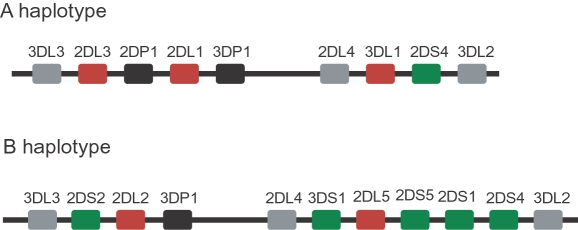
Figure 1
Figure 1. Organization of the KIR gene cluster.
The KIR gene order is shown for the A haplotype and a representative B haplotype. Inhibitory KIR genes are shown as red boxes, whereas the activating genes are shown in green. The framework genes are indicated by grey boxes, and pseudogenes are indicated by black boxes. Each gene spans between 10–16 kb, and the intergenic distances are approximately 2 kb with the exception of the 14 kb region upstream of the KIR2DL4 gene.
Figure 2
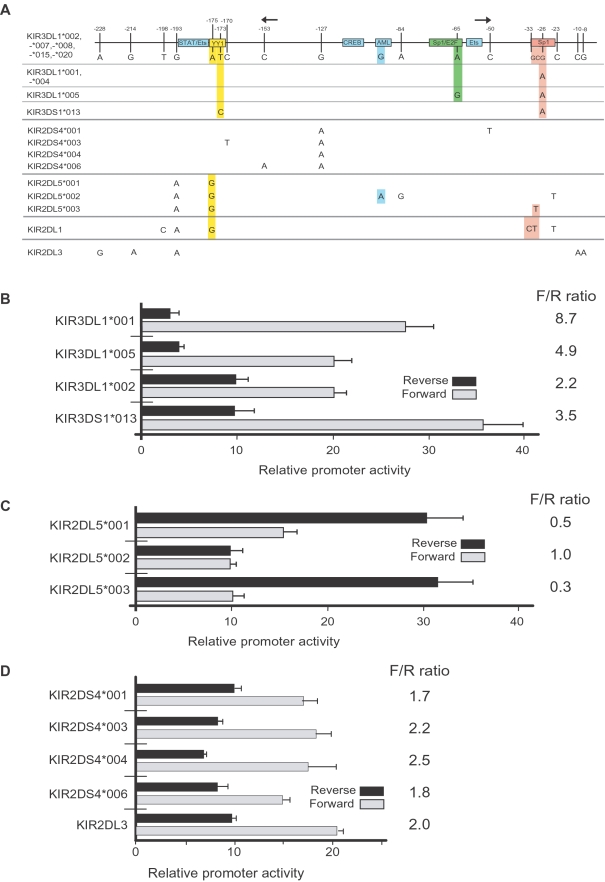
Figure 2. Impact of polymorphisms present in the KIR3DL1, KIR2DS4, KIR2DL3, and KIR2DL5 genes on promoter activity.
(A) A schematic of the KIR bi-directional promoter region is shown with the position of transcription factor binding sites indicated by labeled boxes. The sites of transcript initiation for the sense and antisense promoters are shown by the rightward and leftward arrows respectively. The vertical lines indicate the positions of polymorphic nucleotides relative to the KIR3DL1*002 allele. Numbers above the lines indicate the positions of the polymorphic residues relative to the start codon of the KIR3DL1 gene. The nucleotide present at each variable position is shown for the KIR3DL1*002 gene and only differences are shown for the remaining alleles. (B) The promoter activities of KIR3DL1/S1 promoter alleles are shown. The 229 bp core promoter region of the KIR3DL1 alleles and KIR3DS1 were cloned into the pGL3 reporter vector in the forward and reverse orientation, and the promoter activity of each construct was determined by transfection into the YT-Indy human NK cell line. The ratio of forward promoter activity to reverse activity (F/R ratio) is listed for each allele. (C) Promoter activities of KIR2DL5 alleles. (D) Characterization of promoter activity of the KIR2DS4 alleles and the KIR2DL3 promoter. Values represent fold increase of luciferase activity relative to empty pGL3 vector. The mean and SD of at least 3 independent experiments are shown.
Figure 3
Figure 3. Effect of KIR promoter polymorphisms on Sp1 binding.
EMSA analysis of the Sp1 binding region corresponding to the polymorphisms observed in KIR alleles. (A) Oligonucleotides used for EMSA. The sense strand of oligonucleotide probes corresponding to the predicted Sp1-binding region of the indicated KIR genes is shown. The nucleotide residue labeled (−26) corresponds to the same −26 position shown in Figure 2A. (B) EMSA analysis performed on YT nuclear extracts with probes indicated in A. The right panel shows a supershift of the Sp1 consensus probe from YT extracts or in the presence of recombinant human Sp1 protein (rhSp1).
Figure 4
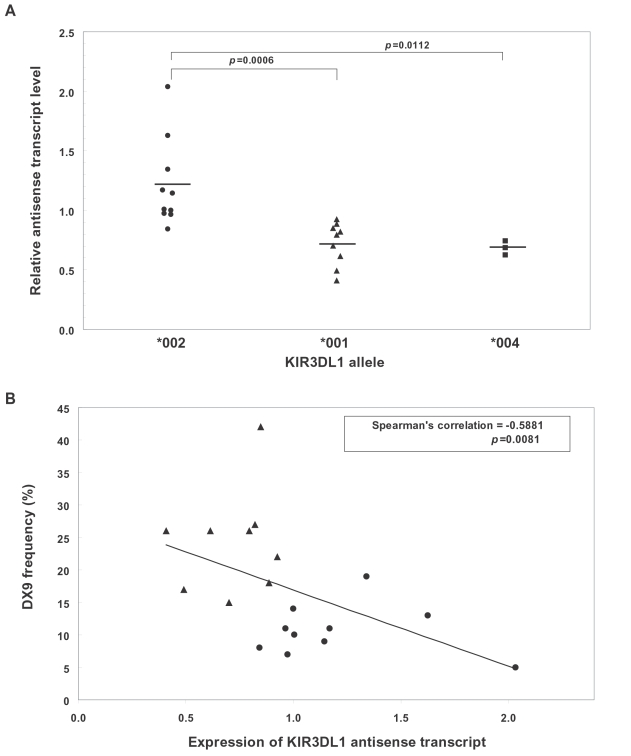
Figure 4. Quantitative analysis of KIR3DL1/S1 antisense transcripts.
(A) Comparison of relative antisense transcript levels in individuals bearing alleles shown to have high (*002) or low (*001/*004) antisense promoter activity in vitro. (B) Correlation of relative antisense transcript levels with frequency of NK cells expressing different KIR3DL1 allotypes. Symbols shown correspond to individuals possessing the KIR alleles as shown in A. The KIR3DL1*004 allele was removed from the analysis since it is not expressed on the NK cell surface.
Figure 5
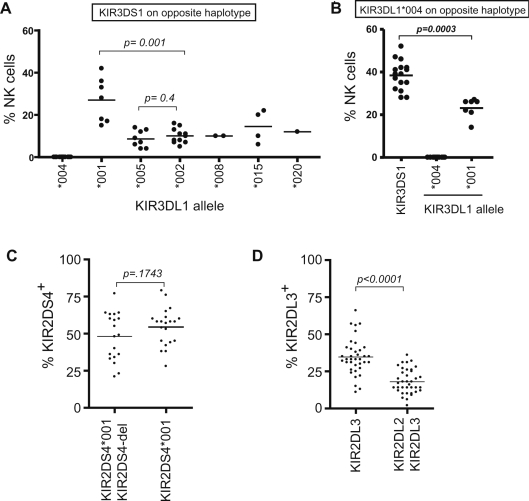
Figure 5. Frequency of expression of KIR3DL1/S1, KIR2DS4 and KIR2DL3 on the NK cell population.
(A) The percentage of NK cells expressing KIR3DL1 in donors containing only one expressed inhibitory allele is indicated for individuals with a KIR3DS1/3DL1 genotype. (B) The percentage of NK cells expressing either KIR3DS1 or the indicated KIR3DL1 allotypes was determined in individuals heterozygous for KIR3DS1 or KIR3DL1 and the KIR3DL1*004 allele (*004 is not expressed on the NK cell surface). (C) The percentage of donor peripheral blood NK cells expressing KIR2DS4 is shown. Individuals are grouped based on the presence of the expressed allele or the non-expressed KIR2DS4 alleles that possess a 22 bp deletion (KIR2DS4-del) Heterozygous KIR2DS4*001/KIR2DS4-del donors possess one expressed KIR2DS4 allele, whereas KIR2DS4*001 (in the absence of the null allele) individuals are expected to possess one copy of KIR2DS4 but could potentially contain a second KIR2DS4*001 allele. (D) Expression of KIR2DL3 on peripheral blood NK cells is shown. Individuals typed as possessing KIR2DL3 virtually always have two copies of the gene, whereas donors that have KIR2DL2/2DL3 are expected to have only a single copy of KIR2DL3.

References

    1. Trinchieri G. Biology of natural killer cells. Adv Immunol. 1989;47:187–376. - PMC - PubMed
    1. Lanier LL. NK cell recognition. Annu Rev Immunol. 2005;23:225–274. - PubMed
    1. Moretta L, Moretta A. Killer immunoglobulin-like receptors. Curr Opin Immunol. 2004;16:626–633. - PubMed
    1. Parham P. MHC class I molecules and KIRs in human history, health and survival. Nat Rev Immunol. 2005;5:201–214. - PubMed
    1. Yokoyama WM, Plougastel BF. Immune functions encoded by the natural killer gene complex. Nat Rev Immunol. 2003;3:304–316. - PubMed

Publication types