. 2009 Jan;149(1):575-84.
doi: 10.1104/pp.108.129783. Epub 2008 Nov 14.

Hydraulic failure defines the recovery and point of death in water-stressed conifers

Affiliations

Hydraulic failure defines the recovery and point of death in water-stressed conifers

Tim J Brodribb et al. Plant Physiol. 2009 Jan.

Abstract

This study combines existing hydraulic principles with recently developed methods for probing leaf hydraulic function to determine whether xylem physiology can explain the dynamic response of gas exchange both during drought and in the recovery phase after rewatering. Four conifer species from wet and dry forests were exposed to a range of water stresses by withholding water and then rewatering to observe the recovery process. During both phases midday transpiration and leaf water potential (Psileaf) were monitored. Stomatal responses to Psileaf were established for each species and these relationships used to evaluate whether the recovery of gas exchange after drought was limited by postembolism hydraulic repair in leaves. Furthermore, the timing of gas-exchange recovery was used to determine the maximum survivable water stress for each species and this index compared with data for both leaf and stem vulnerability to water-stress-induced dysfunction measured for each species. Recovery of gas exchange after water stress took between 1 and >100 d and during this period all species showed strong 1:1 conformity to a combined hydraulic-stomatal limitation model (r2 = 0.70 across all plants). Gas-exchange recovery time showed two distinct phases, a rapid overnight recovery in plants stressed to <50% loss of leaf hydraulic conductance (Kleaf) and a highly Psileaf-dependent phase in plants stressed to >50% loss of Kleaf. Maximum recoverable water stress (Psimin) corresponded to a 95% loss of Kleaf. Thus, we conclude that xylem hydraulics represents a direct limit to the drought tolerance of these conifer species.


Figures
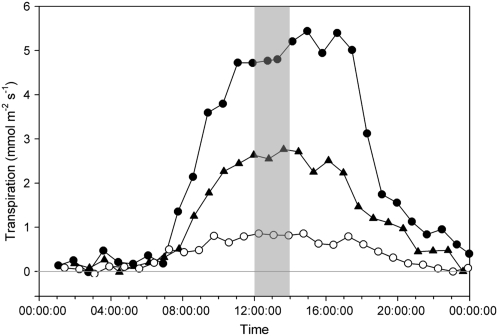
Figure 1.
Figure 1.
Examples of diurnal patterns of whole-plant transpiration in a single individual of A. arenarius during several weeks of withholding water. The three plots show data while unstressed (Ψleaf = −1.15 MPa; black circles), moderately stressed (Ψleaf = −1.65 MPa; triangles), and stressed to >80% stomatal closure (Ψleaf = −2.85 MPa; white circles). Emd was measured during the shaded time interval.
Figure 2.
Figure 2.
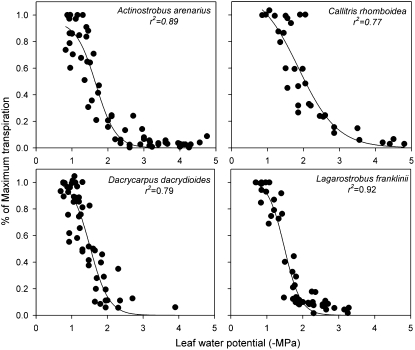
Pooled data (n = 5) showing the response of transpiration (proportional to stomatal conductance under the controlled vapor pressure growth regime) to increasingly negative Ψleaf as soil dried during the drought treatment. Regressions are sigmoidal functions in each case, and these regression functions were used to define the stomatal dependence upon Ψleaf to evaluate the degree of hydraulic limitation during drought recovery (see Fig. 5A).
Figure 3.
Figure 3.
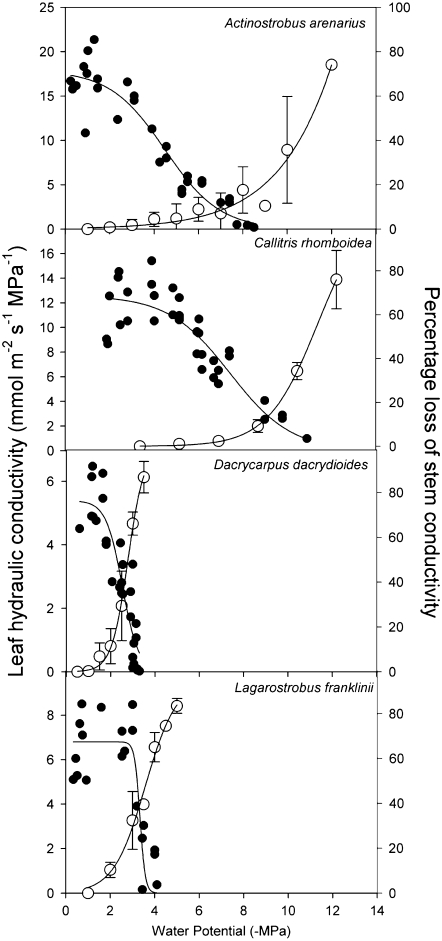
Simultaneous plots of declining Kleaf and increasing percentage loss of Kstem in response to increasingly negative water potential. Leaf data are pooled from three plants exposed to gradually increasing water stress while stem data are means (n = 4) from excised branches exposed to a range of hydraulic tensions induced by centrifuge. Sigmoid functions are fitted to both stem and leaf data and were used to predict 50% and 95% loss of function in stems and leaves.
Figure 4.
Figure 4.
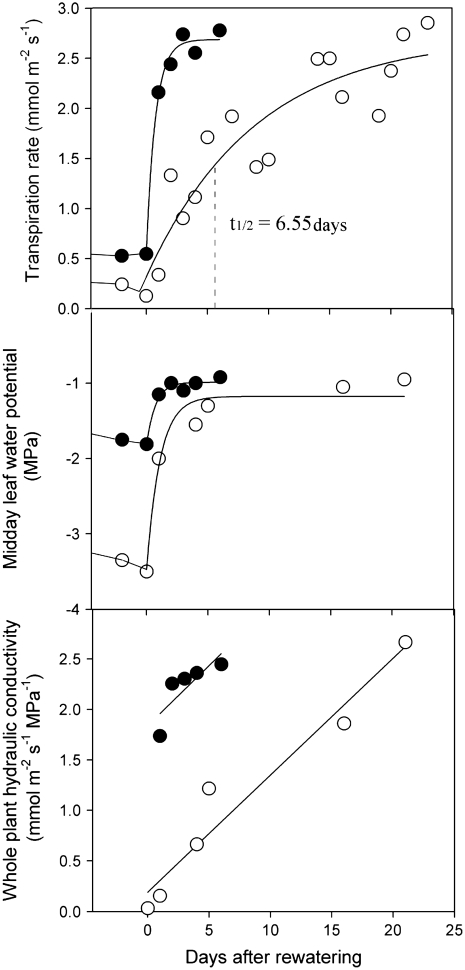
An example of recovery from mild (black circles) and severe (white circles) water stress in rewatered plants of L. franklinii. The mildly stressed plant shows a minimal reduction of Kplant and is able to rapidly recover leaf hydration and gas exchange. By contrast the severely stressed plant experiences profound depression of Kplant that recovers slowly, thus limiting gas-exchange recovery, which has a t1/2 of 6.5 d. Although Ψleaf recovers relatively quickly in both plants, it remains limiting during recovery of the severely stressed plant, thus preventing stomatal reopening.
Figure 5.
Figure 5.
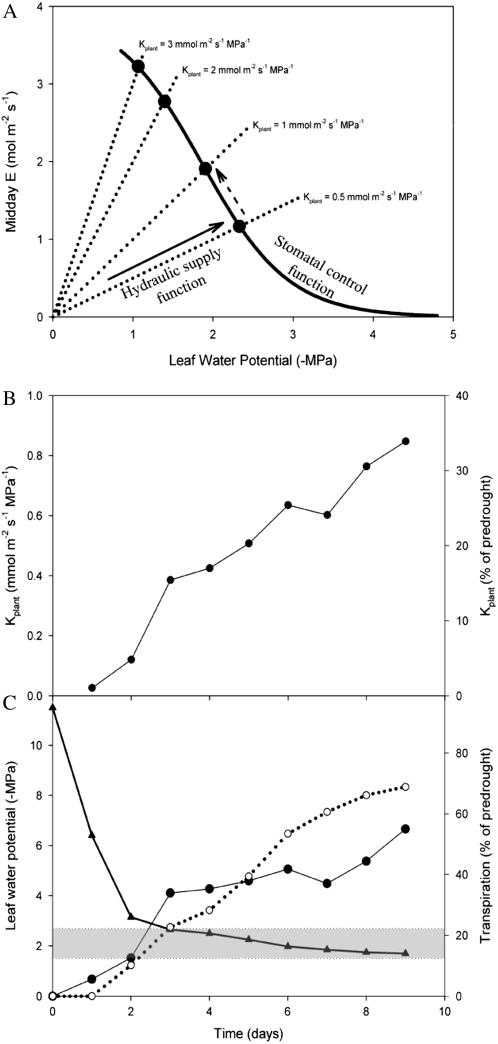
Modeled and measured recovery data for a C. rhomboidea plant subject to a stress sufficient to reduce Kleaf by approximately 90%. A, According to the hydraulic-stomatal limitation model, in fully hydrated soils E will be equal to the intersection of a hydraulic supply function (defined by Kplant) and the stomatal control function (determined empirically from the regression equations in Fig. 2). B, The observed recovery of whole-plant hydraulic conductivity after rewatering. C, The predicted (white circles, dotted line) recovery of midday E closely matches the observed (black circles, unbroken line) dynamic as the rewatered plant initially rehydrates rapidly to the edge of the stomatal control window (shown as the gray region, representing the Ψleaf range responsible for a 20% to 80% reduction in stomatal aperture) then slowly thereafter, thus limiting stomatal conductance and gas exchange. Predicted %E is calculated from entering the measured Ψleaf (triangles) into the stomatal control function equation %E = ƒ(Ψleaf) shown in A.
Figure 6.
Figure 6.
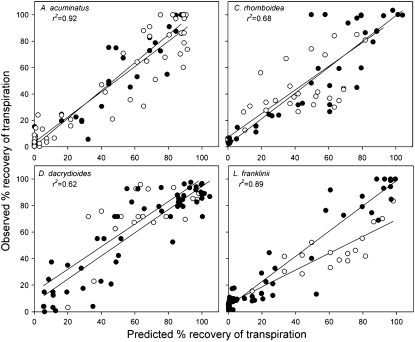
Predicted and observed recovery of Emd (white circles) in all plants after rewatering from all levels of drought. Predicted and observed %Emd are shown simultaneously (black circles) for plants during the droughting phase as well to provide a comparative data set showing stomatal control of gas exchange under limiting soil water content. All plants showed good correlation between observed and predicted %Emd during drought recovery. Only in L. franklinii was there any significant difference in the slopes between recovery and droughting datasets.
Figure 7.
Figure 7.
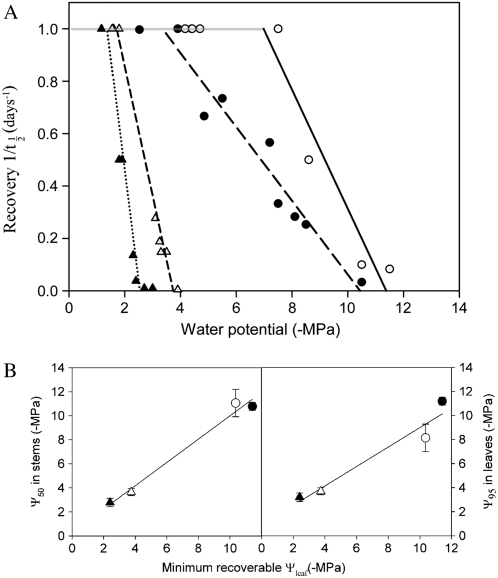
A, The relationship between recovery time (plotted as t1/2−1) and final Ψleaf prior to rewatering in all individuals of A. arenarius (white circles), C. rhomboidea (black circles), D. dacrydioides (black triangles), and L. franklinii (white triangles). Recovery time showed two phases, the first phase was insensitive to Ψleaf (1/t1/2 = 1) and the second highly dependent. Linear regressions fitted through this second phase as t1/2 fell from 1 (overnight recovery of t1/2) to 0 (plant death). The x intercept of these regressions was defined as the minimum recoverable water potential (Ψmin). B, Shows the very highly significant 1:1 relationships between Ψmin derived from A and 50% loss of Kstem (r2= 0.98) and 95% loss of Kleaf (r2=0.94), symbols as in A. Correlation coefficients are for regression lines forced through the origin.
Figure 8.
Figure 8.
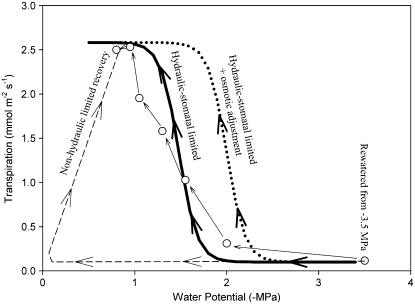
Examples of measured (white circles) and modeled (lines) recovery trajectory of transpiration in a L. franklinii plants over 20 d following rewatering from drought (−3.5 MPa). Three curves depict three models of stomatal-hydraulic behavior: the hydraulic-stomatal limitation model with a fixed E = fleaf) (bold line); a hydraulic-stomatal limitation model with osmotic adjustment to promote stomatal opening at lower Ψleaf (dotted line); and a nonhydraulic limited recovery where stomatal sensitivity to Ψleaf is enhanced or nonexistent postdrought, e.g. as might occur if ABA was limiting stomatal aperture (dashed line). The measured recovery response for this individual and all individuals (Fig. 6) was best described by the constant E = fleaf) function.

References

    1. Alder NN, Pockman WT, Sperry JS, Nuismer S (1997) Use of centrifugal force in the study of xylem cavitation. J Exp Bot 48 665–674
    1. Breda N, Huc R, Granier A, Dreyer E (2006) Temperate forest trees and stands under severe drought: a review of ecophysiological responses, adaptation processes and long-term consequences. Ann For Sci 63 625–644
    1. Brodribb TJ, Feild TS (2000) Stem hydraulic supply is linked to leaf photosynthetic capacity: evidence from New Caledonian and Tasmanian rainforests. Plant Cell Environ 23 1381–1388
    1. Brodribb TJ, Hill RS (1999) The importance of xylem constraints in the distribution of conifer species. New Phytol 143 365–372
    1. Brodribb TJ, Holbrook NM (2003) Changes in leaf hydraulic conductance during leaf shedding in seasonally dry tropical forest. New Phytol 158 295–303