


Toll-like receptor signaling: a critical modulator of cell survival and ischemic injury in the heart
- PMID: 19011041
- PMCID: PMC2637783
- DOI: 10.1152/ajpheart.00995.2008
Toll-like receptor signaling: a critical modulator of cell survival and ischemic injury in the heart
Abstract
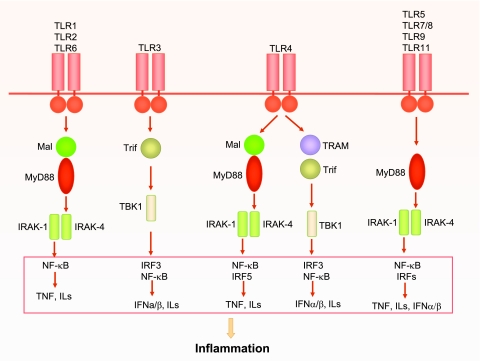
Toll-like receptors (TLRs) represent the first line of host defense against microbial infection and play a pivotal role in both innate and adaptive immunity. TLRs recognize invading pathogens through molecular pattern recognition, transduce signals via distinct intracellular pathways involving a unique set of adaptor proteins and kinases, and ultimately lead to the activation of transcription factors and inflammatory responses. Among 10 TLRs identified in humans, at least two exist in the heart, i.e., TLR2 and TLR4. In addition to the critical role of these in mediating cardiac dysfunction in septic conditions, emerging evidence suggests that the TLRs can also recognize endogenous ligands and may play an important role in modulating cardiomyocyte survival and in ischemic myocardial injury. In animal models of ischemia-reperfusion injury or in hypoxic cardiomyocytes in vitro, the administration of a sublethal dose of lipopolysaccharide, which signals through TLR4, reduces subsequent myocardial infarction, improves cardiac functions, and attenuates cardiomyocyte apoptosis. By contrast, a systemic deficiency of TLR2, TLR4, or myeloid differentiation primary-response gene 88, an adaptor critical for all TLR signaling, except TLR3, leads to an attenuated myocardial inflammation, a smaller infarction size, a better preserved ventricular function, and a reduced ventricular remodeling after ischemic injury. These loss-of-function studies suggest that both TLRs contribute to myocardial inflammation and ischemic injury in the heart although the exact contribution of cardiac (vs. circulatory cell) TLRs remains to be defined. These recent studies demonstrate an emerging role for TLRs as a critical modulator in both cell survival and tissue injury in the heart.
Figures
References
-
- Akira S, Uematsu S, Takeuchi O. Pathogen recognition and innate immunity. Cell 124: 783–801, 2006. - PubMed
-
- Aliprantis AO, Yang RB, Mark MR, Suggett S, Devaux B, Radolf JD, Klimpel GR, Godowski P, Zychlinsky A. Cell activation and apoptosis by bacterial lipoproteins through toll-like receptor-2. Science 285: 736–739, 1999. - PubMed
-
- Anderson KV, Bokla L, Nusslein-Volhard C. Establishment of dorsal-ventral polarity in the Drosophila embryo: the induction of polarity by the Toll gene product. Cell 42: 791–798, 1985. - PubMed
-
- Anderson KV, Jurgens G, Nusslein-Volhard C. Establishment of dorsal-ventral polarity in the Drosophila embryo: genetic studies on the role of the Toll gene product. Cell 42: 779–789, 1985. - PubMed
Publication types
MeSH terms
Substances
Grants and funding
LinkOut - more resources
Full Text Sources
Other Literature Sources
