Obsessive and compulsive symptoms in prediagnosed Huntington's disease
- PMID: 19012814
- PMCID: PMC3658314
- DOI: 10.4088/jcp.v69n1111
Obsessive and compulsive symptoms in prediagnosed Huntington's disease
Abstract
Objective: Obsessive and compulsive symptoms (OCS) are more prevalent in patients with diagnosed Huntington's disease (HD) than in the general population. Although psychiatric symptoms have been reported in individuals with the HD gene expansion prior to clinical diagnosis (pre-HD), little is known about OCS in this phase of disease.
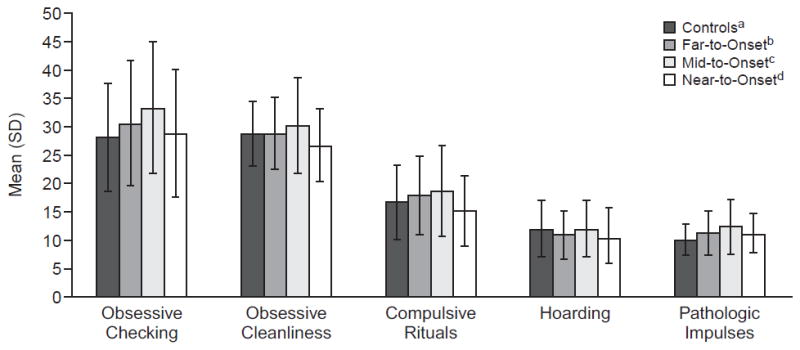
Method: The goal of this study was to assess OCS in 300 pre-HD individuals and 108 non-gene-expanded controls from the Neurobiological Predictors of Huntington's Disease (PREDICT-HD) study (enrolled between November 2002 and April 2007) using a multidimensional, self-report measure of OCS, the Schedule of Compulsions, Obsessions, and Pathologic Impulses (SCOPI). Additionally, pre-HD individuals were classified into 3 prognostic groups on the basis of age and CAG repeat length as "near-to-onset" (< 9 estimated years to onset), "mid-to-onset" (9-15 years to onset), and "far-to-onset" (> 15 years to onset). We compared the 3 pre-HD groups to the controls on SCOPI total score and 5 subscales (checking, cleanliness, compulsive rituals, hoarding, and pathologic impulses), controlling for age and gender.
Results: All models showed a significant (p < .05) group effect except for hoarding, with an inverted-U pattern of increasing symptoms: controls < far-to-onset < mid-to-onset, with the near-to-onset group being similar to controls. Although the mid-to-onset group showed the most pathology, mean scores were below those of patients with diagnosed obsessive-compulsive disorder. SCOPI items that separated pre-HD individuals from controls were focused on perceived cognitive errors and obsessive worrying.
Conclusion: Subclinical OCS were present in pre-HD participants compared to controls. The OCS phenotype in pre-HD may present with obsessive worrying and checking related to cognitive errors and may be a useful target for clinical screening as it could contribute to functional status.
Copyright 2008 Physicians Postgraduate Press, Inc.
Figures
References
-
- Degonda M, Wyss M, Angst J. The Zurich Study, XVIII: obsessive compulsive disorders and syndromes in the general population. Eur Arch Psychiatry Clin Neurosci. 1993;243(1):16–22. - PubMed
-
- Salloway S, Cummings J. Subcortical disease and neuropsychiatric illness. J Neuropsychiatry Clin Neurosci. 1994;6(2):93–99. - PubMed
-
- Joel D. Open interconnected model of basal ganglia–thalamocortical circuitry and its relevance to the clinical syndrome of Huntington’s disease. Mov Disord. 2001;16(3):407–423. - PubMed
-
- Laplane D, Levasseur M, Pillon B, et al. Obsessive-compulsive and other behavioural changes with bilateral basal ganglia lesions: a neuropsychological, magnetic resonance imaging and positron tomography study. Brain. 1989;112:699–725. - PubMed
-
- Watson D, Wu KD. Development and validation of the Schedule of Compulsions, Obsessions, and Pathological Impulses (SCOPI) Assessment. 2005;12(1):50–65. - PubMed
Publication types
MeSH terms
Grants and funding
LinkOut - more resources
Full Text Sources
Medical
Molecular Biology Databases
Miscellaneous