. 2009 Feb;44(2):335-44.
doi: 10.1016/j.bone.2008.10.039. Epub 2008 Oct 25.

Micro-computed tomography assessment of fracture healing: relationships among callus structure, composition, and mechanical function

Affiliations

Micro-computed tomography assessment of fracture healing: relationships among callus structure, composition, and mechanical function

Elise F Morgan et al. Bone. 2009 Feb.

Abstract

Non-invasive characterization of fracture callus structure and composition may facilitate development of surrogate measures of the regain of mechanical function. As such, quantitative computed tomography- (CT-) based analyses of fracture calluses could enable more reliable clinical assessments of bone healing. Although previous studies have used CT to quantify and predict fracture healing, it is unclear which of the many CT-derived metrics of callus structure and composition are the most predictive of callus mechanical properties. The goal of this study was to identify the changes in fracture callus structure and composition that occur over time and that are most closely related to the regain of mechanical function. Micro-computed tomography (microCT) imaging and torsion testing were performed on murine fracture calluses (n=188) at multiple post-fracture timepoints and under different experimental conditions that alter fracture healing. Total callus volume (TV), mineralized callus volume (BV), callus mineralized volume fraction (BV/TV), bone mineral content (BMC), tissue mineral density (TMD), standard deviation of mineral density (sigma(TMD)), effective polar moment of inertia (J(eff)), torsional strength, and torsional rigidity were quantified. Multivariate statistical analyses, including multivariate analysis of variance, principal components analysis, and stepwise regression were used to identify differences in callus structure and composition among experimental groups and to determine which of the microCT outcome measures were the strongest predictors of mechanical properties. Although calluses varied greatly in the absolute and relative amounts of mineralized tissue (BV, BMC, and BV/TV), differences among timepoints were most strongly associated with changes in tissue mineral density. Torsional strength and rigidity were dependent on mineral density as well as the amount of mineralized tissue: TMD, BV, and sigma(TMD) explained 62% of the variation in torsional strength (p<0.001); and TMD, BMC, BV/TV, and sigma(TMD) explained 70% of the variation in torsional rigidity (p<0.001). These results indicate that fracture callus mechanical properties can be predicted by several microCT-derived measures of callus structure and composition. These findings form the basis for developing non-invasive assessments of fracture healing and for identifying biological and biomechanical mechanisms that lead to impaired or enhanced healing.


Figures

Figure 1
Figure 1
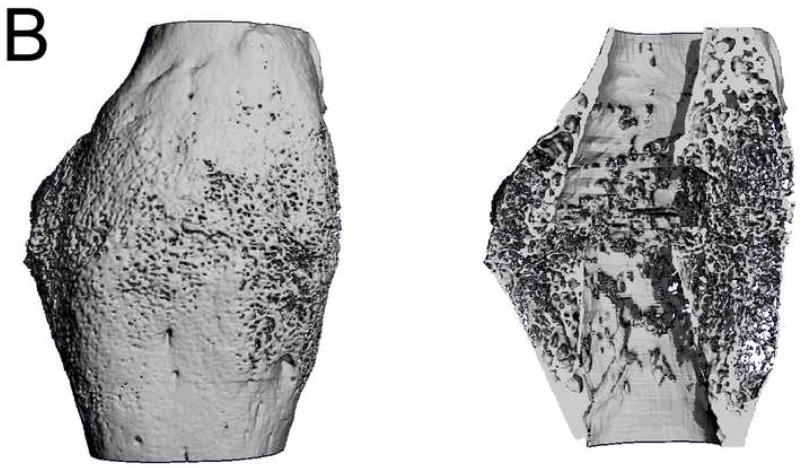
(A) Semi-automated image segmentation was used to define the outer boundary of the callus (green) and the periosteal surface of the cortex (red) on each 2D tomogram. The volume of interest is the region enclosed by these two boundaries. (B) 3-D rendering of the entire volume of interest and a corresponding longitudinal cut-away view for a representative specimen
Figure 1
Figure 1
(A) Semi-automated image segmentation was used to define the outer boundary of the callus (green) and the periosteal surface of the cortex (red) on each 2D tomogram. The volume of interest is the region enclosed by these two boundaries. (B) 3-D rendering of the entire volume of interest and a corresponding longitudinal cut-away view for a representative specimen
Figure 2
Figure 2
Longitudinal, cut-away views of 3-D renderings of representative calluses from each of the three experiments: these specimens correspond to the median BV/TV for their respective experimental groups. The calluses were defined through image segmentation (Figure 1) and do not include the cortex or medullary canal. These renderings depict only the tissue with X-ray attenuation values above the specified threshold.
Figure 3
Figure 3
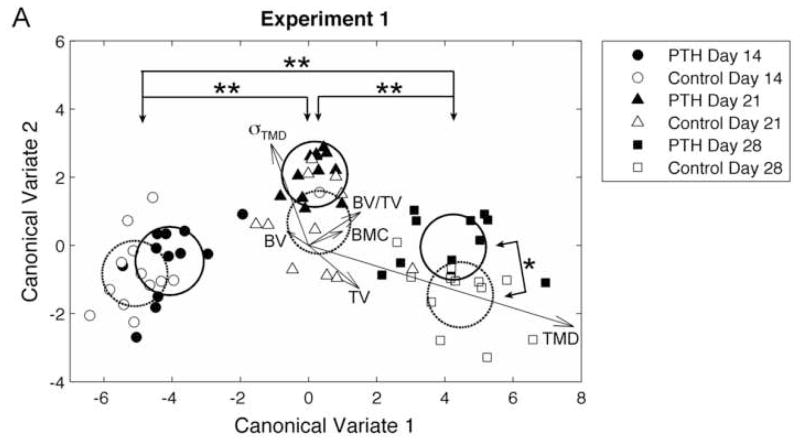
MANOVA results depicting the first and second canonical variates for each of the three experiments. The circles denote 95% confidence intervals, and the centers of the circles represent the group means. The axis that defines each original outcome measure (e.g. BV) is shown as a ray in the space defined by the canonical variates. Only the first two dimensions of this space are shown, because the first two canonical variates accounted for more than 97% of the variation among groups in all three experiments. Differences in callus structure and composition among treatment groups (Experiments 1 and 2, p<0.001), between genotypes (Experiment 3, p=0.01), and over time (p<0.001). In addition, interactions between time and treatment (p<0.001) and between time and genotype (p=0.002) were found for Experiments 2 and 3, respectively. Significant differences between treatments or genotypes within a given timepoint are indicated with an asterisk (*), and significant differences between timepoints, irrespective of treatment or genotype, are indicated with a double asterisk (**).
Figure 3
Figure 3
MANOVA results depicting the first and second canonical variates for each of the three experiments. The circles denote 95% confidence intervals, and the centers of the circles represent the group means. The axis that defines each original outcome measure (e.g. BV) is shown as a ray in the space defined by the canonical variates. Only the first two dimensions of this space are shown, because the first two canonical variates accounted for more than 97% of the variation among groups in all three experiments. Differences in callus structure and composition among treatment groups (Experiments 1 and 2, p<0.001), between genotypes (Experiment 3, p=0.01), and over time (p<0.001). In addition, interactions between time and treatment (p<0.001) and between time and genotype (p=0.002) were found for Experiments 2 and 3, respectively. Significant differences between treatments or genotypes within a given timepoint are indicated with an asterisk (*), and significant differences between timepoints, irrespective of treatment or genotype, are indicated with a double asterisk (**).
Figure 3
Figure 3
MANOVA results depicting the first and second canonical variates for each of the three experiments. The circles denote 95% confidence intervals, and the centers of the circles represent the group means. The axis that defines each original outcome measure (e.g. BV) is shown as a ray in the space defined by the canonical variates. Only the first two dimensions of this space are shown, because the first two canonical variates accounted for more than 97% of the variation among groups in all three experiments. Differences in callus structure and composition among treatment groups (Experiments 1 and 2, p<0.001), between genotypes (Experiment 3, p=0.01), and over time (p<0.001). In addition, interactions between time and treatment (p<0.001) and between time and genotype (p=0.002) were found for Experiments 2 and 3, respectively. Significant differences between treatments or genotypes within a given timepoint are indicated with an asterisk (*), and significant differences between timepoints, irrespective of treatment or genotype, are indicated with a double asterisk (**).
Figure 4
Figure 4
Results of the stepwise regression analysis for maximum torque: Measured, log-transformed values of maximum torque plotted against the values of maximum torque predicted from TMD, BV, and σTMD for all three experiments. The inset table lists the beta weight (β) and partial correlation coefficient (rpartial) for each of the three independent variables in order to provide a measure of the relative contribution of each to maximum torque.
Figure 5
Figure 5
The distribution of grayvalues throughout the fracture callus presents difficulties in devising an automated method for identifying a suitable threshold for distinguishing mineralized tissue from unmineralized tissue. (A) Histogram for a specimen from Experiment 3, with a higher magnification view shown in the inset. (B) Plot of the derivative of BV/TV with respect to threshold against threshold. In μCT studies of trabecular bone, the local maximum on this curve (indicated by the gray arrow) is a natural choice for the threshold that distinguishes bone tissue from marrow. However, when this threshold is applied to the grayscale image of the fracture callus in (C), it results in exclusion of nearly all of the tissue in the callus (D). For comparison purposes, the threshold used in this study results in the binary image shown in (E). In (A) and (B), the black arrow indicates the threshold used in this study (8192), and the white arrows indicate the two alternate thresholds that were investigated (7733 and 8651). These alternate thresholds correspond approximately to 40% and 50% of the attenuation of mature cortical bone for the specimens in this study.

References

    1. Praemer A, Furner S, Rice DP. Musculoskeletal conditions in the United States. Park Ridge, IL: AAOS; 1992.
    1. Grigoryan M, Lynch JA, Fierlinger AL, Guermazi A, Fan B, MacLean DB, MacLean A, Genant HK. Quantitative and qualitative assessment of closed fracture healing using computed tomography and conventional radiography. Acad Radiol. 2003;10:1267–73. - PubMed
    1. Schnarkowski P, Redei J, Peterfy CG, Weidenmaier W, Mutschler W, Arand M, Reiser MF. Tibial shaft fractures: assessment of fracture healing with computed tomography. J Comput Assist Tomogr. 1995;19:777–81. - PubMed
    1. den Boer FC, Bramer JA, Patka P, Bakker FC, Barentsen RH, Feilzer AJ, de Lange ES, Haarman HJ. Quantification of fracture healing with three-dimensional computed tomography. Arch Orthop Trauma Surg. 1998;117:345–50. - PubMed
    1. den Boer FC, Bramer JA, Blokhuis TJ, Van Soest EJ, Jenner JM, Patka P, Bakker FC, Burger EH, Haarman HJ. Effect of recombinant human osteogenic protein-1 on the healing of a freshly closed diaphyseal fracture. Bone. 2002;31:158–64. - PubMed

Publication types