


Reduced brain GABA in primary insomnia: preliminary data from 4T proton magnetic resonance spectroscopy (1H-MRS)
- PMID: 19014069
- PMCID: PMC2579978
- DOI: 10.1093/sleep/31.11.1499
Reduced brain GABA in primary insomnia: preliminary data from 4T proton magnetic resonance spectroscopy (1H-MRS)
Abstract
Study objectives: Both basic and clinical data suggest a potential significant role for GABA in the etiology and maintenance of primary insomnia (PI). Proton magnetic resonance spectroscopy (1H-MRS) can non-invasively determine GABA levels in human brain. Our objective was to assess GABA levels in unmedicated individuals with PI, using 1H-MRS.
Design and setting: Matched-groups, cross-sectional study conducted at two university-based hospitals.
Participants: Sixteen non-medicated individuals (8 women) with PI (mean age = 37.3 +/- 8.1) and 16 (7 women) well-screened normal sleepers (mean age = 37.6 +/- 4.5).
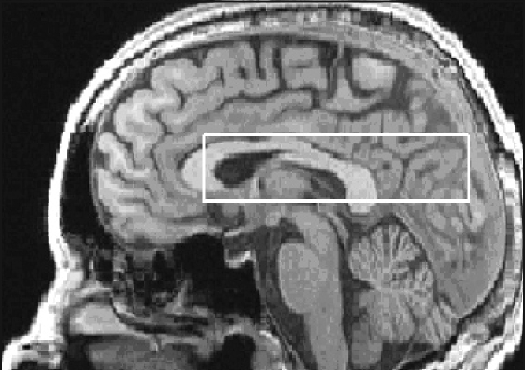
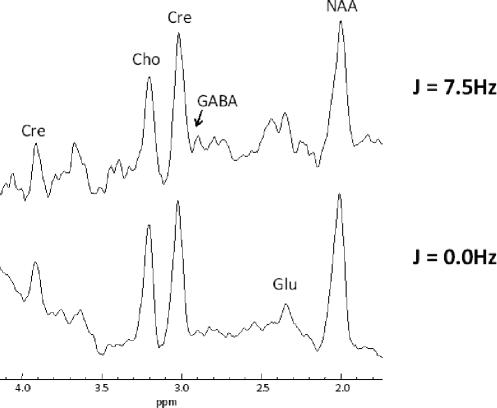
Methods and measurements: PI was established with an unstructured clinical interview, a Structured Clinical Interview for DSM-IV (SCID), sleep diary, actigraphy and polysomnography (PSG). 1H-MRS data were collected on a Varian 4 Tesla magnetic resonance imagingl spectroscopy scanner. Global brain GABA levels were averaged from samples in the basal ganglia, thalamus, and temporal, parietal, and occipital white-matter and cortex.
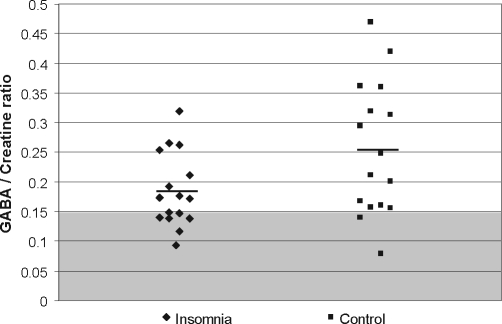
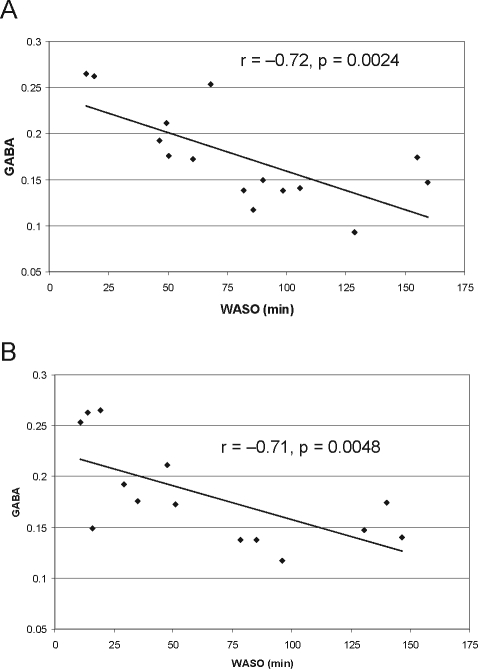
Results: Average brain GABA levels were nearly 30% lower in patients with PI (.18 +/- .06) compared to controls (.25 +/- .11). GABA levels were negatively correlated with wake after sleep onset (WASO) on two independent PSGs (r = -0.71, p = 0.0024 and -0.70, p = 0.0048).
Conclusions: Our preliminary finding of a global reduction in GABA in non-medicated individuals with PI is the first demonstration of a neurochemical difference in the brains of those with PI compared to normal sleeping controls. 1H-MRS is a valuable tool to assess GABA in vivo, and may provide a means to shed further light on the neurobiology of insomnia.
Figures
References
-
- Pearson NJ. Insomnia, trouble sleeping, and complementary and alternative medicine: Analysis of the 2002 national health interview survey data. Arch Intern Med. 2006;166:1775–1782. - PubMed
-
- LeBlanc M. Psychological and health-related quality of life factors associated with insomnia in a population-based sample. J Psychosom Res. 2007;63:157–166. - PubMed
-
- Riemann D. Primary insomnia: a risk factor to develop depression? J Affect Disord. 2003;76:255–259. - PubMed
-
- Gottesman C. GABA mechanisms and sleep. Neuroscience. 2002;111:231–239. - PubMed
-
- Nofzinger EA. Functional neuroimaging evidence for hyperarousal in insomnia. Am J Psychiatry. 2004;161:2126–2128. - PubMed
Publication types
MeSH terms
Substances
Grants and funding
LinkOut - more resources
Full Text Sources
Medical
Research Materials
Miscellaneous
