


Rapid and repeated limb loss in a clade of scincid lizards
- PMID: 19014443
- PMCID: PMC2596130
- DOI: 10.1186/1471-2148-8-310
Rapid and repeated limb loss in a clade of scincid lizards
Abstract
Background: The Australian scincid clade Lerista provides perhaps the best available model for studying limb reduction in squamates (lizards and snakes), comprising more than 75 species displaying a remarkable variety of digit configurations, from pentadactyl to entirely limbless conditions. We investigated the pattern and rate of limb reduction and loss in Lerista, employing a comprehensive phylogeny inferred from nucleotide sequences for a nuclear intron and six mitochondrial genes.
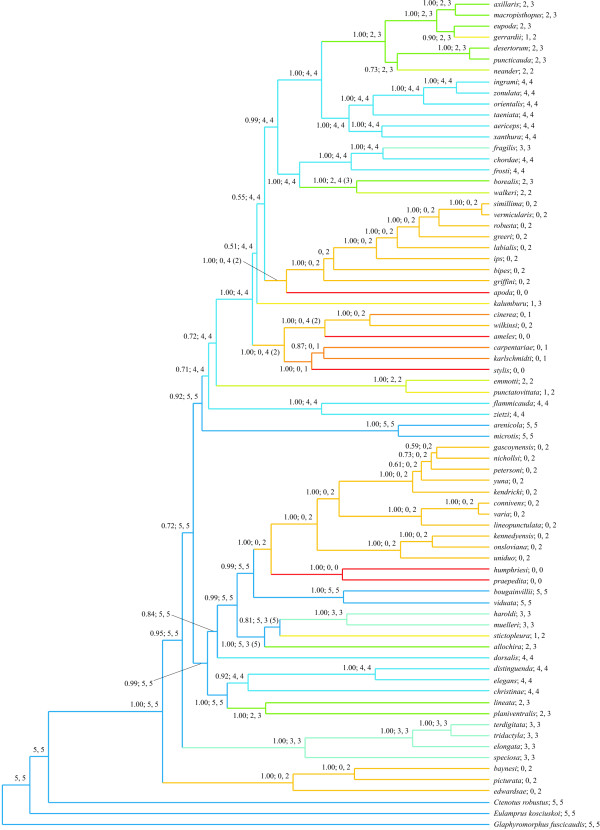
Results: The inferred phylogeny reveals extraordinary evolutionary mutability of limb morphology in Lerista. Ancestral state reconstructions indicate at least ten independent reductions in the number of digits from a pentadactyl condition, with a further seven reductions proceeding independently from a tetradactyl condition derived from one of these reductions. Four independent losses of all digits are inferred, three from pentadactyl or tetradactyl conditions. These conclusions are not substantially affected by uncertainty in assumed rates of character state transition or the phylogeny. An estimated age of 13.4 million years for Lerista entails that limb reduction has occurred not only repeatedly, but also very rapidly. At the highest rate, complete loss of digits from a pentadactyl condition is estimated to have occurred within 3.6 million years.
Conclusion: The exceptionally high frequency and rate of limb reduction inferred for Lerista emphasise the potential for rapid and substantial alteration of body form in squamates. An absence of compelling evidence for reversals of digit loss contrasts with a recent proposal that digits have been regained in some species of the gymnophthalmid clade Bachia, possibly reflecting an influence of differing environmental and genetic contexts on the evolution of limb morphology in these clades. Future study of the genetic, developmental, and ecological bases of limb reduction and loss in Lerista promises the elucidation of not only this phenomenon in squamates, but also the dramatic evolutionary transformations of body form that have produced the extraordinary diversity of multicellular organisms.
Figures
References
-
- Gans C. Tetrapod limblessness: evolution and functional corollaries. Amer Zool. 1975;15:455–467.
-
- Greer AE. Limb reduction in squamates: identification of the lineages and discussion of the trends. J Herpetol. 1991;25:166–173. doi: 10.2307/1564644. - DOI
-
- Wiens JJ, Slingluff JL. How lizards turn into snakes: a phylogenetic analysis of body-form evolution in anguid lizards. Evolution. 2001;55:2303–2318. - PubMed
-
- Brandley MC, Huelsenbeck JP, Wiens JJ. Rates and patterns in the evolution of snake-like body form in squamate reptiles: evidence for repeated re-evolution of lost digits and long-term persistence of intermediate body forms. Evolution. 2008;62:2042–2064. doi: 10.1111/j.1558-5646.2008.00430.x. - DOI - PubMed
Publication types
MeSH terms
Substances
LinkOut - more resources
Full Text Sources
