. 2008 Nov 12:6:49.
doi: 10.1186/1741-7007-6-49.

A comprehensive functional analysis of tissue specificity of human gene expression

Affiliations

A comprehensive functional analysis of tissue specificity of human gene expression

Zoltán Dezso et al. BMC Biol. .

Abstract

Background: In recent years, the maturation of microarray technology has allowed the genome-wide analysis of gene expression patterns to identify tissue-specific and ubiquitously expressed ('housekeeping') genes. We have performed a functional and topological analysis of housekeeping and tissue-specific networks to identify universally necessary biological processes, and those unique to or characteristic of particular tissues.

Results: We measured whole genome expression in 31 human tissues, identifying 2374 housekeeping genes expressed in all tissues, and genes uniquely expressed in each tissue. Comprehensive functional analysis showed that the housekeeping set is substantially larger than previously thought, and is enriched with vital processes such as oxidative phosphorylation, ubiquitin-dependent proteolysis, translation and energy metabolism. Network topology of the housekeeping network was characterized by higher connectivity and shorter paths between the proteins than the global network. Ontology enrichment scoring and network topology of tissue-specific genes were consistent with each tissue's function and expression patterns clustered together in accordance with tissue origin. Tissue-specific genes were twice as likely as housekeeping genes to be drug targets, allowing the identification of tissue 'signature networks' that will facilitate the discovery of new therapeutic targets and biomarkers of tissue-targeted diseases.

Conclusion: A comprehensive functional analysis of housekeeping and tissue-specific genes showed that the biological function of housekeeping and tissue-specific genes was consistent with tissue origin. Network analysis revealed that tissue-specific networks have distinct network properties related to each tissue's function. Tissue 'signature networks' promise to be a rich source of targets and biomarkers for disease treatment and diagnosis.


Figures
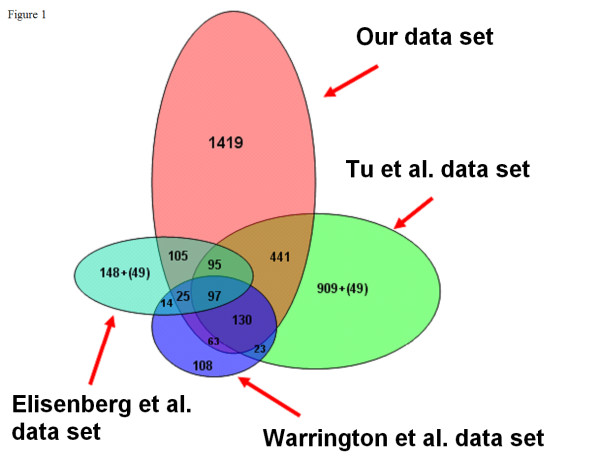
Figure 1
Figure 1
Comparison between housekeeping gene sets. The intersections between Tu et al. [4], Warrington et al. [3], Eisenberg and Levanon [2] and our set are shown. The smallest of the four previously published sets [5] was not included in the figure for clarity. The numbers in parentheses are the number of unique genes that overlap between the sets located at the opposite sides.
Figure 2
Figure 2
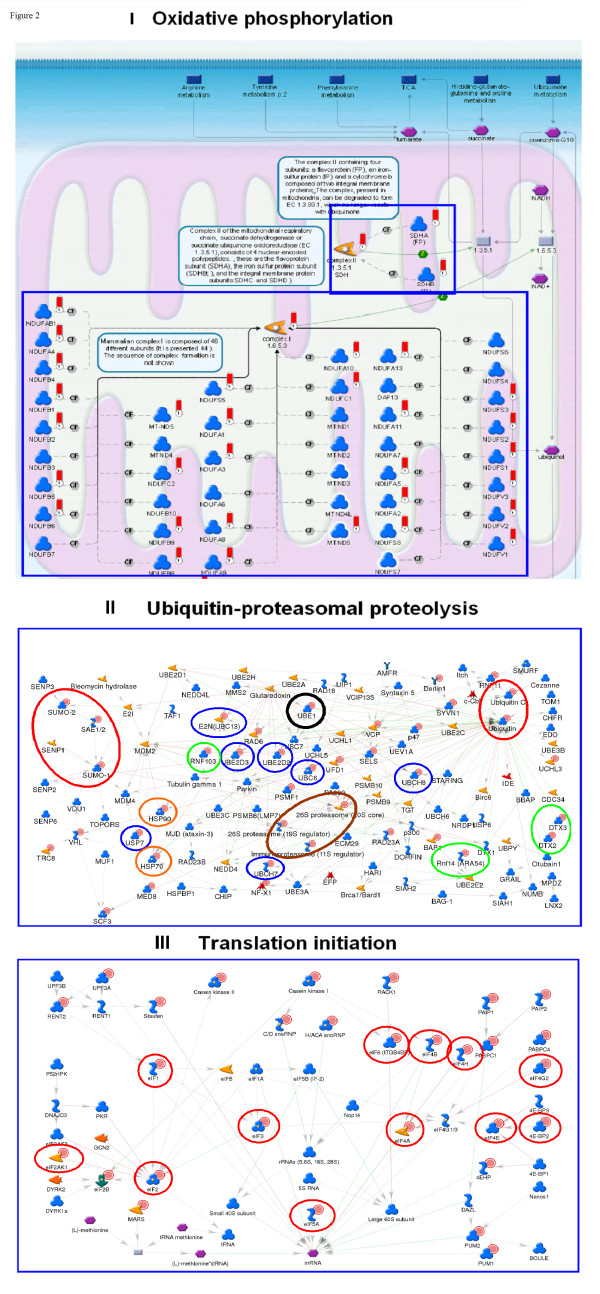
Top-scored pathways maps and process networks for housekeeping proteins. (I) Oxidative phosphorylation map. The subunits of the complexes are grouped in blue boxes; the red 'thermometer' histograms mark housekeeping (HK) genes. (II) Network for ubiquitin-mediated protein degradation in proteosome. HK genes are marked with solid red circles. The most important network components functionally, identified as HK genes, are marked with circles: ubiquitins and small ubiquitin-like modifiers (Ubiquitin, Ubiquitin C, Sumo-1, Sumo-2 are encircled in red); the ubiquitin-activating enzyme (UBE1 is encircled in black); ubiquitin-conjugating enzymes (UBCH8, UBE2D2, UBE2D3, UBC13, UBCH7 are encircled in blue); proteins that may act as ubiquitin protein ligases E3 (DTX2, DTX3, Rnf14, Rnf103 are encircled in green); the chaperons (HSP70 and HSP90 encircled in orange) and proteasomal subunits (26S proteasome, 26S proteasome, immunoproteasome (11S regulator) are encircled in brown). (III) Network for the GeneGo process translation initiation. HK genes are marked with solid red circles and translation initiation factors are encircled in red.
Figure 3
Figure 3
Top-scored canonical maps for tissue-specific genesets. (I) Retina, visual perception canonical map. The genes identified as expressed in retina are marked with red 'thermometer' icons. (II) Cortisone biosynthesis and metabolism canonical map. The genes identified as present in adrenal gland are marked with red 'thermometer' icons.
Figure 4
Figure 4
Network analysis and protein class enrichment of housekeeping and tissue-specific genes. A. Average connectivity of global protein interaction, housekeeping (HK) and several tissue-specific gene sets. B. Protein class enrichment analysis. The actual (black or blue bars) and expected (open red box) number of transcription factors (first bar), receptors (second bar) and enzymes (third bar) for each tissue. The blue bars correspond to HK proteins. The circles identify several tissues enriched in transcriptional factors (blue), receptors (green) and enzymes (red). C. Network component enrichment analysis. The upper part of the figure shows the schematic illustration of IN, OUT and GSC (figure adopted from Brodel et al. [15]). The lower panel shows the actual (black and blue bars) and expected (open red boxes) number of genes in the GSC (first), IN (second) and OUT (third) components. The blue bars correspond to housekeeping proteins. The circles identify several tissues enriched in GSC proteins (red), IN proteins (green) and OUT (blue).
Figure 5
Figure 5
Tissue-specific networks. (I) Liver; (II) Adrenal gland. Genes identified as tissue-specific are marked with solid red circles.
Figure 6
Figure 6
Clustering tissues into groups based on expression patterns. (a) Hierarchical clustering of genes based on gene expression data. (b) Tissue pairs having a significantly large number of genes uniquely expressed in them. (c) Proteins uniquely expressed in spinal cord, retina and brain are involved in diseases of the nervous system.

References

    1. Watson JD, Hopkins NH, Roberts JW, Steitz JA, Weiner AM. Molecular Biology of the Gene. 2. Vol. 1. Benjamin/Cummings; 1987. p. 704.
    1. Eisenberg E, Levanon EY. Human housekeeping genes are compact. Trends Genet. 2003;19:362–365. - PubMed
    1. Warrington JA, Nair A, Mahadevappa M, Tsyganskaya M. Comparison of human adult and fetal expression and identification of 535 housekeeping/maintenance genes. Physiol Genomics. 2000;2:143–147. - PubMed
    1. Tu Z, Wang L, Xu M, Zhou X, Chen T, Sun F. Further understanding human disease genes by comparing with housekeeping genes and other genes. BMC Genomics. 2006;7:31. - PMC - PubMed
    1. Hsiao LL, Dangond F, Yoshida T, Hong R, Jensen RV, Misra J, Dillon W, Lee KF, Clark KE, Haverty P, Weng Z, Mutter GI, Frosch MP, MacDonald ME, Milford EL, Crum CP, Bueno R, Pratt RE, Mahadevappa M, Warrington JA, Stephanopoulos G, Stephanopoulos G, Gullans SR. A compendium of gene expression in normal human tissues. Physiol Genomics. 2001;7:97–104. - PubMed