


Aged B lymphocytes retain their ability to express surface markers but are dysfunctional in their proliferative capability during early activation events
- PMID: 19014641
- PMCID: PMC2615744
- DOI: 10.1186/1742-4933-5-15
Aged B lymphocytes retain their ability to express surface markers but are dysfunctional in their proliferative capability during early activation events
Abstract
Background: Ageing is associated with dysfunction in the humoral response leading to decreased protection against infectious diseases. Defects in T cell function due to age have been well characterized but it is unclear if dysfunctions in antibody responses are due to deficiencies in a helper environment or intrinsic B cell defects. Previous studies from our laboratory have shown that aged B lymphocytes are able to differentiate into high affinity antibody-secreting cells at a frequency similar to their young counterparts. However, expansion of B cells in vivo was reduced in aged animals when compared to young.
Methods: To further investigate the cause of this reduced expansion, we have now examined early activation events of aged B cells in response to anti-CD40 monoclonal antibody (mAb) and lipopolysaccharide (LPS) stimulation in vitro. To do this spleen cells were harvested from young, middle-aged and aged quasi-monoclonal (QM) mice and cultured in complete RPMI for 24 and 48 hours. Cultures contained either LPS or anti-CD40 mAb and murine IL-4. Cells were collected and analyzed using flow cytometry. To examine the proliferative capacity of aged B cells spleen cells were collected as before and cultured in 96 well microtiter plates with either LPS or anti-CD40 mAb and murine IL-4 for 24 hours. Tritiated thymidine ([3H]-Tdr) was added to each well and incubated for another 24 hours after which cells were collected and analyzed using a scintillation counter.
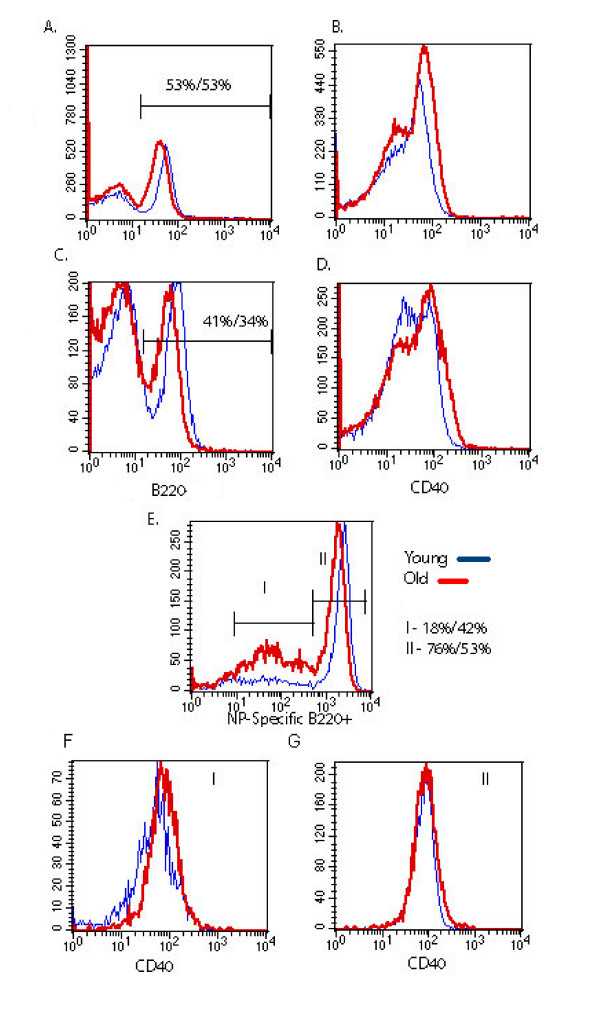
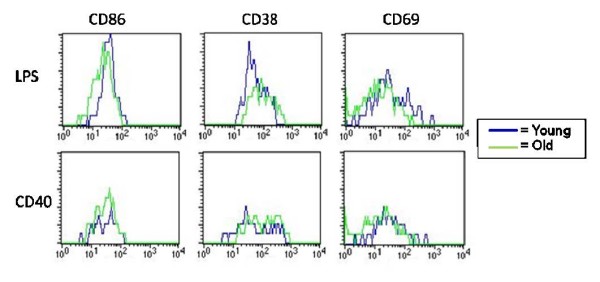
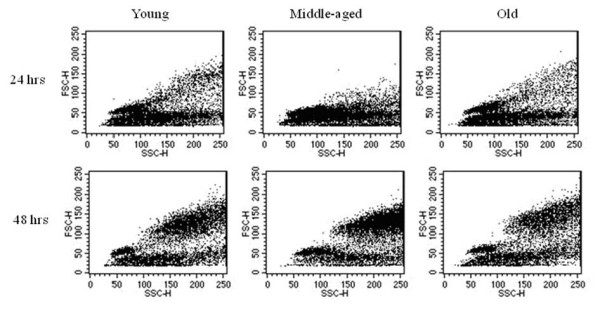
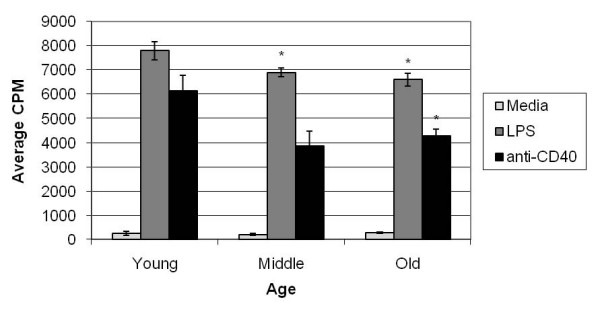
Results: Resting aged B cells exhibited similar levels of CD40 expression when compared to young cells and efficiently up-regulated CD86 and CD69 and also down-regulated CD38 upon stimulation. However, aged B cells proliferated less than young B cells and showed a consistent, but not statistically significant, reduction in their ability to form blast cells.
Conclusion: Aged B cells exhibited a reduced response in some early activation events but produced at least a partial response in all cases. Thus, therapeutic intervention may be possible, despite intrinsically different responses in aged B cells.
Figures


References
-
- Ghia P, Melchers F, Rolink AG. Age-dependent changes in B lymphocyte development in man and mouse. Exp Gerontol. 2000;35:159–165. - PubMed
-
- Globerson A, Effros RB. Ageing of lymphocytes and lymphocytes in the aged. Immunol Today. 2000;21:515–521. - PubMed
-
- Miller RA. The aging immune system: primer and prospectus. Science. 1996;273:70–74. - PubMed
-
- Blaeser A, Panwar A, Vogel LA. Humoral immunity and aging: intrinsic B cell defects. Current Trends in Immunology. 2007;8:61–67.
Grants and funding
LinkOut - more resources
Full Text Sources
Research Materials
