


Connective tissue growth factor promoter activity in normal and wounded skin
- PMID: 19014648
- PMCID: PMC2584011
- DOI: 10.1186/1755-1536-1-3
Connective tissue growth factor promoter activity in normal and wounded skin
Abstract
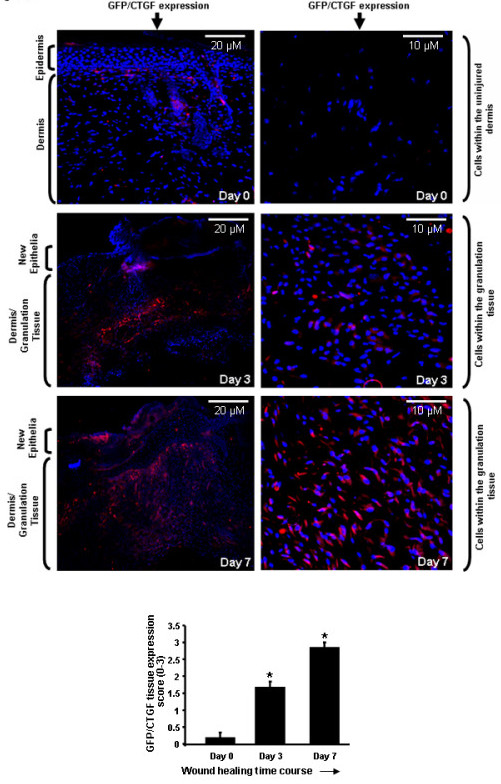
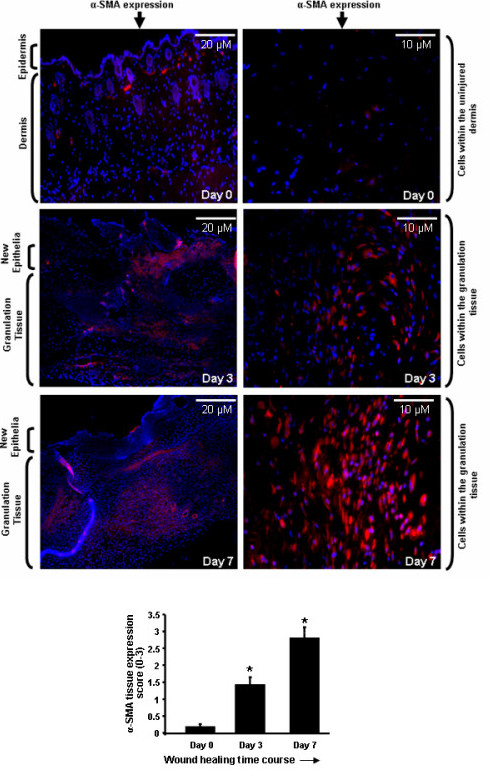
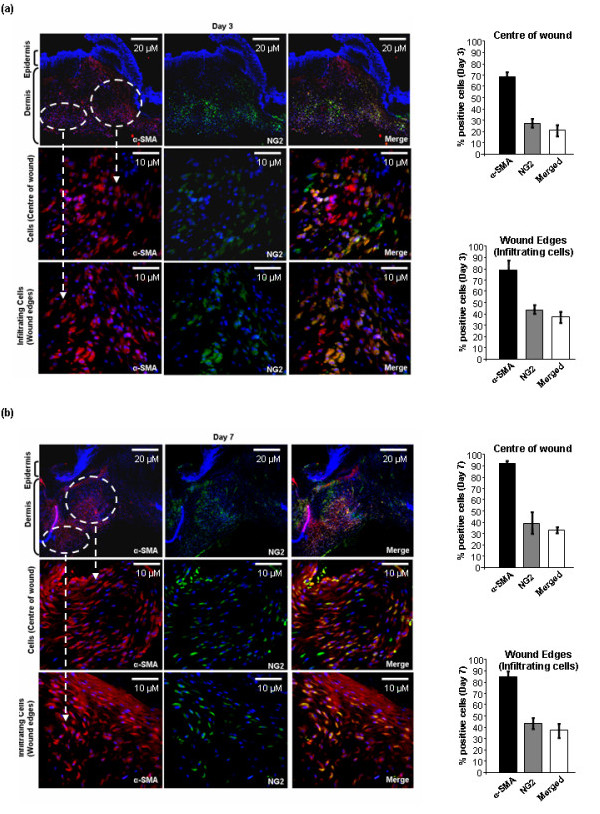
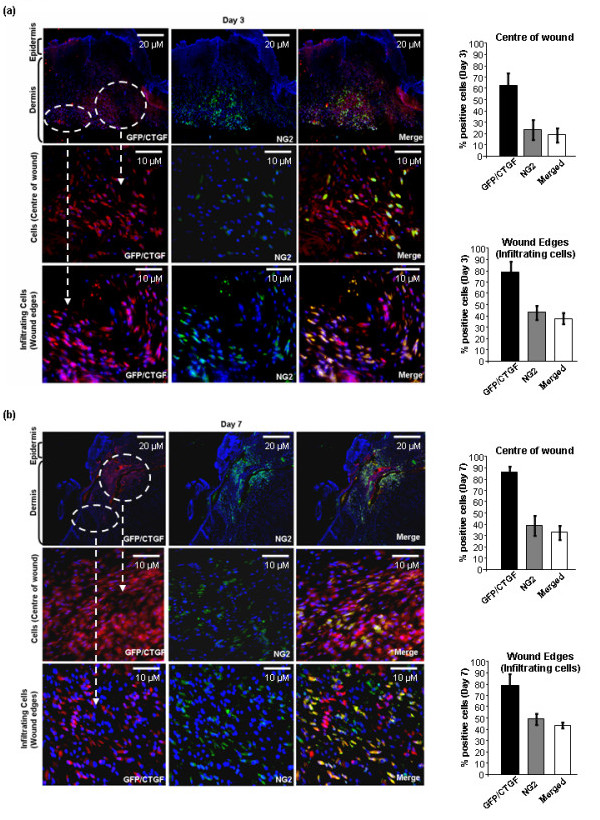
In skin, connective tissue growth factor (CTGF/CCN2) is induced during tissue repair. However, what the exact cell types are that express CTGF in normal and wounded skin remain controversial. In this report, we use transgenic knock-in mice in which the Pacific jellyfish Aequorea victoria enhanced green fluorescent protein (E-GFP) gene has been inserted between the endogenous CTGF promoter and gene. Unwounded (day 0) and wounded (days 3 and 7) skin was examined for GFP to detect cells in which the CTGF promoter was active, alpha-smooth muscle actin (alpha-SMA) to detect myofibroblasts, and NG2 expression to detect pericytes. In unwounded mice, CTGF expression was absent in epidermis and was present in a few cells in the dermis. Upon wounding, CTGF expression was induced in the dermis. Double immunolabeling revealed that CTGF-expressing cells also expressed alpha-SMA, indicating the CTGF was expressed in myofibroblasts. A subset (approximately 30%) of myofibroblasts were also NG2 positive, indicating that pericytes significantly contributed to the number of myofibroblasts in the wound. Pericytes also expressed CTGF. Collectively, these results indicate that CTGF expression in skin correlates with myofibroblast induction, and that CTGF-expressing pericytes are significant contributors to myofibroblast activity during cutaneous tissue repair.
Figures

References
-
- Hinz B, Gabbiani G. Mechanisms of force generation and transmission by myofibroblasts. Curr Opin Biotechnol. 2003;14:538–546. - PubMed
-
- Desmouliere A, Chaponnier C, Gabbiani G. Tissue repair, contraction, and the myofibroblast. Wound Repair Regen. 2005;13:7–12. - PubMed
-
- Chen Y, Shi-wen X, van Beek J, Kennedy L, McLeod M, Renzoni EA, Bou-Gharios G, Wilcox-Adelman S, Goetinck PF, Eastwood M, Black CM, Abraham DJ, Leask A. Matrix contraction by dermal fibroblasts requires transforming growth factor-beta/activin-linked kinase 5, heparan sulfate-containing proteoglycans, and MEK/ERK: insights into pathological scarring in chronic fibrotic disease. Am J Pathol. 2005;67:1699–1711. - PMC - PubMed
-
- Abraham DJ, Eckes B, Rajkumar V, Krieg T. New developments in fibroblast and myofibroblast biology: implications for fibrosis and scleroderma. Curr Rheumatol Rep. 2007;9:136–143. - PubMed
-
- Rajkumar VS, Shi-wen X, Bostrom M, Leoni P, Muddle J, Ivarsson M, Gerdin B, Denton CP, Bou-Gharios G, Black CM, Abraham DJ. Platelet-derived growth factor-beta receptor activation is essential for fibroblast and pericyte recruitment during cutaneous wound healing. Am J Pathol. 2006;169:2254–2265. - PMC - PubMed
LinkOut - more resources
Full Text Sources
Molecular Biology Databases
Miscellaneous
