


Metabolic and cardiovascular risk in patients with a history of differentiated thyroid carcinoma: A case-controlled cohort study
- PMID: 19014658
- PMCID: PMC2577042
- DOI: 10.1186/1756-6614-1-2
Metabolic and cardiovascular risk in patients with a history of differentiated thyroid carcinoma: A case-controlled cohort study
Abstract
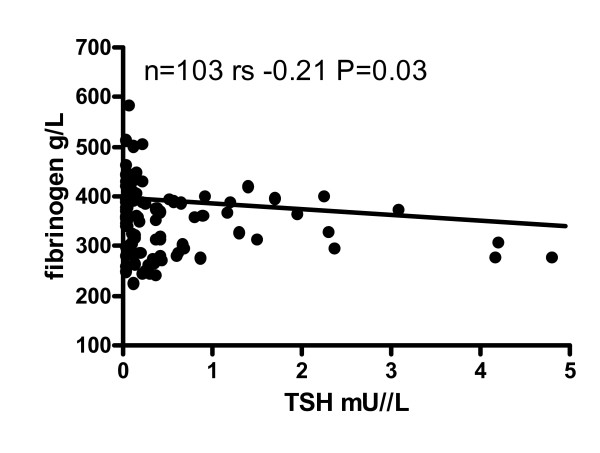
Hyperthyroidism seems to increase metabolic and cardiovascular risk, while the effects of sub-clinical hyperthyroidism are controversial. We evaluated metabolic and cardiovascular parameters in differentiated thyroid carcinoma (DTC) patients with suppressed thyrotropin (TSH) due to levo-thyroxine (L-T4) therapy. We studied DTC patients and, as a control group, patients with a history of surgery for non-malignant thyroid pathology. Significantly higher insulin and lower HDL-cholesterol levels were recorded in DTC subjects. In both groups, insulin levels were significantly related with body mass index (BMI) but not with age or L-T4 dosage. In DTC patients, a significant negative correlation was seen between HDL-cholesterol and BMI or L-T4 dosage. In both groups, intima-media thickness (IMT) correlated positively with age, BMI, glucose levels and systolic blood pressure. In DTC patients, increased IMT was significantly correlated with glycated hemoglobin (HbA1c), cholesterol and triglycerides. In DTC patients, C-reactive protein correlated positively with insulin, insulin resistance, triglycerides and systolic blood pressure, and negatively with HDL-cholesterol. In both DTC and control subjects, fibrinogen correlated positively with age, BMI, increased IMT, HbA1c and systolic blood pressure. In DTC subjects, plasma fibrinogen concentrations correlated positively with insulin resistance, cholesterol and LDL-cholesterol, and negatively with TSH levels. Our data confirm that the favorable evolution of DTC can be impaired by a high incidence of abnormal metabolic and cardiovascular data that are, at least in part, related to L-T4 therapy. These findings underline the need for adequate L-T4 titration.
Figures
References
-
- Gorges R. The changing epidemiology of the thyroid cancer. In: Biersack H-J, Grunwald F, editor. Thyroid cancer. 2. Springer, Berlin; 2005. pp. 3–21.
-
- Belfiore A, La Rosa GL, La Porta GA, Giuffrida D, Milazzo G, Lupo L, Regalbuto C, Vigneri R. Cancer risk in patients with cold thyroid nodules: relevance of thyroid intake, sex, age and multinodularity. Am J Med. 1992;93:363–369. - PubMed
-
- Papini E, Guglielmi R, Bianchini A, Crescenzi A, Taccogna S, Nardi F, Panunzi C, Rinaldi R, Toscano V, Pacella CM. Risk of malignancy in non-palpable thyroid nodules: predictive value of ultrasound and color Doppler features. J Clin Endocrinol Metab. 2002;87:1941–1946. - PubMed
-
- Sidoti M, Marino G, Resmini E, Augeri C, Cappi C, Cavallero D, Lagasio C, Ceppa P, Minuto F, Giusti M. The rational use of fine needle aspiration biopsy (FNAB) in diagnosing thyroid nodules. Minerva Endocrinol. 2006;31:159–172. - PubMed
-
- Tuttle RM, Leboeuf R, Martorella AJ. Papillary thyroid cancer and therapy. Endocrinol Metab Clin N Am. 2007;36:753–778. - PubMed
LinkOut - more resources
Full Text Sources
Research Materials
