


Opioid-mediated muscle afferents inhibit central motor drive and limit peripheral muscle fatigue development in humans
- PMID: 19015193
- PMCID: PMC2670040
- DOI: 10.1113/jphysiol.2008.163303
Opioid-mediated muscle afferents inhibit central motor drive and limit peripheral muscle fatigue development in humans
Abstract
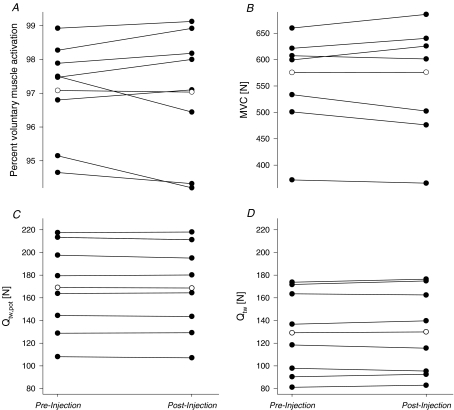
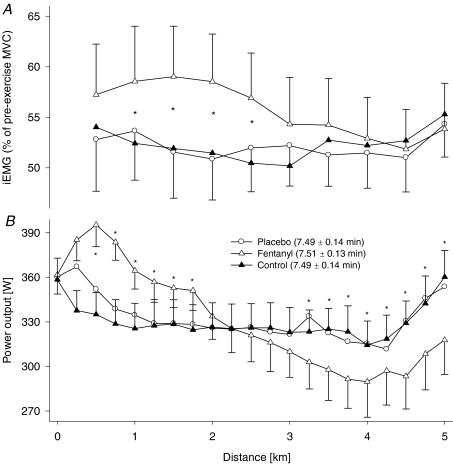
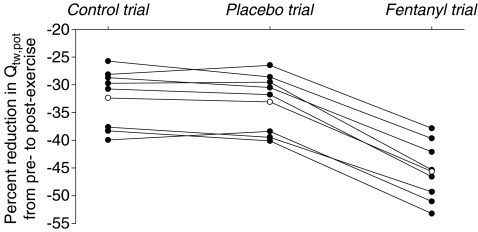
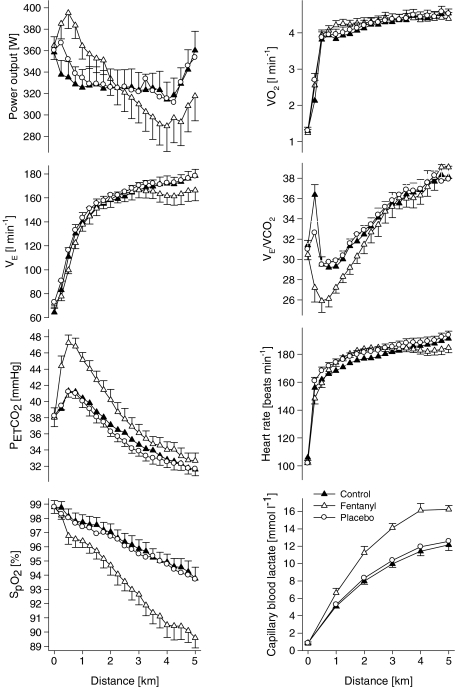
We investigated the role of somatosensory feedback from locomotor muscles on central motor drive (CMD) and the development of peripheral fatigue during high-intensity endurance exercise. In a double-blind, placebo-controlled design, eight cyclists randomly performed three 5 km time trials: control, interspinous ligament injection of saline (5K(Plac), L3-L4) or intrathecal fentanyl (5K(Fent), L3-L4) to impair cortical projection of opioid-mediated muscle afferents. Peripheral quadriceps fatigue was assessed via changes in force output pre- versus postexercise in response to supramaximal magnetic femoral nerve stimulation (DeltaQ(tw)). The CMD during the time trials was estimated via quadriceps electromyogram (iEMG). Fentanyl had no effect on quadriceps strength. Impairment of neural feedback from the locomotor muscles increased iEMG during the first 2.5 km of 5K(Fent) versus 5K(Plac) by 12 +/- 3% (P < 0.05); during the second 2.5 km, iEMG was similar between trials. Power output was also 6 +/- 2% higher during the first and 11 +/- 2% lower during the second 2.5 km of 5K(Fent) versus 5K(Plac) (both P < 0.05). Capillary blood lactate was higher (16.3 +/- 0.5 versus 12.6 +/- 1.0%) and arterial haemoglobin O(2) saturation was lower (89 +/- 1 versus 94 +/- 1%) during 5K(Fent) versus 5K(Plac). Exercise-induced DeltaQ(tw) was greater following 5K(Fent) versus 5K(Plac) (-46 +/- 2 versus -33 +/- 2%, P < 0.001). Our results emphasize the critical role of somatosensory feedback from working muscles on the centrally mediated determination of CMD. Attenuated afferent feedback from exercising locomotor muscles results in an overshoot in CMD and power output normally chosen by the athlete, thereby causing a greater rate of accumulation of muscle metabolites and excessive development of peripheral muscle fatigue.
Figures
Comment in
-
Planning the long run.J Physiol. 2009 Jan 15;587(1):7. doi: 10.1113/jphysiol.2008.166892. J Physiol. 2009. PMID: 19119181 Free PMC article. No abstract available.
References
-
- Adreani CM, Hill JM, Kaufman MP. Responses of group III and IV muscle afferents to dynamic exercise. J Appl Physiol. 1997;82:1811–1817. - PubMed
-
- Allen DG, Lamb GD, Westerblad H. Impaired calcium release during fatigue. J Appl Physiol. 2008a;104:296–305. - PubMed
-
- Allen DG, Lamb GD, Westerblad H. Skeletal muscle fatigue: cellular mechanisms. Physiol Rev. 2008b;88:287–332. - PubMed
-
- Almeida TF, Roizenblatt S, Tufik S. Afferent pain pathways: a neuroanatomical review. Brain Res. 2004;1000:40–56. - PubMed
-
- Amann M, Calbet JA. Convective oxygen transport and fatigue. J Appl Physiol. 2008;104:861–870. - PubMed
Publication types
MeSH terms
Substances
Grants and funding
LinkOut - more resources
Full Text Sources
Other Literature Sources
Medical
