


Electrophysiological consequences of acute regional ischemia/reperfusion in neonatal rat ventricular myocyte monolayers
- PMID: 19015404
- PMCID: PMC2730415
- DOI: 10.1161/CIRCULATIONAHA.108.789149
Electrophysiological consequences of acute regional ischemia/reperfusion in neonatal rat ventricular myocyte monolayers
Abstract
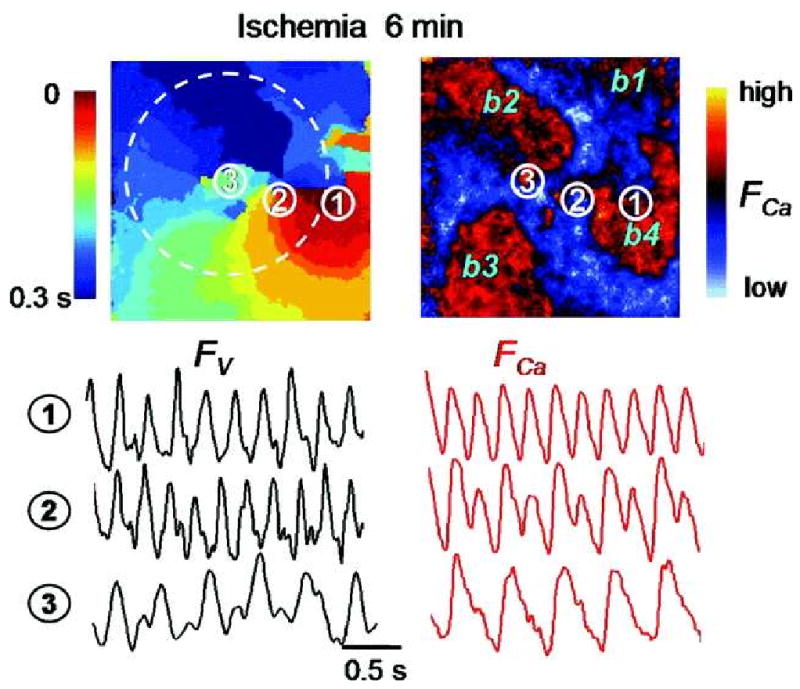
Background: Electrophysiological changes promoting arrhythmias during acute regional ischemia/reperfusion are challenging to study in intact cardiac tissue because of complex 3-dimensional myocardial and vascular geometry. We characterized electrophysiological alterations and arrhythmias during regional ischemia/reperfusion in a simpler 2-dimensional geometry of cultured neonatal rat ventricular myocyte monolayers.
Methods and results: Optical mapping of intracellular Ca (Ca(i)) and voltage was performed with the use of Rhod 2-AM and Rh-237, respectively. Regional ischemia was mimicked by covering the central portion of monolayer with a glass coverslip, and reperfusion was mimicked by removing the coverslip. Monolayers were stained with fluorescent antibodies to detect total and dephosphorylated connexin-43 at various time points. During coverslip ischemia, action potential duration shortened, Ca(i) transient duration was prolonged, and local conduction velocity (CV) slowed progressively, with loss of excitability after 10.6 +/- 3.6 minutes. CV slowing was accompanied by connexin-43 dephosphorylation. During ischemia, spontaneous reentry occurred in 5 of 11 monolayers, initiated by extrasystoles arising from the border zone or unidirectional conduction block of paced beats. On reperfusion, excitability recovered within 1.0 +/- 0.8 minutes, but CV remained depressed for 9.0 +/- 3.0 minutes, promoting reentry in the reperfused zone. As connexin-43 phosphorylation recovered in the reperfused zone, CV normalized, and arrhythmias resolved.
Conclusions: Acute regional ischemia/reperfusion in neonatal rat ventricular myocyte monolayers recapitulates electrophysiological alterations and arrhythmias similar to those observed during acute coronary occlusion/reperfusion in intact hearts. During early reperfusion, slow recovery from connexin-43 dephosphorylation leads to persistent CV slowing, creating a highly arrhythmogenic substrate.
Conflict of interest statement
Figures




References
-
- Zipes DP, Wellens HJ. Sudden cardiac death. Circulation. 1998;98:2334–51. - PubMed
-
- Carmeliet E. Cardiac ionic currents and acute ischemia: from channels to arrhythmias. Physiol Rev. 1999;79:917–1017. - PubMed
-
- Janse MJ, Wit AL. Electrophysiological mechanisms of ventricular arrhythmias resulting from myocardial ischemia and infarction. Physiol Rev. 1989;69:1049–1169. - PubMed
-
- Kleber AG, Riegger CB, Janse MJ. Electrical uncoupling and increase of extracellular resistance after induction of ischemia in isolated, arterially perfused rabbit papillary muscle. Circ Res. 1987;61:271–279. - PubMed
-
- Weiss J, Shine KI. [K+]o accumulation and electrophysiological alterations during early myocardial ischemia. Am J Physiol. 1982;243:318–327. - PubMed
Publication types
MeSH terms
Substances
Grants and funding
LinkOut - more resources
Full Text Sources
Other Literature Sources
Research Materials
