


Maternal plasma 25-hydroxyvitamin D concentrations and the risk for gestational diabetes mellitus
- PMID: 19015731
- PMCID: PMC2582131
- DOI: 10.1371/journal.pone.0003753
Maternal plasma 25-hydroxyvitamin D concentrations and the risk for gestational diabetes mellitus
Abstract
Background: Evidence is accumulating for a role of vitamin D in maintaining normal glucose homeostasis. However, studies that prospectively examined circulating concentrations of 25-hydroxyvitamin D (25-[OH] D) in relation to diabetes risk are limited. Our objective is to determine the association between maternal plasma 25-[OH] D concentrations in early pregnancy and the risk for gestational diabetes mellitus (GDM).
Methods: A nested case-control study was conducted among a prospective cohort of 953 pregnant women. Among them, 57 incident GDM cases were ascertained and 114 women who were not diagnosed with GDM were selected as controls. Controls were frequency matched to cases for the estimated season of conception of the index pregnancy.
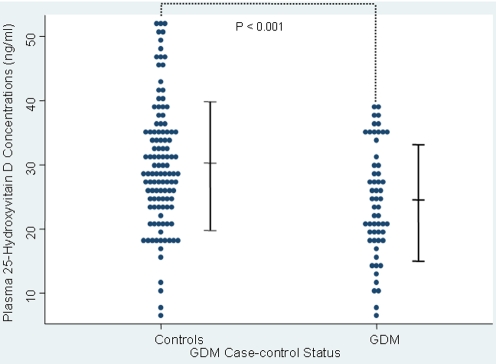
Results: Among women who developed GDM, maternal plasma 25-[OH] D concentrations at an average of 16 weeks of gestation were significantly lower than controls (24.2 vs. 30.1 ng/ml, P<0.001). This difference remained significant (3.62 ng/ml lower on average in GDM cases than controls (P value = 0.018)) after the adjustment for maternal age, race, family history of diabetes, and pre-pregnancy BMI. Approximately 33% of GDM cases, compared with 14% of controls (P<0.001), had maternal plasma 25-[OH] D concentrations consistent with a pre-specified diagnosis of vitamin D deficiency (<20 ng/ml). After adjustment for the aforementioned covariates including BMI, vitamin D deficiency was associated with a 2.66-fold (OR (95% CI): 2.66 (1.01-7.02)) increased GDM risk. Moreover, each 5 ng/ml decrease in 25-[OH] D concentrations was related to a 1.29-fold increase in GDM risk (OR (95% CI): 1.29 (1.05-1.60)). Additional adjustment for season and physical activity did not change findings substantially.
Conclusions: Findings from the present study suggest that maternal vitamin D deficiency in early pregnancy is significantly associated with an elevated risk for GDM.
Conflict of interest statement
Figures
References
-
- Holick MF. Vitamin D deficiency. N Engl J Med. 2007;357:266–281. - PubMed
-
- Lind L, Hanni A, Lithell H, Hvarfner A, Sorensen OH, et al. Vitamin D is related to blood pressure and other cardiovascular risk factors in middle-aged men. Am J Hypertens. 1995;8:894–901. - PubMed
-
- Kristal-Boneh E, Froom P, Harari G, Ribak J. Association of calcitriol and blood pressure in normotensive men. Hypertension. 1997;30:1289–1294. - PubMed
-
- Poole KE, Loveridge N, Barker PJ, Halsall DJ, Rose C, et al. Reduced vitamin D in acute stroke. Stroke. 2006;37:243–245. - PubMed
-
- Scragg R, Jackson R, Holdaway IM, Lim T, Beaglehole R. Myocardial infarction is inversely associated with plasma 25-hydroxyvitamin D3 levels: a community-based study. Int J Epidemiol. 1990;19:559–563. - PubMed
Publication types
MeSH terms
Substances
Grants and funding
LinkOut - more resources
Full Text Sources
Medical
