Low radiation dose imaging of myocardial perfusion and coronary angiography with a hybrid PET/CT scanner
- PMID: 19016814
- PMCID: PMC2701563
- DOI: 10.1111/j.1475-097X.2008.00838.x
Low radiation dose imaging of myocardial perfusion and coronary angiography with a hybrid PET/CT scanner
Abstract
Objectives: To test the image quality and feasibility of a sequential low radiation dose protocol for hybrid cardiac PET/CT angiography (CTA).
Background: Multidetector computed tomography (MDCT) is a non-invasive method for coronary angiography. The negative predictive value of MDCT is high but perfusion imaging has a role in detecting functional significance of coronary lesions. This has encouraged combining these techniques. However, radiation dose is of concern. We report our first experiences with a low dose sequential CTA mode applicable to hybrid imaging.
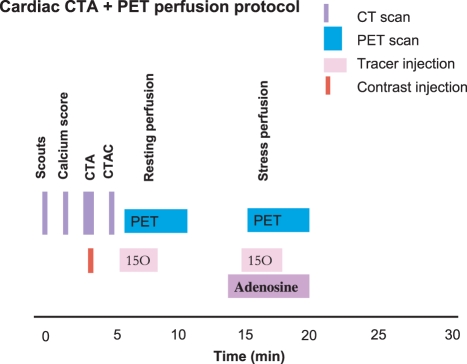
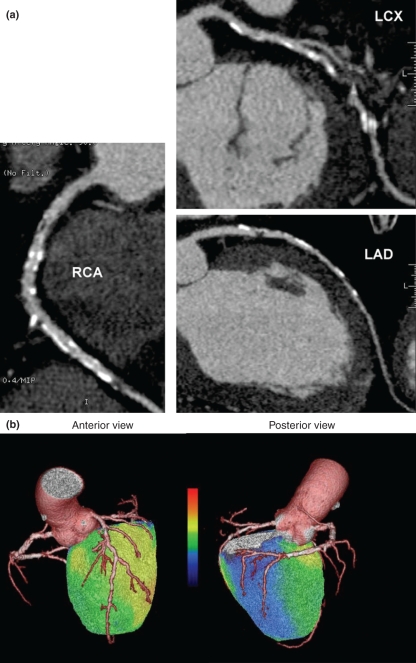
Methods: In the first phase, 10 consecutive cardiac MDCT angiographies were performed with spiral acquisition and compared in terms of image quality and dose with the following 10 patients performed with a new sequential mode. In the second phase, feasibility and radiation dose of a combined (15)O-water rest-stress PET perfusion/sequential CTA protocol were assessed in another group of 61 consecutive patients.
Results: Mean effective radiation dose was 60% lower in the sequential group than in the spiral group (19.3 versus 7.6 mSv, P<0.001). In the second phase, the new sequential hybrid protocol proved possible in 87% of the patients given the preconditions determined by the manufacturer. Mean effective dose of the CT acquisition was 7.6 mSv and total dose from the PET/CTA hybrid study 9.5 mSv.
Conclusion: Low dose PET/CT allows cardiac hybrid studies with <10 mSv. The protocol can be applied to almost nine out of 10 patients with CT image quality comparable to spiral acquisition.
Figures
References
-
- Achenbach S, Anders K, Kalender WA. Dual-source cardiac computed tomography: image quality and dose considerations. Eur Radiol. 2008;18:1188–1198. - PubMed
-
- Berman DL, Hachamovitch R, Shaw LJ, Friedman JD, Hayes SW, Thomson LE, Fieno DS, Germano G, Slomka P, Wong ND, Kang X, Rozanski A. Roles of nuclear cardiology, cardiac computed tomography and cardiac magnetic resonance: assessment of patients with suspected coronary artery disease. J Nucl Med. 2006;47:74–82. - PubMed
-
- Earls JP, Berman EL, Urban BA, Curry CA, Lane JL, Jennigs RS, McCulloch CC, Hsieh J, Londt JH. Prospectively gated transverse coronary CT angiography versus retrospectively gated helical technique: improved image quality and reduced radiation dose. Radiology. 2008;246:742–753. - PubMed
-
- EC99 . Report EURO 16262 EN. Luxembourg: European Commission; 1999. European guidelines on quality criteria for computed tomography; pp. 69–78.