


Comparison of self-report measures for identifying late-life generalized anxiety in primary care
- PMID: 19017779
- PMCID: PMC2597543
- DOI: 10.1177/0891988708324936
Comparison of self-report measures for identifying late-life generalized anxiety in primary care
Abstract
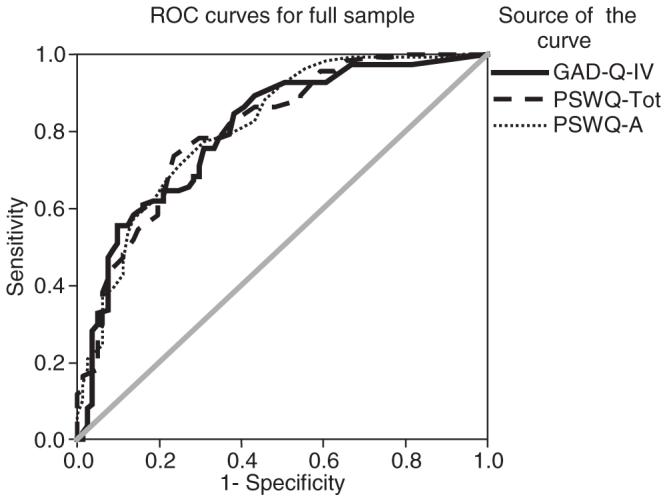
This study evaluated the Penn State Worry Questionnaire, Penn State Worry Questionnaire-Abbreviated, and the Generalized Anxiety Disorder Questionnaire-IV for identifying generalized anxiety disorder in older medical patients. Participants were 191 of 281 patients screened for a clinical trial evaluating cognitive-behavior treatment, n = 110 with generalized anxiety disorder, 81 without. Participants completed the Penn State Worry Questionnaire and Generalized Anxiety Disorder Questionnaire-IV at pretreatment. Kappa coefficients estimated agreement with the Structured Clinical Interview for Diagnosis. Receiver operating characteristic curves compared sensitivity and specificity of self-report measures. The Penn State Worry Questionnaire (cutoff = 50) provided the strongest prediction of generalized anxiety disorder (sensitivity, 76%; specificity, 73%; 75% correctly classified; kappa = .49. Item 2 of the Generalized Anxiety Disorder Questionnaire-IV demonstrated comparable accuracy. The Penn State Worry Questionnaire, Generalized Anxiety Disorder Questionnaire-IV, and briefer versions of these measures may be useful in identifying late-life generalized anxiety disorder in medical settings.
Figures
References
-
- Beekman ATF, Bremmer MA, Deeg DJH, et al. Anxiety disorders in later life: a report from the Longitudinal Aging Study Amsterdam. Int J Geriatr Psychiatry. 1998;13:717–726. - PubMed
-
- deBeurs E, Beekman ATF, van Balkom AJLM, Deeg DJ, van Dyck R, van Tilburg W. Consequences of anxiety in older persons: its effect on disability, well-being and use of health services. Psychol Med. 1999;29:583–593. - PubMed
-
- Stanley MA, Roberts RE, Bourland SL, Novy DM. Anxiety disorders among older primary care patients. J Clin Geropsychol. 2001;7:105–116.
-
- Stanley MA, Diefenbach GJ, Hopko DR, et al. The nature of generalized anxiety in older primary care patients: preliminary findings. J Psychopathol Behav Assess. 2003;25:273–280.
Publication types
MeSH terms
Grants and funding
LinkOut - more resources
Full Text Sources
Medical
