. 2008 Dec 1;181(11):7917-24.
doi: 10.4049/jimmunol.181.11.7917.

A novel IFN regulatory factor 3-dependent pathway activated by trypanosomes triggers IFN-beta in macrophages and fibroblasts

Affiliations

A novel IFN regulatory factor 3-dependent pathway activated by trypanosomes triggers IFN-beta in macrophages and fibroblasts

Anne-Danielle C Chessler et al. J Immunol. .

Abstract

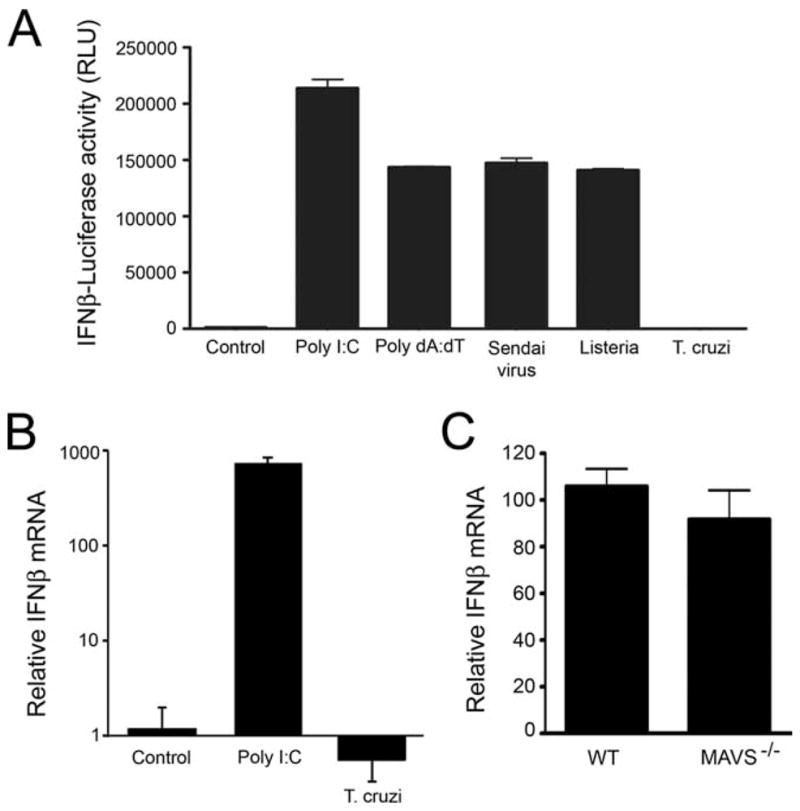
Innate immune recognition of intracellular pathogens involves both extracellular and cytosolic surveillance mechanisms. The intracellular protozoan parasite Trypanosoma cruzi triggers a robust type I IFN response in both immune and nonimmune cell types. In this study, we report that signaling through TBK1 and IFN regulatory factor 3 is required for T. cruzi-mediated expression of IFN-beta. The TLR adaptors MyD88 and TRIF, as well as TLR4 and TLR3, were found to be dispensable, demonstrating that T. cruzi induces IFN-beta expression in a TLR-independent manner. The potential role for cytosolic dsRNA sensing pathways acting through RIG-I and MDA5 was ruled out because T. cruzi was shown to trigger robust expression of IFN-beta in macrophages lacking the MAVS/IPS1/VISA/CARDif adaptor protein. The failure of T. cruzi to activate HEK293-IFN-beta-luciferase cells, which are highly sensitive to cytosolic triggers of IFN-beta expression including Listeria, Sendai virus, and transfected dsRNA and dsDNA, further indicates that the parasite does not engage currently recognized cytosolic surveillance pathways. Together, these findings identify the existence of a novel TLR-independent pathogen-sensing mechanism in immune and nonimmune cells that converges on TBK1 and IFN regulatory factor 3 for activation of IFN-beta gene expression.


Conflict of interest statement

Disclosures

The authors have no financial conflict of interest.

Figures
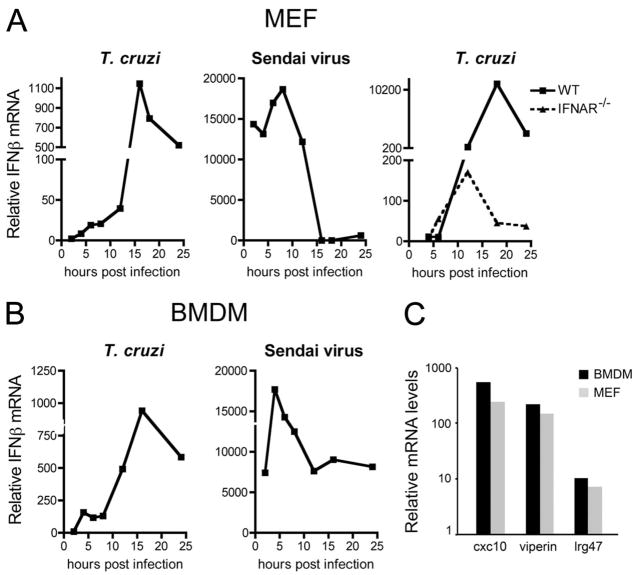
FIGURE 1
FIGURE 1
Kinetics of ifnb and ISG induction in T. cruzi-infected cells. Kinetics of IFN-β mRNA induction in WT or IFNAR−/− MEF (a) and BMDM (b) in response to T. cruzi or Sendai virus infection as determined by qRT-PCR. Induction of the ISGs cxcl10, viperin, and lrg47 in response to 16 h of T. cruzi infection was confirmed in BMDM and MEF by qRT-PCR (c). Values reported represent the mean fold induction relative to mock-infected controls.
FIGURE 2
FIGURE 2
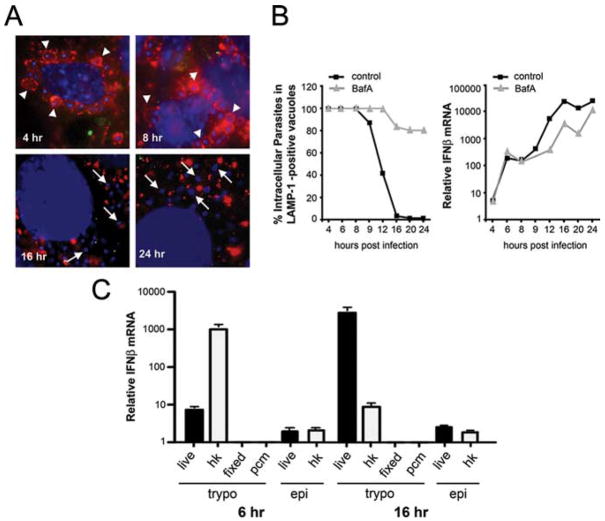
Intracellular localization is not required for ifnb induction in T. cruzi-infected cells. Kinetics of egress from the parasitophorous vacuole was examined by immunofluorescence staining (A). Extracellular parasites were stained with T. cruzi-specific Abs (green), vacuole membrane with Lamp-1 (red), host and parasite DNA (blue) in T. cruzi-infected MEF at 4, 8, 16, and 24 h after infection. A subset of parasites in Lamp-1-positive vacuoles is highlighted by arrowheads and arrows are used to indicate cytosolic parasites. Fibroblasts treated with (gray triangles) or without (black squares) 50 nM bafilomycin A (BafA) were infected with T. cruzi and the percentage of Lamp-1-positive parasites (B, first panel) or IFN-β mRNA (B, second panel) was quantitated. MEF were exposed to infective T. cruzi trypomastigotes (live trypos), heat-killed trypomastigotes (hk), aldehyde-fixed trypomastigotes (fixed), parasite-conditioned medium (pcm), live noninfective T. cruzi epimastigotes (epi), and heat-killed epimastigotes (hk epi) to induce ifnb. Transcription was determined by qRT-PCR at 6 and 16 h after infection (C). Values reported represent the mean fold induction relative to mock-infected controls ± SD.
FIGURE 3
FIGURE 3
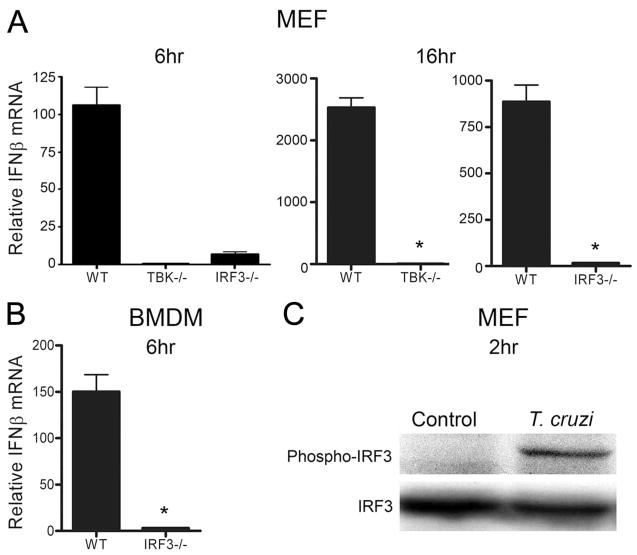
TBK1 and IRF3 are required for T. cruzi-induced IFN-β expression. ifnb transcript levels were measured by qRT-PCR in WT and IRF-3−/− or TBK1−/− MEF (A) and in IRF3−/− BMDM (B) following infection with T. cruzi for 6 and 16 h (MEF) or 6 h (BMDM). Values reported represent the mean fold induction relative to mock-infected controls ± SD. C, IRF3 is phosphorylated (Ser396) following a 2-h exposure of MEF to live T. cruzi trypomastigotes.
FIGURE 4
FIGURE 4
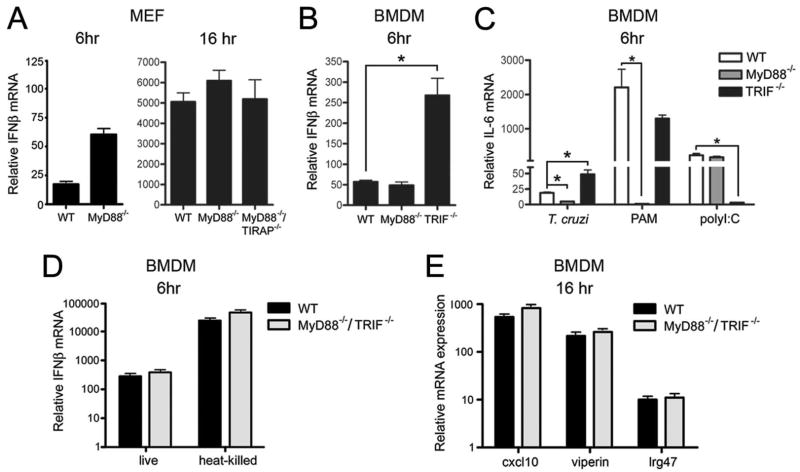
MyD88 and TRIF are not required for T. cruzi induction of IFN-β. Relative IFN-β mRNA levels were measured by qRT-PCR in T. cruzi-infected WT, MyD88−/−, and MyD88−/−/TIRAP−/− MEF 6 and/or 16 h after infection (A) or WT, MyD88−/−, and TRIF−/− BMDM 6 h after infection (B). Relative IL-6 mRNA levels were measured by qRT-PCR in WT, MyD88−/−, and TRIF−/− BMDM 6 h after infection with T. cruzi or treatment with Pam2Csk4 (PAM) or poly(I:C) (C). Relative induction of ifnb by live parasites or heat-killed T. cruzi trypomastigotes (D) and of the ISGs genes cxcl10, viperin, and lrg47 by live T. cruzi trypomastigotes (E) was determined by qRT-PCR in WT or MyD88−/−/TRIF−/− BMDM 16 h after exposure. Values reported represent the mean fold induction relative to mock-infected controls ± SD.
FIGURE 5
FIGURE 5
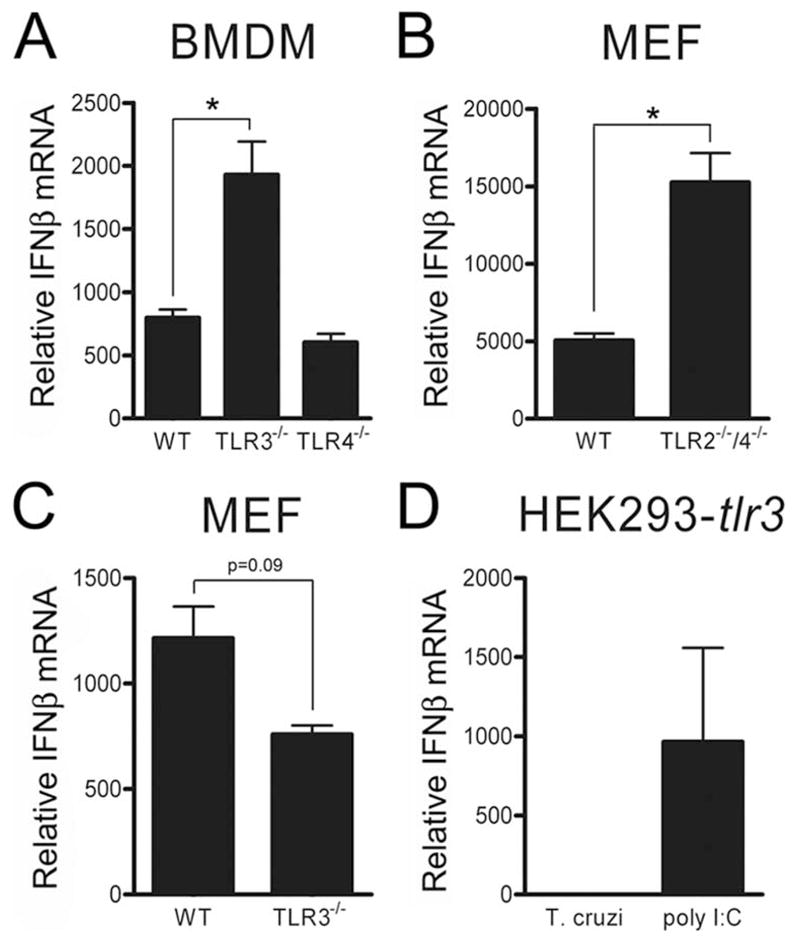
TLR3 and TLR4 are not required for T. cruzi induction of ifnb. Relative ifnb transcript abundance was measured by qRT-PCR in WT, TLR3−/−, and TLR4−/− BMDM (A), WT and TLR2−/−/TLR4−/− MEF (B), or WT and TLR3−/− MEF (C) following infection with T. cruzi for 16 h (MEF) or 6 h (BMDM). D, HEK293 cells stably expressing TLR3 HEK293-tlr3 were infected with T. cruzi or activated with the TLR3 ligand poly(I:C) for 16 h and relative IFN-β mRNA levels were measured by qRT-PCR. Values reported represent the mean fold induction relative to mock-infected controls ± SD.
FIGURE 6
FIGURE 6
T. cruzi triggers IFN-β expression independently of characterized cytosolic pathways. HEK293-IFN-β-luciferase reporter cells were transfected with dsRNA (poly(I:C)) or dsDNA (poly(dA:dT)) or infected with Sendai virus, L. monocytogenes, or T. cruzi. Luciferase activity (A) or endogenous IFN-β mRNA (B) was measured 24 h after treatment. Relative ifnb transcript abundance was measured by qRT-PCR in WT and MAVS−/− BMDM after 6 h of infection (C). Values reported represent the mean fold induction relative to mock-infected controls ± SD.

References

    1. Bogdan C, Mattner J, Schleicher U. The role of type I interferons in non-viral infections. Immunol Rev. 2004;202:33–48. - PubMed
    1. O’Riordan M, Yi CH, Gonzales R, Lee KD, Portnoy DA. Innate recognition of bacteria by a macrophage cytosolic surveillance pathway. Proc Natl Acad Sci USA. 2002;99:13861–13866. - PMC - PubMed
    1. Noppert SJ, Fitzgerald KA, Hertzog PJ. The role of type I interferons in TLR responses. Immunol Cell Biol. 2007;85:446–457. - PubMed
    1. Akira S, Uematsu S, Takeuchi O. Pathogen recognition and innate immunity. Cell. 2006;124:783–801. - PubMed
    1. Yoneyama M, Kikuchi M, Natsukawa T, Shinobu N, Imaizumi T, Miyagishi M, Taira K, Akira S, Fujita T. The RNA helicase RIG-I has an essential function in double-stranded RNA-induced innate antiviral responses. Nat Immunol. 2004;5:730–737. - PubMed

Publication types

MeSH terms