


Apoprotein E as a lipid transport and signaling protein in the blood, liver, and artery wall
- PMID: 19018038
- PMCID: PMC2674757
- DOI: 10.1194/jlr.R800058-JLR200
Apoprotein E as a lipid transport and signaling protein in the blood, liver, and artery wall
Abstract
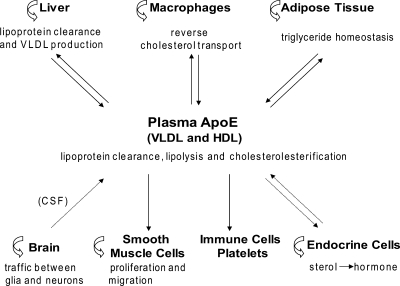
Apoprotein E (apoE) is synthesized by a number of tissues including the liver, brain, adipose tissue, and artery wall. The majority of apoE is found in the plasma associated with specific lipoprotein subclasses and is derived primarily from the liver. However the fact that apoE expression is sustained in nonhepatic tissues suggests that the local production must have some unique functional attribute. ApoE is involved in many steps in lipid and lipoprotein homeostasis, for the triglyceride-rich lipoproteins and for HDL. ApoE is also important for lipid homeostasis in the brain, artery wall, and adipose tissue through its synthesis by glial cells, adipocytes, and macrophages. In addition, nonlipid related functions have also been attributed to apoE, including effects on immune response and inflammation, oxidation, and smooth muscle proliferation and migration. Some of these effects have been shown to be dependent upon different domains of the protein, different concentrations, and lipidation state. Thus, this multifunctional protein impacts normal and pathophysiology at multiple levels.
Figures
References
-
- Dong L. M., and K. H. Weisgraber. 1996. Human apolipoprotein E4 domain interaction. Arginine 61 and glutamic acid 255 interact to direct the preference for very low density lipoproteins. J. Biol. Chem. 271 19053–19057. - PubMed
-
- Driscoll D. M., and G. S. Getz. 1984. Extrahepatic synthesis of apolipoprotein E. J. Lipid Res. 25 1368–1379. - PubMed
-
- Mahley R. W., and Z. S. Ji. 1999. Remnant lipoprotein metabolism: key pathways involving cell-surface heparan sulfate proteoglycans and apolipoprotein E. J. Lipid Res. 40 1–16. - PubMed
Publication types
MeSH terms
Substances
LinkOut - more resources
Full Text Sources
Miscellaneous
