Risk of suicide after suicide attempt according to coexisting psychiatric disorder: Swedish cohort study with long term follow-up
- PMID: 19018040
- PMCID: PMC2590902
- DOI: 10.1136/bmj.a2205
Risk of suicide after suicide attempt according to coexisting psychiatric disorder: Swedish cohort study with long term follow-up
Abstract
Objective: To investigate the impact of coexistent psychiatric morbidity on risk of suicide after a suicide attempt.
Design: Cohort study with follow-up for 21-31 years.
Setting: Swedish national register based study.
Participants: 39 685 people (53% women) admitted to hospital for attempted suicide during 1973-82.
Main outcome measure: Completed suicide during 1973-2003.
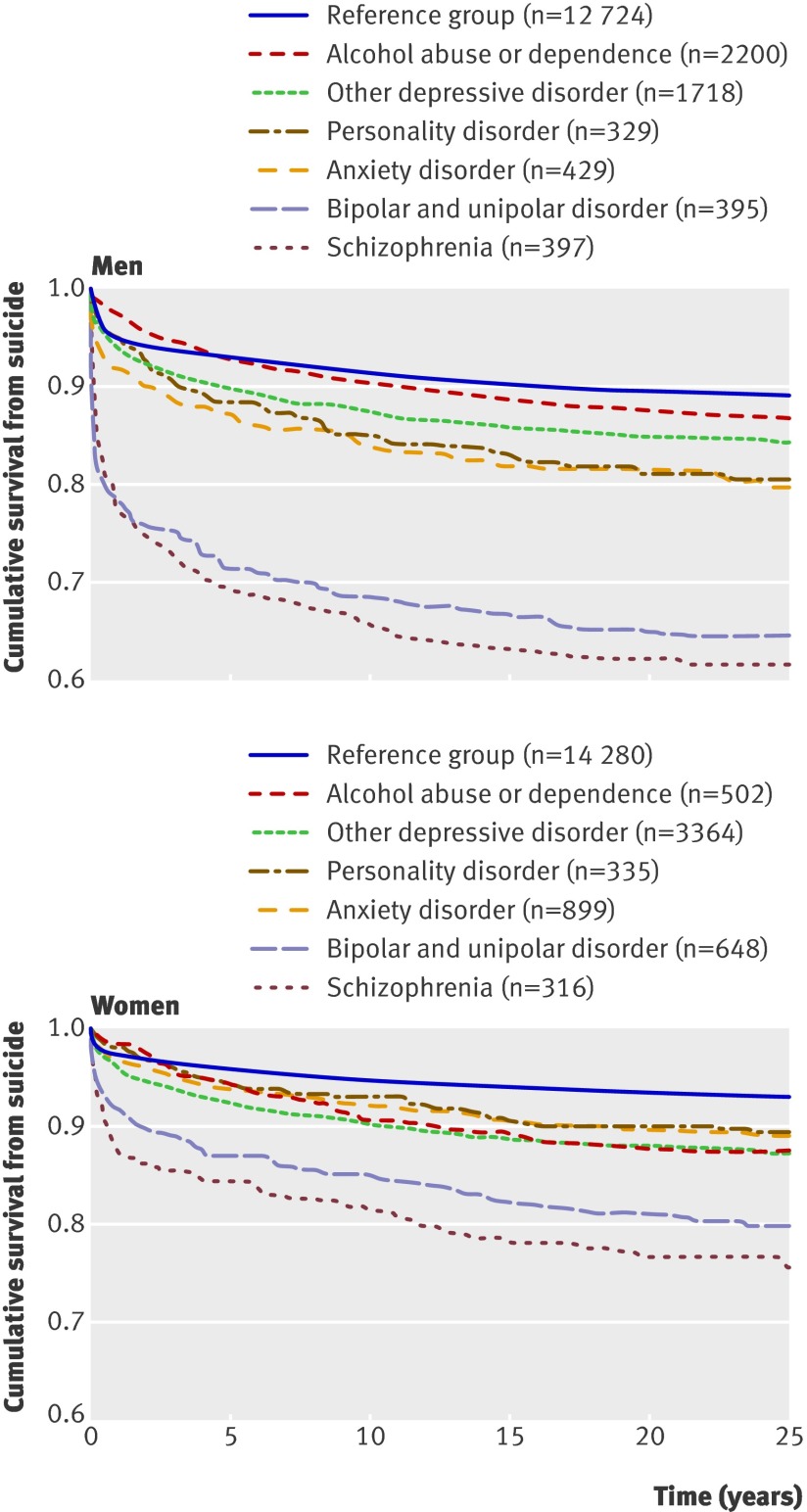
Results: A high proportion of suicides in all diagnostic categories took place within the first year of follow-up (14-64% in men, 14-54% in women); the highest short term risk was associated with bipolar and unipolar disorder (64% in men, 42% in women) and schizophrenia (56% in men, 54% in women). The strongest psychiatric predictors of completed suicide throughout the entire follow-up were schizophrenia (adjusted hazard ratio 4.1, 95% confidence interval 3.5 to 4.8 in men, 3.5, 2.8 to 4.4 in women) and bipolar and unipolar disorder (3.5, 3.0 to 4.2 in men, 2.5, 2.1 to 3.0 in women). Increased risks were also found for other depressive disorder, anxiety disorder, alcohol misuse (women), drug misuse, and personality disorder. The highest population attributable fractions for suicide among people who had previously attempted suicide were found for other depression in women (population attributable fraction 9.3), followed by schizophrenia in men (4.6), and bipolar and unipolar disorder in women and men (4.1 and 4.0, respectively).
Conclusion: Type of psychiatric disorder coexistent with a suicide attempt substantially influences overall risk and temporality for completed suicide. To reduce this risk, high risk patients need aftercare, especially during the first two years after attempted suicide among patients with schizophrenia or bipolar and unipolar disorder.
Conflict of interest statement
Competing interests: None declared.
Figures
Comment in
-
Suicide risk after a suicide attempt.BMJ. 2008 Nov 18;337:a2512. doi: 10.1136/bmj.a2512. BMJ. 2008. PMID: 19018042 No abstract available.
References
-
- De Moore GM, Robertson AR. Suicide in the 18 years after deliberate self-harm: a prospective study. Br J Psychiatry 1996;169:489-94. - PubMed
-
- Owens D, Horrocks J, House A. Fatal and non-fatal repetition of self-harm. Systematic review. Br J Psychiatry 2002;181:193-9. - PubMed
-
- Suokas J, Suominen K, Isometsä E, Ostamo A, Lönnqvist J. Long-term risk factors for suicide mortality after attempted suicide—findings of a 14-year follow-up study. Acta Psychiatr Scand 2001;104:117-21. - PubMed
-
- Suominen K, Isometsä E, Suokas J, Haukka J, Achte K, Lönnqvist J. Completed suicide after a suicide attempt: a 37-year follow-up study. Am J Psychiatry 2004;161:562-3. - PubMed
Publication types
MeSH terms
LinkOut - more resources
Full Text Sources
Medical