


Lipoprotein-associated phospholipase A2 activity and risk of recurrent stroke
- PMID: 19018137
- PMCID: PMC2846303
- DOI: 10.1159/000172633
Lipoprotein-associated phospholipase A2 activity and risk of recurrent stroke
Abstract
Background: Mass levels of lipoprotein-associated phospholipase A(2) (Lp-PLA(2)), a leukocyte-derived enzyme involved in the metabolism of low-density lipoprotein to pro-inflammatory mediators, are associated with prognosis after stroke. Lp-PLA(2) mass correlates only moderately with levels of Lp-PLA(2) activity. The relationship of Lp-PLA(2) activity to risk of stroke recurrence is unknown. We hypothesized that Lp-PLA(2) activity levels would predict risk of recurrence.
Methods: In the population-based Northern Manhattan Stroke Study, first ischemic stroke patients >or=40 years were followed for recurrent stroke. Levels of Lp-PLA(2) activity were assessed in 467 patients, and categorized by quartile. Cox proportional hazard models were used to calculate hazard ratios (HR) and 95% confidence intervals (95% CI) for risk of recurrent stroke associated with marker quartiles after adjusting for demographics, vascular risk factors, and high-sensitivity C-reactive protein (hsCRP).
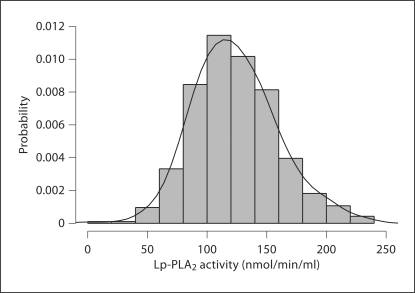
Results: Mean age was 68.9 +/- 12.7 years; 54.6% were women; 53.3% Hispanic, 27.2% black, and 17.8% white. Median follow-up was 4.0 years, and there were 80 recurrent strokes. Compared to the lowest quartile of Lp-PLA(2) activity, those in the highest had an increased risk of recurrent stroke (adjusted HR 2.54, 95% CI 1.01-6.39).
Conclusion: Stroke patients with Lp-PLA(2) activity levels in the highest quartile, compared to those in the lowest quartile, had an increased risk of recurrence after first ischemic stroke. Further studies are warranted to determine whether this biomarker has clinical utility in determining high-risk populations of stroke survivors, and whether anti-inflammatory strategies that reduce levels of activity of Lp-PLA(2) reduce the risk of stroke recurrence.
Copyright 2008 S. Karger AG, Basel.
Figures

References
-
- Ross R. Atherosclerosis – an inflammatory disease. N Engl J Med. 1999;340:115–126. - PubMed
-
- Elkind MS, Cheng J, Boden-Albala B, Paik MC, Sacco RL. Elevated white blood cell count and carotid plaque thickness: the Northern Manhattan Stroke Study. Stroke. 2001;32:842–849. - PubMed
-
- Elkind MS, Sciacca R, Boden-Albala B, Rundek T, Paik MC, Sacco RL. Relative elevation in leukocyte count predicts first cerebral infarction. Neurology. 2005;64:2121–2125. - PubMed
-
- Pearson TA, Mensah GA, Alexander RW, Anderson JL, Cannon RO, 3rd, Criqui M, Fadl YY, Fortmann SP, Hong Y, Myers GL, Rifai N, Smith SC, Jr, Taubert K, Tracy RP, Vinicor F. Markers of inflammation and cardiovascular disease. Application to clinical and public health practice. A statement for healthcare professionals from the Centers for Disease Control and Prevention and the American Heart Association. Circulation. 2003;107:499–511. - PubMed
-
- Kannel WB, Anderson K, Wilson PW. White blood cell count and cardiovascular disease. Insights from the Framingham Study. JAMA. 1992;267:1253–1256. - PubMed
Publication types
MeSH terms
Substances
Grants and funding
LinkOut - more resources
Full Text Sources
Medical
Research Materials
