


Antibody epitope peptides as potential inducers of IgG antibodies against CD98 oncoprotein
- PMID: 19018757
- PMCID: PMC11159124
- DOI: 10.1111/j.1349-7006.2008.00998.x
Antibody epitope peptides as potential inducers of IgG antibodies against CD98 oncoprotein
Abstract
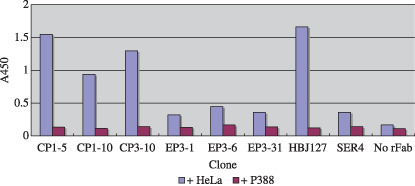
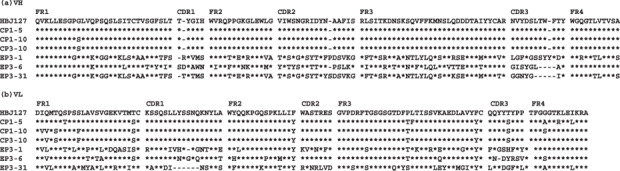
An epitope is an antibody-recognition site on a target antigen. As such, active immunization of epitope peptides may induce therapeutic efficacy equivalent to the administration of parent antibody medicines. In the present study, we designed peptides based on the epitope recognized by the tumor-suppresive anti-CD98 monoclonal antibody HBJ127, and investigated their efficacy for induction of antitumor immunity. The immune sera showed reactivity against the corresponding peptide-keyhole limpet hemocyanin (KLH) and peptide-bovine serum abumin (BSA) conjugates, although they did not react with CD98-positive HeLa cells or recombinant CD98 heavy chain. To elucidate whether the epitope peptide failed to induce antitumor immunity or not, we constructed the IgG1, kappa Fab phage display libraries from spleen cells of immunized mice and tried to retrieve CD98-reactive recombinant Fab (rFab) fragments by panning against either epitope peptide-BSA conjugates or live HeLa cells. RFab fragments retrieved from peptide-BSA panning showed no reactivity to HeLa cells. Their variable-region sequences were different from HBJ127. However, rFab fragments retrieved from HeLa cell panning showed reactivity to CD98 by indirect immunofluorescence and immunoprecipitation. Moreover, they were structurally almost identical to HBJ127. Although the immunogenicity of epitope peptides may be insufficient for induction of expected antitumor activity in vivo, we used antibody phage display to show that IgG antibodies almost identical to HBJ127 were an undetectable population in epitope peptide-induced immune sera.
Figures




References
-
- Haynes BF, Hemler ME, Mann DL et al . Characterization of a monoclonal antibody (4F2) that binds to human monocytes and to a subset of activated lymphocytes. J Immunol 1981; 126: 1409–14. - PubMed
-
- Kanai Y, Segawa H, Miyamoto K, Uchino H, Takeda E, Endou H. Expression cloning and characterization of a transporter for large neutral amino acids activated by the heavy chain of 4F2 antigen (CD98). J Biol Chem 1998; 273: 23 629–32. - PubMed
-
- Hashimoto Y, Masuko T, Yagita H, Endo N, Kanazawa J, Tazawa J. A proliferation‐associated rat cell surface antigen recognized by a murine monoclonal antibody. Gann 1983; 74: 819–21. - PubMed
-
- Masuko T, Abe J, Yagita H, Hashimoto Y. Human bladder cancer cell‐surface antigens recognized by murine monoclonal antibodies raised against T24 bladder cancer cells. Jpn J Cancer Res 1985; 76: 386–94. - PubMed
Publication types
MeSH terms
Substances
LinkOut - more resources
Full Text Sources
Research Materials
