


IL1beta- and LPS-induced serotonin secretion is increased in EC cells derived from Crohn's disease
- PMID: 19019013
- PMCID: PMC4040949
- DOI: 10.1111/j.1365-2982.2008.01210.x
IL1beta- and LPS-induced serotonin secretion is increased in EC cells derived from Crohn's disease
Abstract
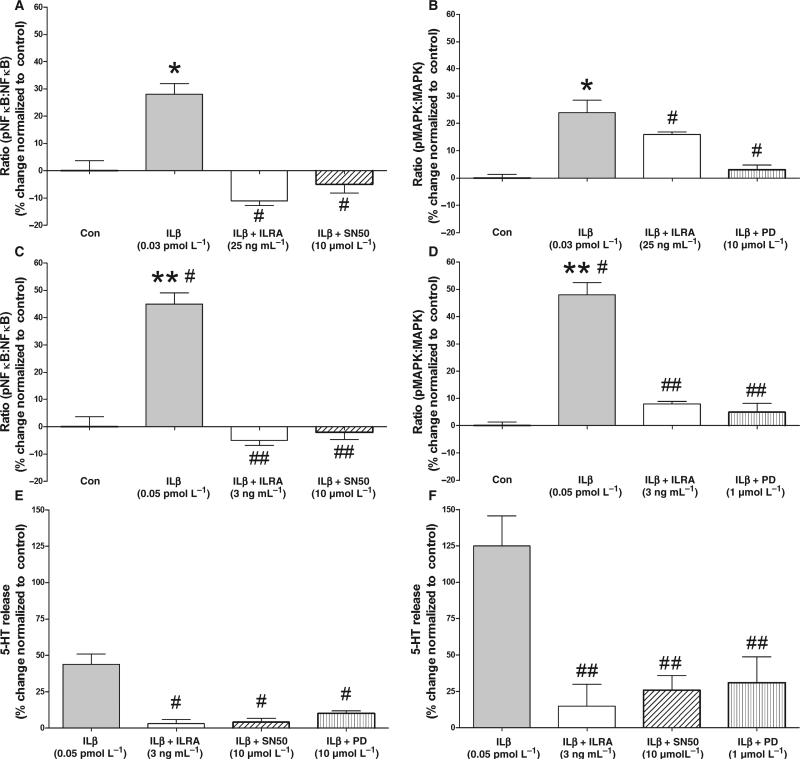
Gut mucosal enterochromaffin (EC) cells are regarded as key regulators of intestinal motility and fluid secretion via secretion of serotonin (5HT), are increased in numbers in mucosal inflammation and located in close proximity to immune cells. We examined whether interleukin (IL)1beta and Escherichia coli lipopolysaccharide (LPS) induced EC cell 5HT release through Toll-like/IL-1 (TIL) receptor activation, nuclear factor kappa B (NFkappaB) and mitogen-activated protein kinase (MAPK) phosphorylation and evaluated whether somatostatin could inhibit this phenomenon. Pure (>98%) human intestinal EC cells were isolated by fluorescent activated cell sorting from preparations of normal (n = 5) and Crohn's colitis (n = 6) mucosa. 5HT release was measured (ELISA), and NFkappaB and ERK phosphorylation quantitated (ELISA) in response to IL1beta and LPS. 5HT secretion was increased by both E. coli LPS (EC(50) = 5 ng mL(-1)) and IL1beta (EC(50) = 0.05 pmol L(-1)) >2-fold (P < 0.05) in Crohn's EC cells compared with normal EC cells. Secretion was reversible by the TLR4 antagonist, E. coli K12 LPS (IC(50) = 12 ng mL(-1)) and the IL1beta receptor antagonist (ILRA; IC(50) = 3.4 ng mL(-1)). IL1beta caused significant (P < 0.05) NFkappaB and MAPK phosphorylation (40-55%). The somatostatin analogue, lanreotide inhibited IL1beta-stimulated secretion in Crohn's (IC(50) = 0.61 nmol L(-1)) and normal EC cells (IC(50) = 1.8 nmol L(-1)). Interleukins (IL1beta) and bacterial products (E. coli LPS) stimulated 5HT secretion from Crohn's EC cells via TIL receptor activation (TLR4 and IL1beta). Immune-mediated alterations in EC cell secretion of 5HT may represent a component of the pathogenesis of abnormal bowel function in Crohn's disease. Inhibition of EC cell-mediated 5HT secretion may be an alternative therapeutic strategy in the amelioration of inflammatory bowel disease symptomatology.
Figures


References
-
- Crowell MD, Shetzline MA, Moses PL, Mawe GM, Talley NJ. Enterochromaffin cells and 5-HT signaling in the pathophysiology of disorders of gastrointestinal function. Curr Opin Investig Drugs. 2004;5:55–60. - PubMed
-
- Thompson A, Keelman M, Thiesen A, Clandinin M, Ropeleski M, Wild G. Small bowel review: normal physiology part 2. Dig Dis Sci. 2001;46:2588–607. - PubMed
-
- Yang GB, Lackner AA. Proximity between 5-HT secreting enteroendocrine cells and lymphocytes in the gut mucosa of rhesus macaques (Macaca mulatta) is suggestive of a role for enterochromaffin cell 5-HT in mucosal immunity. J Neuroimmunol. 2004;146:46–9. - PubMed
Publication types
MeSH terms
Substances
Grants and funding
LinkOut - more resources
Full Text Sources
Medical
Miscellaneous
