


T-614, a novel immunomodulator, attenuates joint inflammation and articular damage in collagen-induced arthritis
- PMID: 19019215
- PMCID: PMC2656239
- DOI: 10.1186/ar2554
T-614, a novel immunomodulator, attenuates joint inflammation and articular damage in collagen-induced arthritis
Abstract
Introduction: T-614 is a novel oral antirheumatic agent for the treatment of rheumatoid arthritis. Whether it has immunomodulatory or disease-modifying properties and its mechanism of action are largely undetermined.
Methods: Rats with collagen-induced arthritis (CIA) were treated with T-614 (5 and 20 mg/kg) daily. Animals receiving methotrexate (1 mg/kg every 3 days) and the nonsteroidal anti-inflammatory agent nimesulide (10 mg/kg per day) were used as controls. A combination therapy group was treated with both T-614(10 mg/kg per day) and methotrexate (1 mg/kg every 3 days). Hind paw swelling was evaluated and radiographic scores calculated. Serum cytokine levels were assessed by Bio-plex analysis. Quantitative PCR was used to evaluate expression of mRNA for interferon-gamma, IL-4 and IL-17. Serum IL-17 and anti-type II collagen antibodies (total IgG, IgG1, IgG2a, IgG2b and IgM) were measured using ELISA.
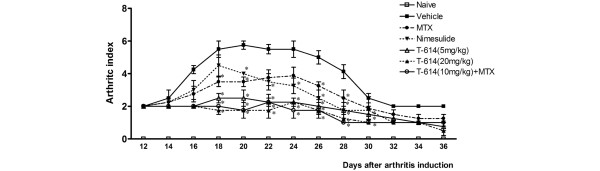
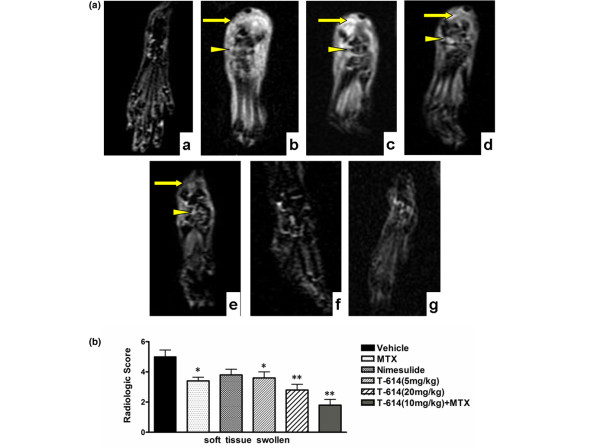
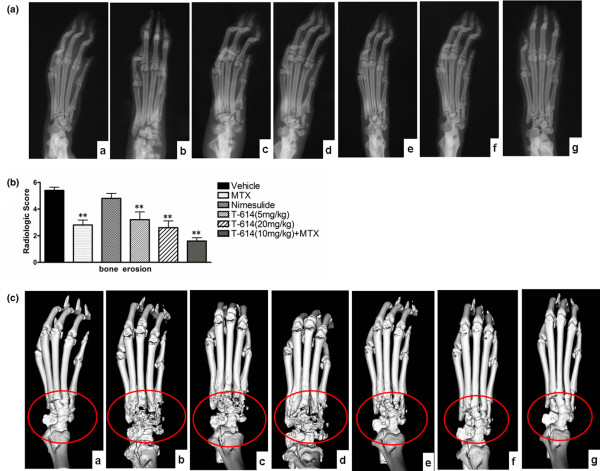
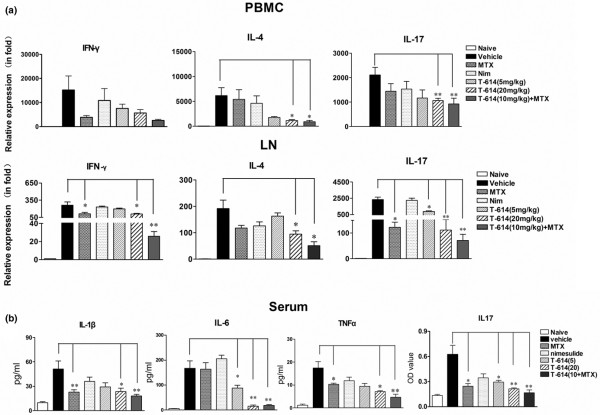
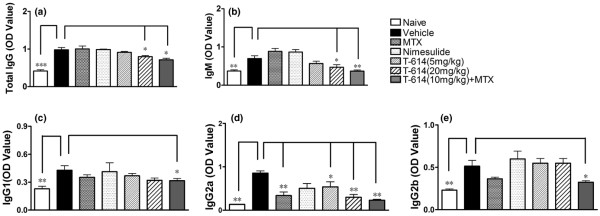
Results: Oral T-614 inhibited paw swelling and offered significant protection against arthritis-induced cartilage and bone erosion, comparable to the effects of methotrexate. CIA rats treated with T-614 exhibited decreases in both mRNA expression of IL-17 in peripheral blood mononuclear cells and lymph node cells, and circulating IL-17 in a dose-dependent manner. T-614 also reduced serum levels of tumor necrosis factor-alpha, IL-1beta and IL-6. A synergistic effect was observed for the combination of methotrexate and T-614. In addition, T-614 (20 mg/kg per day) depressed production of anti-type II collagen antibodies and differentially affected levels of IgG2a subclasses in vivo, whereas IgM level was decreased without any change in the IgG1 level. Together, the findings presented here indicate that the novel agent T-614 has disease-modifying effects against experimental arthritis, as opposed to nimesulide.
Conclusions: Our data suggested that T-614 is an effective disease-modifying agent that can prevent bone/cartilage destruction and inflammation in in CIA rats. Combination with methotrexate markedly enhances the therapeutic effect of T-614.
Figures
References
-
- Tanaka K, Yamamoto T, Aikawa Y, Kizawa K, Muramoto K, Matsuno H, Muraguchi A. Inhibitory effects of an anti-rheumatic agent T-614 on immunoglobulin production by cultured B cells and rheumatoid synovial tissues engrafted into SCID mice. Rheumatology (Oxford) 2003;42:1365–1371. doi: 10.1093/rheumatology/keg381. - DOI - PubMed
-
- Sawada T, Hashimoto S, Tohma S, Nishioka Y, Nagai T, Sato T, Ito K, Inoue T, Iwata M, Yamamoto K. Inhibition of L-leucine methyl ester mediated killing of THP-1, a human monocytic cell line, by a new anti-inflammatory drug, T614. Immunopharmacology. 2000;49:285–294. doi: 10.1016/S0162-3109(00)00242-3. - DOI - PubMed
-
- Lu LJ, Teng JL, Bao CD, Han XH, Sun LY, Xu JH, Li XF, Wu HX. Safety and efficacy of T-614 in the treatment of patients with active rheumatoid arthritis: a double blind, randomized, placebo-controlled and multicenter trial. Chin Med J (Engl) 2008;121:615–619. - PubMed
Publication types
MeSH terms
Substances
LinkOut - more resources
Full Text Sources
Other Literature Sources
