Insecticide-treated net coverage in Africa: mapping progress in 2000-07
- PMID: 19019422
- PMCID: PMC2652031
- DOI: 10.1016/S0140-6736(08)61596-2
Insecticide-treated net coverage in Africa: mapping progress in 2000-07
Abstract
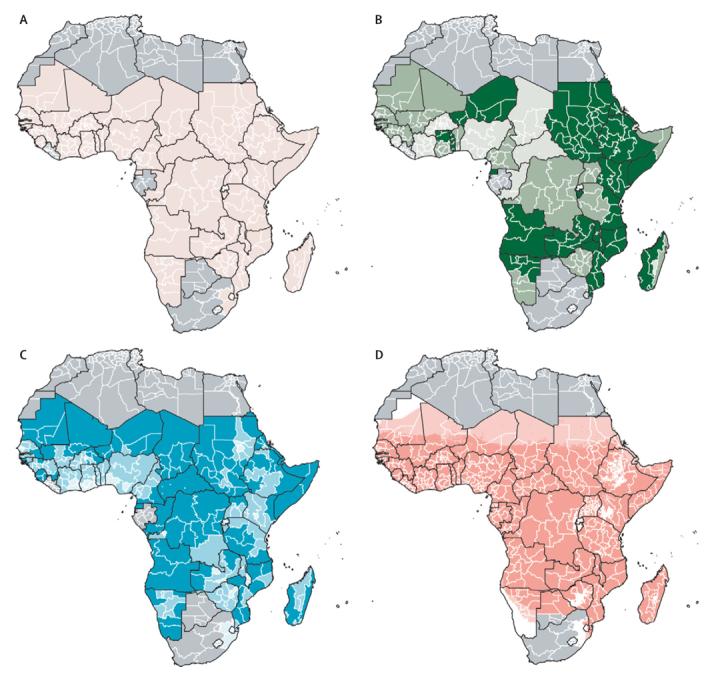
Background: Insecticide-treated bednets (ITNs) provide a means to improve child survival across Africa. Sales figures of these nets and survey coverage data presented nationally mask inequities in populations at biological and economic risk, and do not allow for precision in the estimation of unmet commodity needs. We gathered subnational ITN coverage sample survey data from 40 malaria-endemic countries in Africa between 2000 and 2007.
Methods: We computed the projected ITN coverage among children aged less than 5 years for age-adjusted population data that were stratified according to malaria transmission risks, proximate determinants of poverty, and methods of ITN delivery.
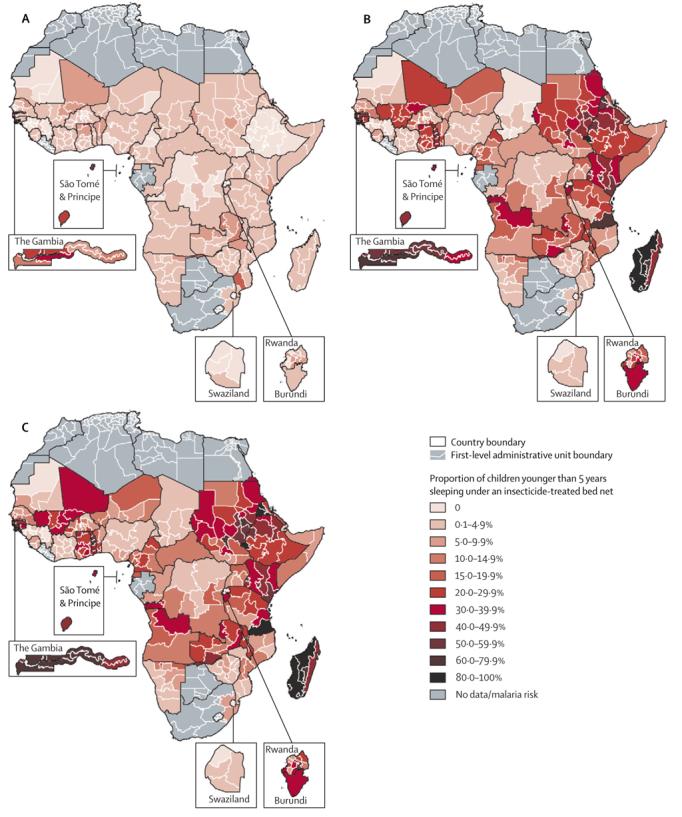
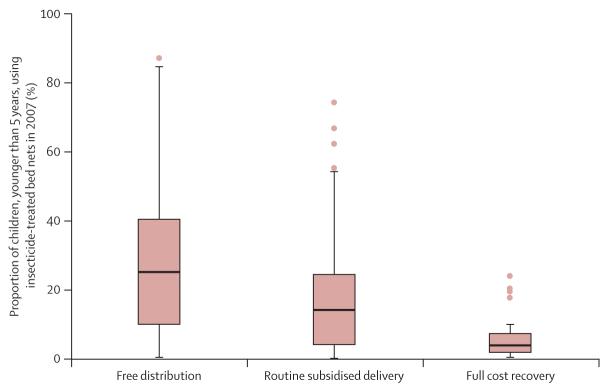
Findings: In 2000, only 1.7 million (1.8%) African children living in stable malaria-endemic conditions were protected by an ITN and the number increased to 20.3 million (18.5%) by 2007 leaving 89.6 million children unprotected. Of these, 30 million were living in some of the poorest areas of Africa: 54% were living in only seven countries and 25% in Nigeria alone. Overall, 33 (83%) countries were estimated to have ITN coverage of less than 40% in 2007. On average, we noted a greater increase in ITN coverage in areas where free distribution had operated between survey periods.
Interpretation: By mapping the distribution of populations in relation to malaria risk and intervention coverage, we provide a means to track the future requirements for scaling up essential disease-prevention strategies. The present coverage of ITN in Africa remains inadequate and a focused effort to improve distribution in selected areas would have a substantial effect on the continent's malaria burden.
Figures
Comment in
-
Malaria scale-up progress: is the glass half-empty or half-full?Lancet. 2009 Jan 3;373(9657):11-3. doi: 10.1016/S0140-6736(08)61597-4. Epub 2008 Nov 18. Lancet. 2009. PMID: 19019423 No abstract available.
-
Neglected tropical diseases and the Global Fund.Lancet. 2009 Jan 24;373(9660):296-7. doi: 10.1016/S0140-6736(09)60089-1. Lancet. 2009. PMID: 19167564 No abstract available.
References
-
- Grabowsky M. The billion-dollar question. Nature. 2008;451:1051–52. - PubMed
-
- Teklehaimanot A, McCord GC, Sachs JD. Scaling up malaria control in Africa: an economic and epidemiological assessment. Am J Trop Med Hyg. 2007;77:138–44. - PubMed
-
- UN . Road map towards the implementation of the United Nations millennium declaration. United Nations General Assembly; 2001. A/56/326. http://www.un.org/ (accessed July 17, 2007)
-
- UNICEF . Progress in Intervention Coverage. The United Nations Children's Fund (UNICEF); New York: 2007. Malaria and Children. http://www.unicef.org/health/files/Malaria_Oct6_for_web(1).pdf (accessed Jan 28, 2008)
Publication types
MeSH terms
Substances
Grants and funding
LinkOut - more resources
Full Text Sources