


Need-service matching in substance abuse treatment: racial/ethnic differences
- PMID: 19019434
- PMCID: PMC2975433
- DOI: 10.1016/j.evalprogplan.2008.09.003
Need-service matching in substance abuse treatment: racial/ethnic differences
Abstract
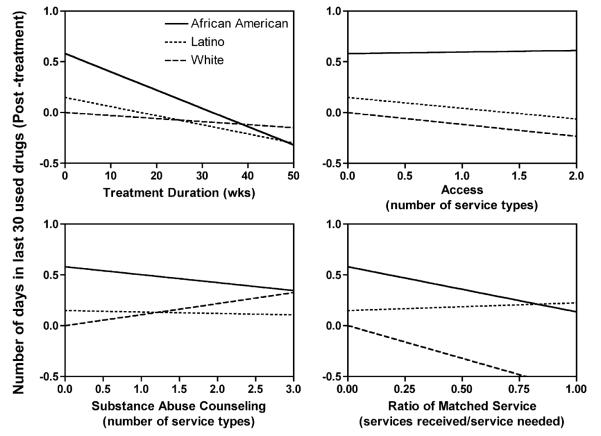
This study examines the impact of ancillary health and social services matched to client needs in substance abuse treatment for African Americans, Latinos and Whites. The study uses data collected from 1992 to 1997 for the National Treatment Improvement Evaluation Study, a prospective cohort study of substance abuse treatment programs and their clients. The analytic sample consists of 3142 clients (1812 African Americans, 486 Latinos, 844 Whites) from 59 treatment facilities. Results show that racial/ethnic minorities are underserved compared to Whites in the substance abuse service system. Different racial/ethnic groups come into treatment with distinct needs and receive distinct services. Although groups respond differentially to service types, substance abuse counseling and matching services to needs is an effective strategy both for retaining clients in treatment and for reducing post-treatment substance use for African Americans and Whites. Receipt of access services was related to reduced post-treatment substance use for Latinos. Study findings are relevant to planning special services for African Americans and Latinos.
Figures
References
-
- Agosti V, Nunes E, Ocepek-Welikson K. Patient factors related to early attrition from an outpatient cocaine research clinic. American Journal of Drug Alcohol Abuse. 1996;22:29–39. - PubMed
-
- Alegria M, Page JB, Hansen H, Cauce AM, Robles R, Blanco C, et al. Improving drug treatment services for Hispanics: Research gaps and scientific opportunities. Drug and Alcohol Dependence. 2006;84S:S76–S84. - PubMed
-
- Alvarez J, Olsen BD, Jason LA, Davis MI, Ferrari JR. Heterogeneity among Latina and Latinos entering substance abuse treatment: Findings from a national database. Journal of Substance Abuse Treatment. 2004;26:277–284. - PubMed
-
- Baron RM, Kenny DA. The moderator–mediator variables distinction in social psychological research: Conceptual, strategic, and statistical considerations. Journal of Personality and Social Psychology. 1986;51:1173–1182. - PubMed
Publication types
MeSH terms
Grants and funding
LinkOut - more resources
Full Text Sources
Medical
