


Hantaan virus nucleocapsid protein binds to importin alpha proteins and inhibits tumor necrosis factor alpha-induced activation of nuclear factor kappa B
- PMID: 19019947
- PMCID: PMC2620888
- DOI: 10.1128/JVI.00986-08
Hantaan virus nucleocapsid protein binds to importin alpha proteins and inhibits tumor necrosis factor alpha-induced activation of nuclear factor kappa B
Abstract
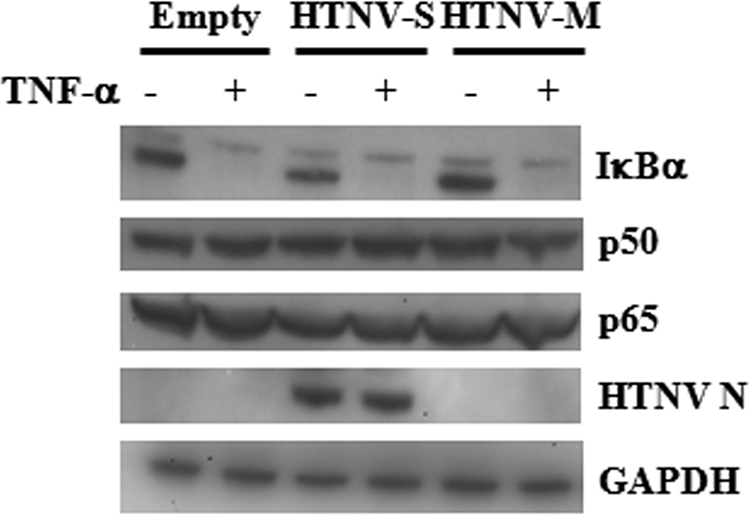
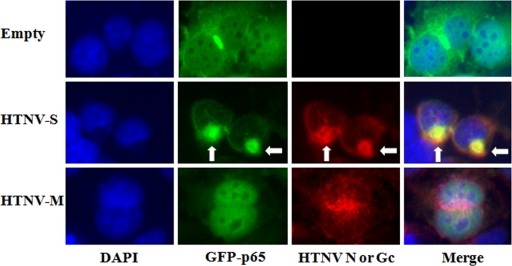
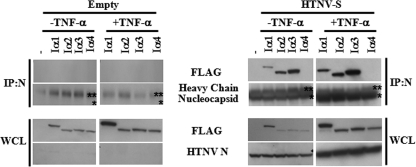
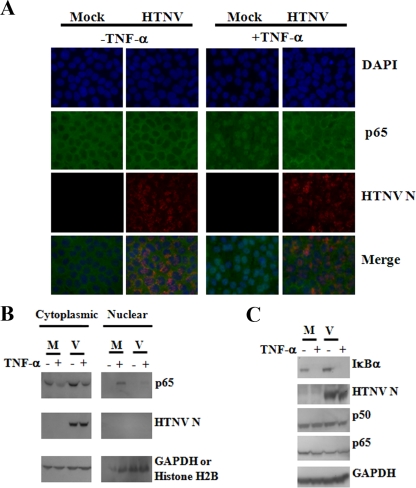
Hantaviruses such as Hantaan virus (HTNV) and Andes virus cause two human diseases, hemorrhagic fever with renal syndrome and hantavirus pulmonary syndrome, respectively. For both, disease pathogenesis is thought to be immunologically mediated and there have been numerous reports of patients with elevated levels of proinflammatory and inflammatory cytokines, including tumor necrosis factor alpha (TNF-alpha), in their sera. Multiple viruses have developed evasion strategies to circumvent the host cell inflammatory process, with one of the most prevalent being the disruption of nuclear factor kappa B (NF-kappaB) activation. We hypothesized that hantaviruses might also moderate host inflammation by interfering with this pathway. We report here that the nucleocapsid (N) protein of HTNV was able to inhibit TNF-alpha-induced activation of NF-kappaB, as measured by a reporter assay, and the activation of endogenous p65, an NF-kappaB subunit. Surprisingly, there was no defect in the degradation of the inhibitor of NF-kappaB (IkappaB) protein, nor was there any alteration in the level of p65 expression in HTNV N-expressing cells. However, immunofluorescence antibody staining demonstrated that cells expressing HTNV N protein and a green fluorescent protein-p65 fusion had limited p65 nuclear translocation. Furthermore, we were able to detect an interaction between HTNV N protein and importin alpha, a nuclear import molecule responsible for shuttling NF-kappaB to the nucleus. Collectively, our data suggest that HTNV N protein can sequester NF-kappaB in the cytoplasm, thus inhibiting NF-kappaB activity. These findings, which were obtained using cells transfected with cDNA representing the HTNV N gene, were confirmed using HTNV-infected cells.
Figures
References
-
- Baeuerle, P. A., and D. Baltimore. 1996. NF-kappa B: ten years after. Cell 8713-20. - PubMed
-
- Beg, A. A., S. M. Ruben, R. I. Scheinman, S. Haskill, C. A. Rosen, and A. S. Baldwin, Jr. 1992. I kappa B interacts with the nuclear localization sequences of the subunits of NF-kappa B: a mechanism for cytoplasmic retention. Genes Dev. 6:1899-1913. - PubMed
-
- Conti, E., M. Uy, L. Leighton, G. Blobel, and J. Kuriyan. 1998. Crystallographic analysis of the recognition of a nuclear localization signal by the nuclear import factor karyopherin alpha. Cell 94193-204. - PubMed
-
- Cunningham, M. D., J. Cleaveland, and S. G. Nadler. 2003. An intracellular targeted NLS peptide inhibitor of karyopherin alpha:NF-kappa B interactions. Biochem. Biophys. Res. Commun. 300403-407. - PubMed
Publication types
MeSH terms
Substances
LinkOut - more resources
Full Text Sources
Other Literature Sources
