. 2008 Dec 2;105(48):18735-9.
doi: 10.1073/pnas.0810518105. Epub 2008 Nov 19.

Restoration of electron transport without proton pumping in mammalian mitochondria

Affiliations

Restoration of electron transport without proton pumping in mammalian mitochondria

Ester Perales-Clemente et al. Proc Natl Acad Sci U S A. .

Abstract

We have restored the CoQ oxidative capacity of mouse mtDNA-less cells (rho degrees cells) by transforming them with the alternative oxidase Aox of Emericella nidulans. Cotransforming rho degrees cells with the NADH dehydrogenase of Saccharomyces cerevisiae, Ndi1 and Aox recovered the NADH DH/CoQ reductase and the CoQ oxidase activities. CoQ oxidation by AOX reduces the dependence of rho degrees cells on pyruvate and uridine. Coexpression of AOX and NDI1 further improves the recycling of NAD(+). Therefore, 2 single-protein enzymes restore the electron transport in mammalian mitochondria substituting >80 nuclear DNA-encoded and 11 mtDNA-encoded proteins. Because those enzymes do not pump protons, we were able to split electron transport and proton pumping (ATP synthesis) and inquire which of the metabolic deficiencies associated with the loss of oxidative phosphorylation should be attributed to each of the 2 processes.


Conflict of interest statement

The authors declare no conflict of interest.

Figures
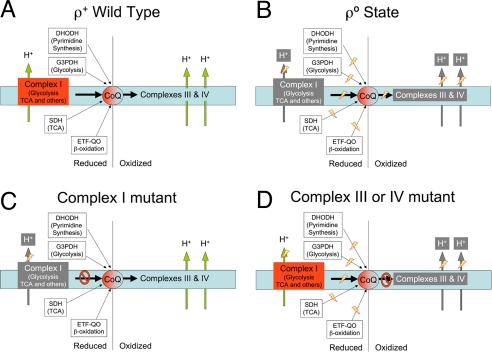
Fig. 1.
Fig. 1.
CoQ role in the mitochondrial electron transport chain (mtETC). Schematic representation of the respiratory chain status (electron flow and proton pumping activities) in wild-type (ρ+) cells (A), mtDNA-less (ρ°) cells (B), and in cells with knockout mutations in either complex I (C) or in complexes III or IV (D). The pivotal role of CoQ as electron acceptor from different routes and as electron donor to complexes III and IV is highlighted. DHODH, dihydroorotate dehydrogenase; G3PDH, glycerol-3-phosphate dehydrogenase (glycerol-phosphate shuttle); SDH, succinate dehydrogenase; ETF-QO, electron-transfer flavoprotein-ubiquinone oxidoreductase; TCA, tricarboxylic acid cycle.
Fig. 2.
Fig. 2.
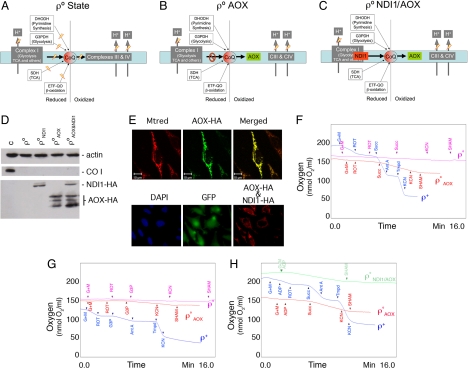
Partial or total reconstruction of the mitochondrial respiratory chain in ρ° cells with exogenous enzymes. (A–E) MtETC status in ρ° cells (A) and in the same cells expressing Emericella nidulans alternative oxidase AOX (B) or AOX plus Saccharomyces cerevisiae NADH dehydrogenase NDI1 (C). Western blots showing the expression of actin, of mtDNA encoded COX subunit I or of the exogenous enzymes NDI1 and/or AOX in the indicated cell line, where C represented ρ+ cells (D). (E) (Upper) Subcellular localization of AOX in ρ°AOX cells immunostained for the HA epitope (green) and costained for mitochondria with Mito Tracker red. (Lower) Subcellular localization of NDI1 and AOX in ρ°NDI1/AOX cells immunostained for the HA epitope (red). Green color shows the expression of GFP as a marker for cell transfection with NDI1 expressing vector and blue color shows the staining of cell nucleus with DAPI. (F–H) Polarographic traces showing the respiratory activity of the indicated cell lines (F and G) ρ+: 5 × 10⁶ cells, ρ° and ρ°AOX: 107 cells or isolated mitochondria (H) (0.5–1.0 mg of total protein) in the presence of different substrates and inhibitors. DHODH, dihydroorotate dehydrogenase; G3PDH, glycerol-3-phosphate dehydrogenase (glycerol-phosphate shuttle); SDH, succinate dehydrogenase; ETF-QO, electron-transfer flavoprotein-ubiquinone oxidoreductase; TCA, tricarboxylic acid cycle; Mtrred, Mito Tracker red, HA, hemagglutinin epitope; G+M, glutamate plus malate; ROT, rotenone; Succ, succinate; Ant A, antimycin A; Tmpd, N,N,N′, N′-tetramethyl-p-phenylenediamine; KCN, potassium cyanide; SHAM, salicylhydroxamic acid.
Fig. 3.
Fig. 3.
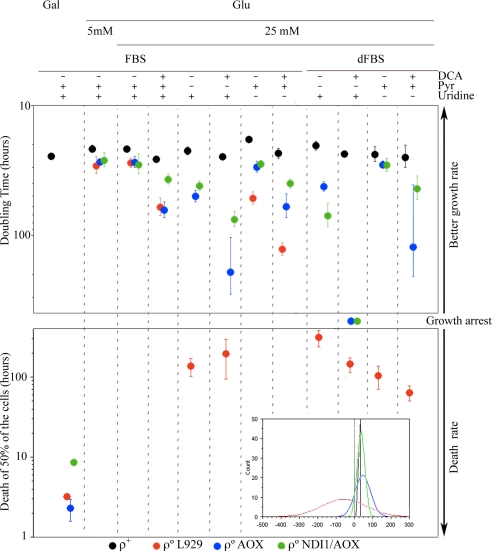
Consequences on cell growth due to the mtETC recovery by AOX or NDI1 and AOX expression. (Inset) Frequency distribution of the growth and/or death rates (as negative values) obtained for each cell type and adjusted to a normal distribution. ρ+ cells, black profile; ρ° cells, red profile; ρ°AOX cells, blue profile; ρ°NDI1/AOX, green profile. Effect of AOX or NDI1+AOX expression on cell growth (DT) and survival under the indicated culture conditions. Data for different media are expressed as mean ± standard deviation being n (from left to right in the figure) = 3, 3, 4, 4, 5, 5, 3, 3, 3, 3, 4, 5 for ρ+; n = 3, 3, 4, 4, 4, 4, 3, 3,3, 3, 4, 5 for ρ°; n = 3, 3, 4, 3, 5, 3, 3, 3, 3, 3, 4, 4 for ρ°AOX; n = 3, 3, 4, 3, 4, 3, 3, 3, 3, 3,4, 4 for ρ°NDI1/AOX. The significance of the mean differences was determined by the ANOVA, Fisher's PLSD test. Gal, galactose; Glu, glucose; DCA, sodium dichloro acetate (15 mM); Uri, uridine (0.2 mM); Pyr, pyruvate (1 mM); CM, complete medium containing uridine and pyruvate; dFBS, dialyzed fetal bovine serum.
Fig. 4.
Fig. 4.
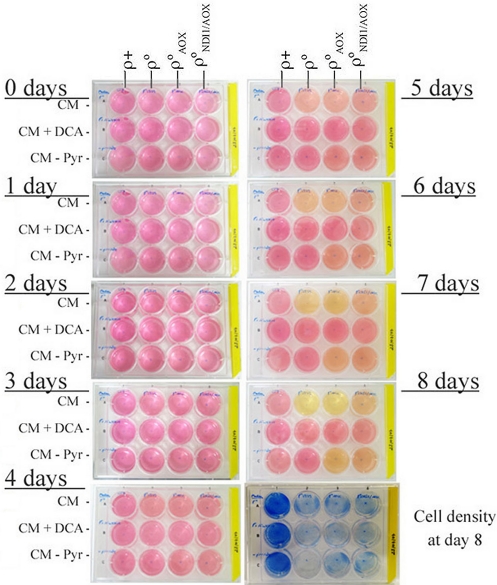
Lactic fermentation of the different cell lines. The levels of medium acidification (yellow color) and cell density (methylene blue staining) achieved by the different cell lines in 3 culture conditions and after 8 days in culture is shown as a representative experiment. Gal, galactose; Glu, glucose; DCA, sodium dichloro acetate (15 mM); Uri, uridine (0.2 mM); Pyr, pyruvate (1 mM); CM, complete medium containing uridine and pyruvate.

References

    1. Lenaz G, Genova ML. Kinetics of integrated electron transfer in the mitochondrial respiratory chain: Random collisions vs. solid state electron channeling. Am J Physiol. 2007;292:C1221–1239. - PubMed
    1. Hakkaart GA, Dassa EP, Jacobs HT, Rustin P. Allotopic expression of a mitochondrial alternative oxidase confers cyanide resistance to human cell respiration. EMBO Rep. 2006;7:341–345. - PMC - PubMed
    1. Yagi T, et al. Can a single subunit yeast NADH dehydrogenase (Ndi1) remedy diseases caused by respiratory complex I defects? Rejuvenation Res. 2006;9:191–197. - PubMed
    1. King MP, Attardi G. Human cells lacking mtDNA: Repopulation with exogenous mitochondria by complementation. Science. 1989;246:500–503. - PubMed
    1. Morais R, Desjardins P, Turmel C, Zinkewich-Peotti K. Development and characterization of continuous avian cell lines depleted of mitochondrial DNA in vitro. Cell Dev Biol. 1988;24:649–658. - PubMed

Publication types

MeSH terms