


24 hours of sleep deprivation in the rat increases sleepiness and decreases vigilance: introduction of the rat-psychomotor vigilance task
- PMID: 19021853
- PMCID: PMC2605519
- DOI: 10.1111/j.1365-2869.2008.00698.x
24 hours of sleep deprivation in the rat increases sleepiness and decreases vigilance: introduction of the rat-psychomotor vigilance task
Erratum in
- J Sleep Res. 2009 Mar;18(1):143
Abstract
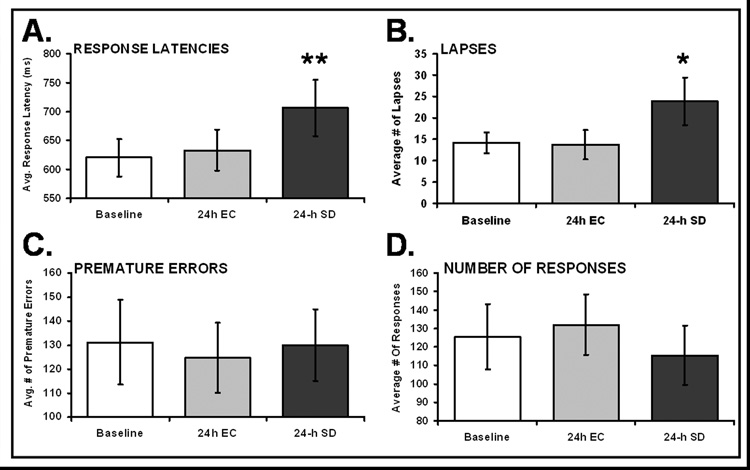
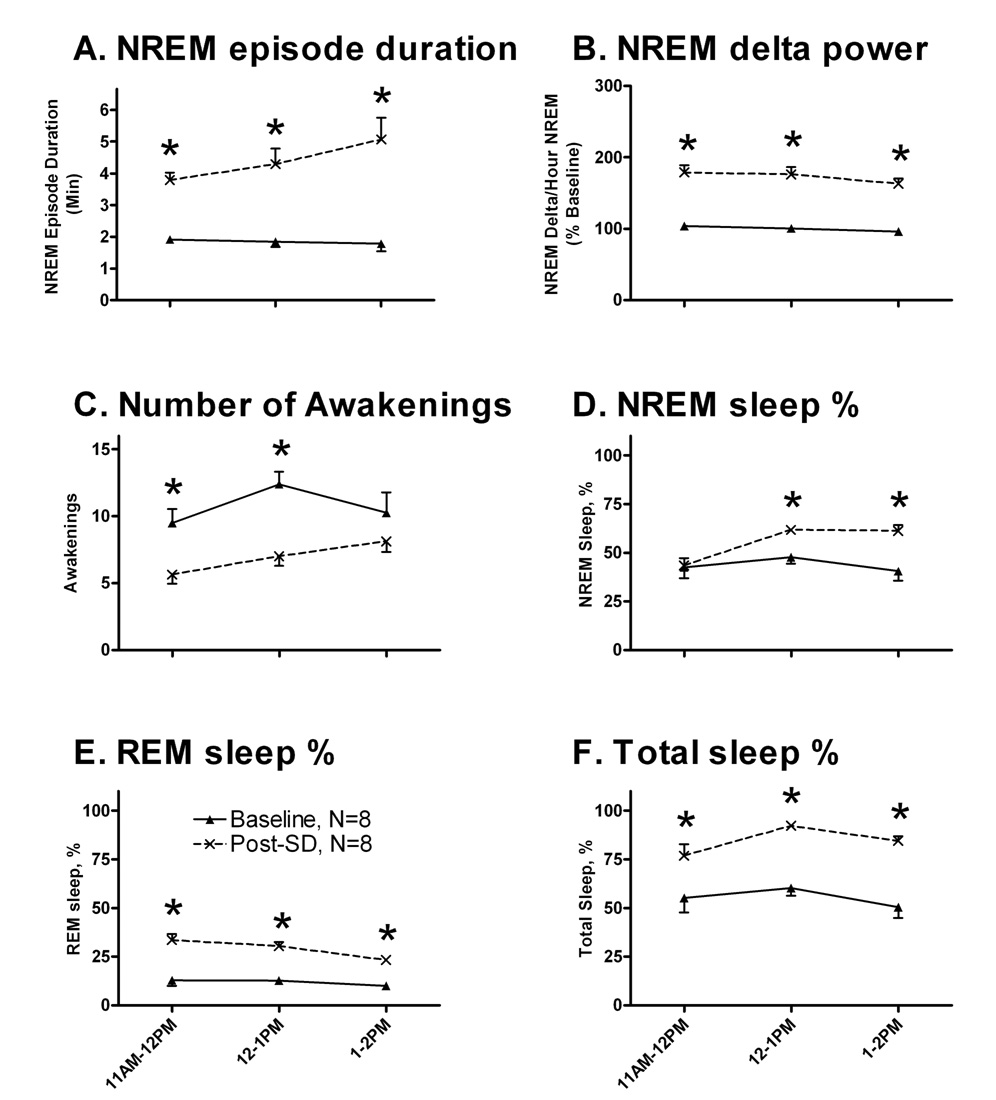
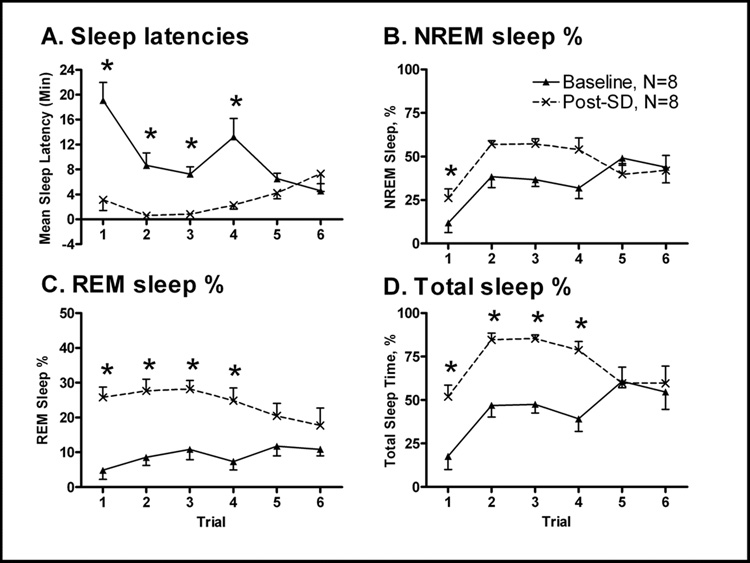
A novel animal-analog of the human psychomotor vigilance task (PVT) was validated by subjecting rats to 24 h of sleep deprivation (SD) and examining the effect on performance in the rat-PVT (rPVT), and a rat multiple sleep latency test (rMSLT). During a three-phase (separate cohorts) crossover design, vigilance performance in the rPVT was compared with 24 h SD-induced changes in sleepiness assessed by polysomnographic evaluation and the rMSLT. Twenty-four hours of SD was produced by brief rotation of activity wheels at regular intervals in which the animals resided throughout the experiment. In the rPVT experiment, exercise controls (EC) experienced the same overall amount of locomotor activity as during SD, but allowed long periods of undisturbed sleep. After 24 h SD response latencies slowed, and lapses increased significantly during rPVT performance when compared with baseline and EC conditions. During the first 3 h of the recovery period following 24 h SD, polysomnographic measures indicated sleepiness. Latency to fall asleep after 24 h SD was assessed six times during the first 3 h after SD. Rats fell asleep significantly faster immediately after SD, than after non-SD baseline sessions. In conclusion, 24 h of SD in rats increased sleepiness, as indicated by polysomnography and the rMSLT, and impaired vigilance as measured by the rPVT. The rPVT closely resembles the human PVT test widely used in human sleep research and will assist investigation of the neurobiologic mechanisms that produce vigilance impairments after sleep disruption.
Conflict of interest statement
This was not an industry supported study. The authors have indicated no financial conflicts of interest.
Figures
References
-
- Abrantes-Pais F, Friedman JK, Lovallo WR, Ross ED. Psychological or physiological: Why are tetraplegic patients content? Neurology. 2007;69:261–267. - PubMed
-
- Adam M, Retey JV, Khatami R, Landolt HP. Age-related changes in the time course of vigilant attention during 40 hours without sleep in man. Sleep. 2006;29:55–57. - PubMed
-
- Balkin TJ, Bliese PD, Belenky G, et al. Comparative utility of instruments for monitoring sleepiness-related performance decrements in the operational environment. J. Sleep Res. 2004;13:219–227. - PubMed
-
- Belenky G, Wesensten NJ, Thorne DR, Thomas ML, Sing HC, Redmond DP, Russo MB, Balkin TJ. Patterns of performance degradation and restoration during sleep restriction and subsequent recovery: a sleep dose-response study. J Sleep Res. 2003;12:1–12. - PubMed
Publication types
MeSH terms
Grants and funding
LinkOut - more resources
Full Text Sources
