


Genotype-Phenotype correlations in multiple sclerosis: HLA genes influence disease severity inferred by 1HMR spectroscopy and MRI measures
- PMID: 19022862
- PMCID: PMC2638695
- DOI: 10.1093/brain/awn301
Genotype-Phenotype correlations in multiple sclerosis: HLA genes influence disease severity inferred by 1HMR spectroscopy and MRI measures
Abstract
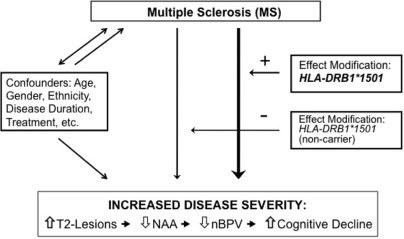
Genetic susceptibility to multiple sclerosis (MS) is associated with the human leukocyte antigen (HLA) DRB1*1501 allele. Here we show a clear association between DRB1*1501 carrier status and four domains of disease severity in an investigation of genotype-phenotype associations in 505 robust, clinically well characterized MS patients evaluated cross-sectionally: (i) a reduction in the N-acetyl-aspartate (NAA) concentration within normal appearing white matter (NAWM) via (1)HMR spectroscopy (P = 0.025), (ii) an increase in the volume of white matter (WM) lesions utilizing conventional anatomical MRI techniques (1,127 mm(3); P = 0.031), (iii) a reduction in normalized brain parenchymal volume (nBPV) (P = 0.023), and (iv) impairments in cognitive function as measured by the Paced Auditory Serial Addition Test (PASAT-3) performance (Mean Z Score: DRB1*1501+: 0.110 versus DRB1*1501-: 0.048; P = 0.004). In addition, DRB1*1501+ patients had significantly more women (74% versus 63%; P = 0.009) and a younger mean age at disease onset (32.4 years versus 34.3 years; P = 0.025). Our findings suggest that DRB1*1501 increases disease severity in MS by facilitating the development of more T2-foci, thereby increasing the potential for irreversible axonal compromise and subsequent neuronal degeneration, as suggested by the reduction of NAA concentrations in NAWM, ultimately leading to a decline in brain volume. These structural aberrations may explain the significant differences in cognitive performance observed between DRB1*1501 groups. The overall goal of a deep phenotypic approach to MS is to develop an array of meaningful biomarkers to monitor the course of the disease, predict future disease behaviour, determine when treatment is necessary, and perhaps to more effectively recommend an available therapeutic intervention.
Figures
References
-
- Allegretta M, Nicklas JA, Sriram S, Albertini RJ. T cells responsive to myelin basic protein in patients with multiple sclerosis. Science. 1990;247:718–21. - PubMed
-
- Barcellos LF, Oksenberg JR, Green AJ, Bucher P, Rimmler JB, Schmidt S, et al. Genetic basis for clinical expression in multiple sclerosis. Brain. 2002;125:150–8. - PubMed
-
- Barcellos LF, Sawcer S, Ramsay PP, Baranzini SE, Thomson G, Briggs F, et al. Heterogeneity at the HLA-DRB1 locus and risk for multiple sclerosis. Hum Mol Genet. 2006;15:2813–24. - PubMed
-
- Bertrams J, Kuwert E. HL-A antigen frequencies in multiple sclerosis. Significant increase of HL-A3, HL-A10 and W5, and decrease of HL-A12. Eur Neurol. 1972;7:74–8. - PubMed
Publication types
MeSH terms
Substances
Grants and funding
LinkOut - more resources
Full Text Sources
Other Literature Sources
Medical
Research Materials
