


Psychosocial mediators of a school-based tobacco prevention program in India: results from the first year of project MYTRI
- PMID: 19023657
- PMCID: PMC2821665
- DOI: 10.1007/s11121-008-0113-x
Psychosocial mediators of a school-based tobacco prevention program in India: results from the first year of project MYTRI
Abstract
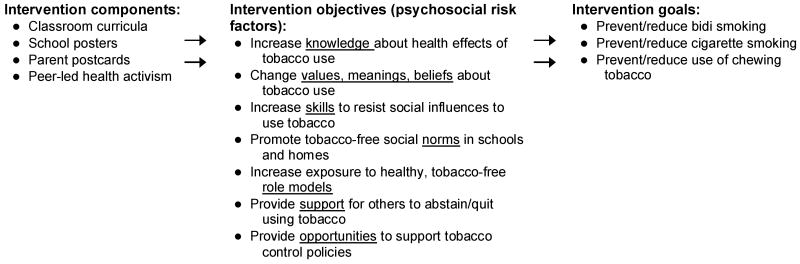
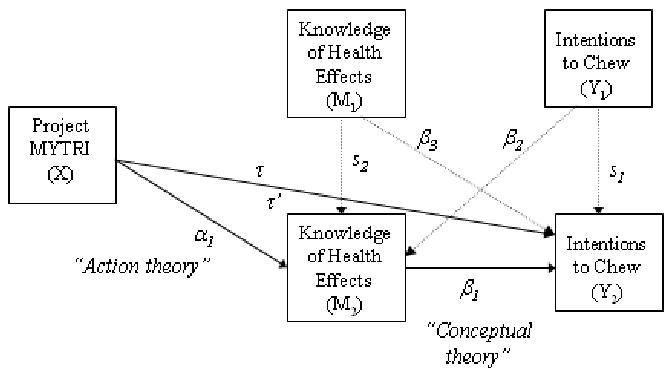
Each day in India, an estimated 5,500 youth initiate tobacco use, contributing to predictions that by 2020, tobacco will account for 13% of all deaths in India. Project MYTRI (Mobilizing Youth for Tobacco-Related Initiatives in India) is a multi-component school-based intervention designed to prevent and reduce tobacco use among adolescents in Delhi and Chennai, India. The intervention was implemented over the 2004-2006 school years and involved 6th and 8th grade students in 32 classrooms. Students participated in peer-led classroom activities involving games, competitions, and other activities intended to target a number of psychosocial risk factors believed to prevent tobacco use among urban Indian youth. To more fully understand how Project MYTRI influenced students' intentions to smoke or chew tobacco, the current study used mediation analysis to investigate whether Project MYTRI altered the psychosocial risk factors as intended, and whether the changes in psychosocial risk factors were, in turn, responsible for altering students' tobacco-use intentions. Multi-level mediation models were estimated using student data from baseline and 1-year follow-up surveys. Results indicated that the psychosocial risk factors Knowledge of Health Effects, Normative Beliefs, Reasons to Use Tobacco, and Perceived Prevalence were significant mediators between the intervention activities and students' tobacco use intentions. Evidence of inconsistent mediation was observed for the Perceived Prevalence factor. These findings, combined with those from qualitative research and the second-year student data, will help to illuminate the impact of Project MYTRI on participating youth.
Figures
References
-
- Bandura A. Health promotion from the perspective of social cognitive theory. Psychology and Health. 1998;13:623–649.
-
- Bandura A. Social cognitive theory: An agentic perspective. Annual Review of Psychology. 2001;52:1–26. - PubMed
-
- Bandura A. Health promotion by social cognitive means. Health Education & Behavior. 2004;31:143–164. - PubMed
-
- Baranowski T, Perry CL, Parcel GS. How individuals, environments and health behavior interact: Social cognitive theory. In: Glanz K, Lewis FM, Rimer B, editors. Health behavior and health education: Theory, research & practice. 2nd. San Francisco, CA: Jossey-Bass; 1996. pp. 246–279.
-
- Baron RM, Kenny DA. The moderator-mediator variable distinction in social psychological research: conceptual, strategic, and statistical considerations. Journal of Personality and Social Psychology. 1986;51:1173–1182. - PubMed
Publication types
MeSH terms
Grants and funding
LinkOut - more resources
Full Text Sources
Medical
