. 2009 Jan;290(1):70-8.
doi: 10.1111/j.1574-6968.2008.01406.x. Epub 2008 Nov 18.

Genomic islands of Pseudomonas aeruginosa

Affiliations

Genomic islands of Pseudomonas aeruginosa

Scott E Battle et al. FEMS Microbiol Lett. 2009 Jan.

Abstract

Key to Pseudomonas aeruginosa's ability to thrive in a diversity of niches is the presence of numerous genomic islands that confer adaptive traits upon individual strains. We reasoned that P. aeruginosa strains capable of surviving in the harsh environments of multiple hosts would therefore represent rich sources of genomic islands. To this end, we identified a strain, PSE9, that was virulent in both animals and plants. Subtractive hybridization was used to compare the genome of PSE9 with the less virulent strain PAO1. Nine genomic islands were identified in PSE9 that were absent in PAO1; seven of these had not been described previously. One of these seven islands, designated P. aeruginosa genomic island (PAGI)-5, has already been shown to carry numerous interesting ORFs, including several required for virulence in mammals. Here we describe the remaining six genomic islands, PAGI-6, -7, -8, -9, -10, and -11, which include a prophage element and two Rhs elements.


Figures
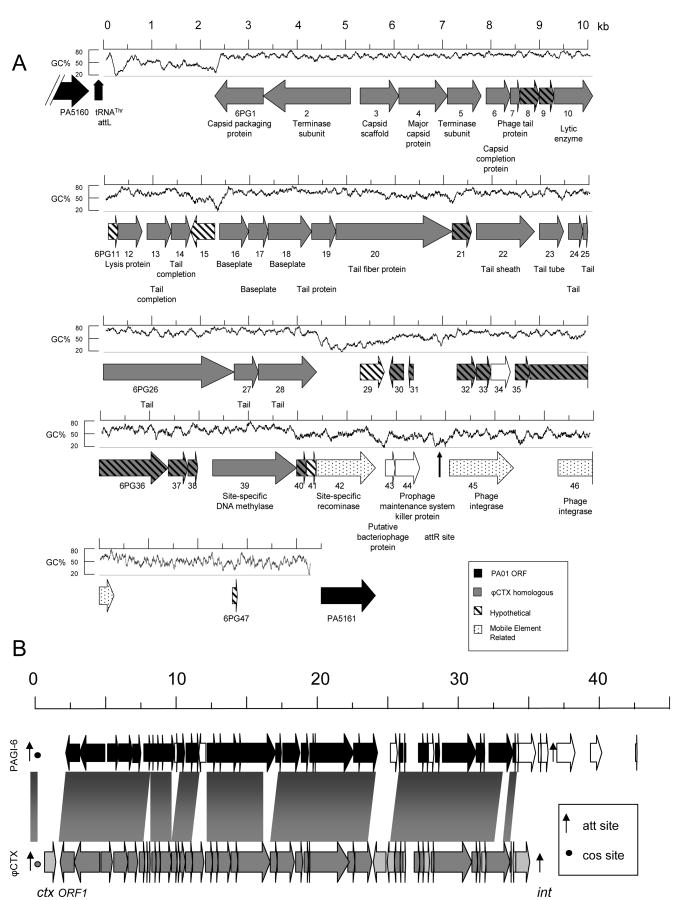
Figure 1
Figure 1
The PAGI-6 genomic island. (A) Map of PAGI-6. Arrows represent ORFs and are oriented in the direction of transcription. Arrows with gray backgrounds represent ORFs with similarity to ϕCTX sequences, and arrows with white backgrounds represent ORFs that lack ϕCTX similarity. Black arrows represent PAO1 ORFs that flank PAGI-6. ORFs without similarity to characterized ORFs are indicated with diagonal stripes, and ORFs expected to play a role in DNA mobility are speckled. tRNA attL and attR sites are represented by vertical arrows. G+C content is shown above the ORFs, calculated from a sliding 100 bp window. PAGI-6 ORFs are referred to as “6PG#”, where “#” is the sequential number of the ORF within the genomic island. (B) PAGI-6 alignment with the ϕCTX genome. Dark bands and ORFs represent conserved nucleotide sequences whereas light gray and white ORFs indicate unrelated sequences. att sites are represented by vertical arrows, and cos sites by circles.
Figure 2
Figure 2
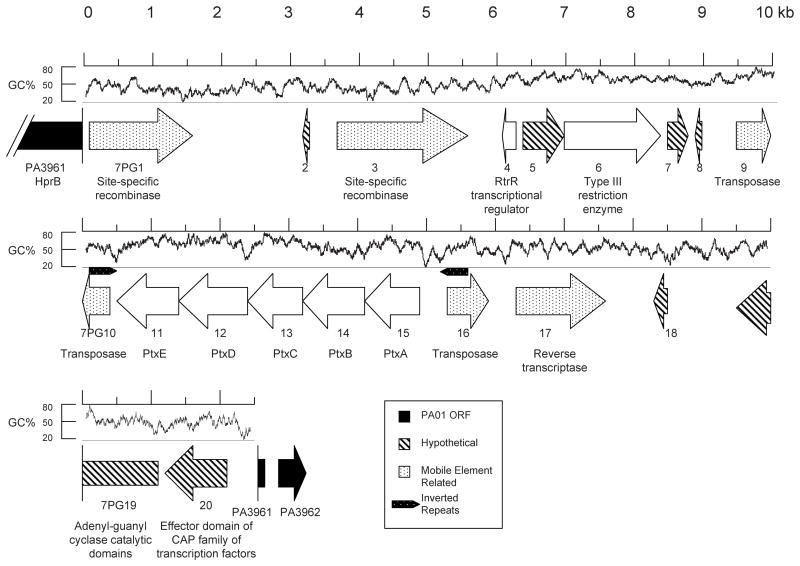
Map of PAGI-7. Arrows represent ORFs and are oriented in the direction of transcription. Arrows with white backgrounds represent PAGI-7 ORFs, and black arrows represent PAO1 ORFs that flank PAGI-7. ORFs without similarity to characterized ORFs are indicated with diagonal stripes, and ORFs expected to play a role in DNA mobility are speckled. The locations of inverted repeat sequences are indicated. G+C content is shown above the ORFs, calculated from a sliding 100 bp window. PAGI-7 ORFs are referred to as “7PG#”, where “#” is the sequential number of the ORF within the genomic island.
Figure 3
Figure 3
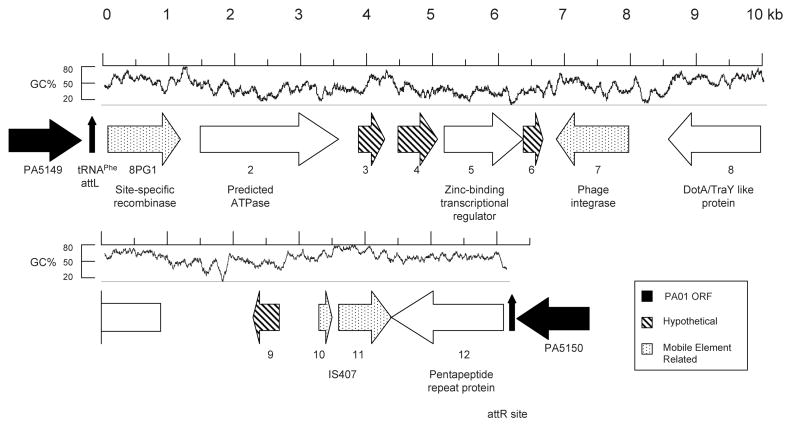
Map of PAGI-8. Arrows represent ORFs and are oriented in the direction of transcription. Arrows with white backgrounds represent PAGI-8 ORFs, and black arrows represent PAO1 ORFs that flank PAGI-8. ORFs without similarity to characterized ORFs are indicated with diagonal stripes, and ORFs expected to play a role in DNA mobility are speckled. tRNA attL and attR sites are represented by vertical arrows. G+C content is shown above the ORFs, calculated from a sliding 100 bp window. PAGI-8 ORFs are referred to as “8PG#”, where “#” is the sequential number of the ORF within the genomic island.
Figure 4
Figure 4
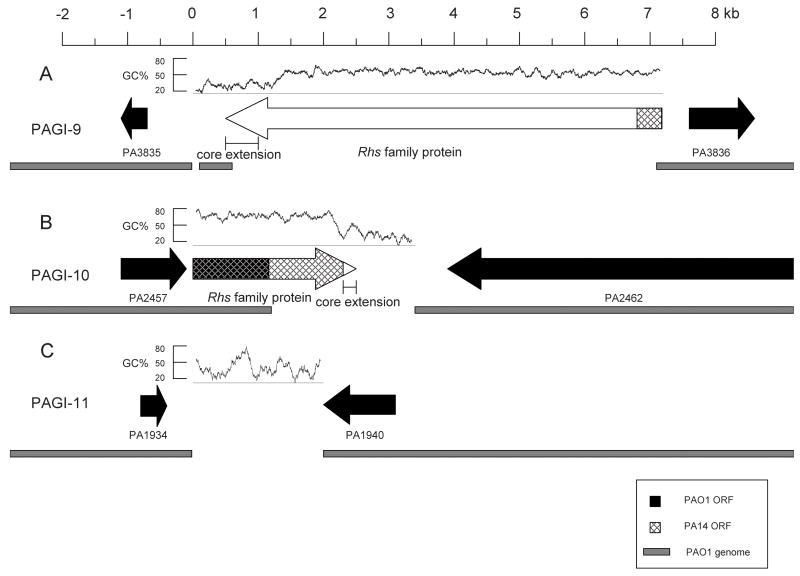
Maps of PAGI-9 (A), PAGI-10 (B), and PAGI-11 (C). Arrows with white backgrounds represent genomic island ORFs, and black arrows represent flanking PAO1 ORFs. The underlying gray bars indicate the extent of PAO1 conserved sequence. Cross-hatching represents conserved PA14 sequence. The predicted locations of the Rhs element core extensions are indicated. G+C content is shown above the ORFs, calculated from a sliding 100 bp window.

References

    1. Altschul SF, Gish W, Miller W, Myers EW, Lipman DJ. Basic local alignment search tool. J Mol Biol. 1990;215:403–410. - PubMed
    1. Battle SE, Meyer F, Rello J, Kung VL, Hauser AR. The hybrid pathogenicity island PAGI-5 contributes to the highly virulent phenotype of a Pseudomonas aeruginosa isolate in mammals. J Bacteriol. 2008 [ePub ahead of print] - PMC - PubMed
    1. Cheetham BF, Katz ME. A role for bacteriophages in the evolution and transfer of bacterial virulence determinants. Mol Microbiol. 1995;18:201–208. - PubMed
    1. Costas AM, White AK, Metcalf WW. Purification and characterization of a novel phosphorus-oxidizing enzyme from Pseudomonas stutzeri WM88. J Biol Chem. 2001;276:17429–17436. - PubMed
    1. Cserzo M, Wallin E, Simon I, von Heijne G, Elofsson A. Prediction of transmembrane alpha-helices in prokaryotic membrane proteins: the dense alignment surface method. Protein Eng. 1997;10:673–676. - PubMed

Publication types

MeSH terms