


Longitudinal assessment of bone density and structure in an incident cohort of children with Crohn's disease
- PMID: 19026647
- PMCID: PMC2705767
- DOI: 10.1053/j.gastro.2008.09.072
Longitudinal assessment of bone density and structure in an incident cohort of children with Crohn's disease
Abstract
Background & aims: The impact of childhood Crohn's disease (CD) on volumetric bone mineral density (vBMD), bone structure, and muscle mass have not been established. The objective of this longitudinal study was to assess musculoskeletal outcomes in an incident cohort of children with CD using peripheral quantitative computed tomography (pQCT).
Methods: Tibia pQCT was performed in 78 CD subjects (ages, 5-18 years) at diagnosis and in 67 over the subsequent year. pQCT outcomes were converted to sex- and race-specific z scores based on reference data in over 650 controls. Multivariable linear regression models identified factors associated with changes in bone outcomes.
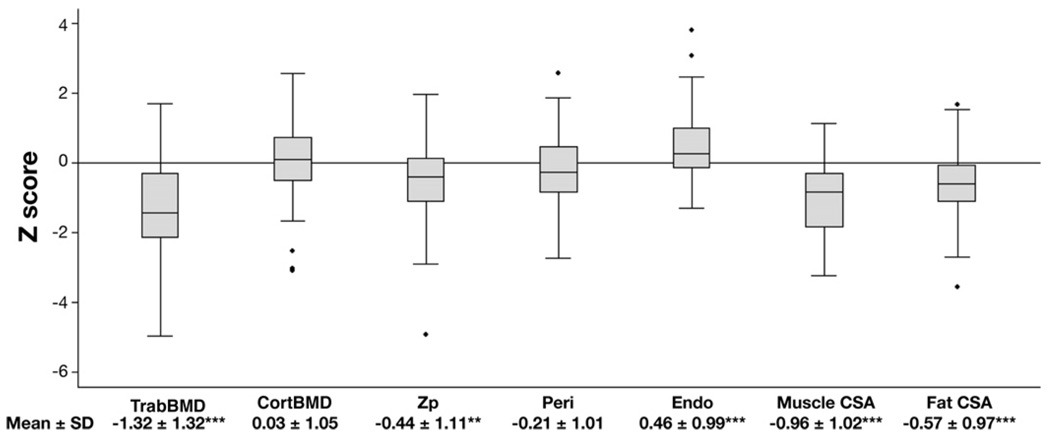
Results: At diagnosis, CD subjects had significant deficits in trabecular vBMD (z score, -1.32+/-1.32; P< .001), cortical section modulus (a measure of bone geometry and strength) (z score, -0.44+/-1.11; P< .01), and muscle (z score, -0.96+/-1.02; P< .001) compared with controls. Over the first 6 months, trabecular vBMD and muscle z scores improved significantly (both, P< .001); however, section modulus worsened (P= .0001), and all 3 parameters remained low after 1 year. Increases in muscle z scores were associated with less severe declines in cortical section modulus z scores. Improvements in trabecular vBMD z scores were greater in prepubertal subjects. Glucocorticoids were associated with increases in cortical vBMD.
Conclusions: Substantial deficits in trabecular vBMD, cortical bone geometry, and muscle were observed at CD diagnosis. Trabecular vBMD improved incompletely; however, cortical deficits progressed despite improvements in muscle. Glucocorticoids were not associated with bone loss. Therapies to improve bone accrual in childhood CD are needed.
Figures
Comment in
-
Boning up: exploring bone structure and strength in children with Crohn's disease.Gastroenterology. 2009 Jan;136(1):35-9. doi: 10.1053/j.gastro.2008.11.025. Epub 2008 Nov 28. Gastroenterology. 2009. PMID: 19041650 No abstract available.
References
-
- Semeao EJ, Stallings VA, Peck SN, et al. Vertebral compression fractures in pediatric patients with Crohn’s disease. Gastroenterology. 1997;112:1710–1713. - PubMed
-
- Gokhale R, Favus MJ, Karrison T, et al. Bone mineral density assessment in children with inflammatory bowel disease. Gastroenterology. 1998;114:902–911. - PubMed
-
- Burnham JM, Shults J, Petit MA, et al. Alterations in proximal femur geometry in children treated with glucocorticoids for Crohn’s disease or nephrotic syndrome: impact of the underlying disease. J Bone Miner Res. 2007;22:551–559. - PubMed
-
- Burnham JM, Shults J, Semeao E, et al. Whole body BMC in pediatric Crohn’s disease: independent effects of altered growth, maturation, and body composition. J Bone Miner Res. 2004;19:1961–1968. - PubMed
-
- Bischoff SC, Herrmann A, Goke M, et al. Altered bone metabolism in inflammatory bowel disease. Am J Gastroenterol. 1997;92:1157–1163. - PubMed
Publication types
MeSH terms
Grants and funding
LinkOut - more resources
Full Text Sources
Other Literature Sources
Medical
