. 2009 Feb;29(3):626-39.
doi: 10.1128/MCB.00423-08. Epub 2008 Nov 24.

Mutant telomeric repeats in yeast can disrupt the negative regulation of recombination-mediated telomere maintenance and create an alternative lengthening of telomeres-like phenotype

Affiliations

Mutant telomeric repeats in yeast can disrupt the negative regulation of recombination-mediated telomere maintenance and create an alternative lengthening of telomeres-like phenotype

Laura H Bechard et al. Mol Cell Biol. 2009 Feb.

Abstract

Some human cancers maintain telomeres using alternative lengthening of telomeres (ALT), a process thought to be due to recombination. In Kluyveromyces lactis mutants lacking telomerase, recombinational telomere elongation (RTE) is induced at short telomeres but is suppressed once telomeres are moderately elongated by RTE. Recent work has shown that certain telomere capping defects can trigger a different type of RTE that results in much more extensive telomere elongation that is reminiscent of human ALT cells. In this study, we generated telomeres composed of either of two types of mutant telomeric repeats, Acc and SnaB, that each alter the binding site for the telomeric protein Rap1. We show here that arrays of both types of mutant repeats present basally on a telomere were defective in negatively regulating telomere length in the presence of telomerase. Similarly, when each type of mutant repeat was spread to all chromosome ends in cells lacking telomerase, they led to the formation of telomeres produced by RTE that were much longer than those seen in cells with only wild-type telomeric repeats. The Acc repeats produced the more severe defect in both types of telomere maintenance, consistent with their more severe Rap1 binding defect. Curiously, although telomerase deletion mutants with telomeres composed of Acc repeats invariably showed extreme telomere elongation, they often also initially showed persistent very short telomeres with few or no Acc repeats. We suggest that these result from futile cycles of recombinational elongation and truncation of the Acc repeats from the telomeres. The presence of extensive 3' overhangs at mutant telomeres suggests that Rap1 may normally be involved in controlling 5' end degradation.


Figures
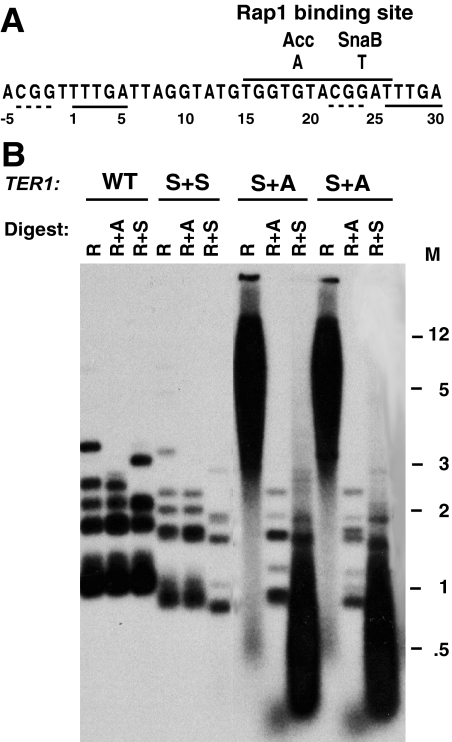
FIG. 1.
FIG. 1.
The long-telomere phenotype of the ter1-19A(Acc) mutation is dominant to the ter1-24T(SnaB) mutation in trans. (A) Diagram of the K. lactis telomerase RNA template region. The strand shown is the complement of that present in the RNA. The numbers shown signify the coordinates used for base positions in and around the template. Rap1 binds at the overlined sequence. Base substitutions making AccI and SnaBI restriction sites are indicated. The underlined sequences are involved in accurate alignment of the template with the telomeric DNA during telomerase translocation. (B) Southern blot of telomeric hybridization to DNA from ter1-24T(SnaB) and ter1-19A(Acc) cells created by integration of a ter1-19A(Acc)-containing plasmid into haploid ter1-24T(SnaB) cells. Two independent heteroallelic strains are shown (S+A). DNAs from a wild-type (WT) strain and a matching control containing two ter1-24T(SnaB) alleles are also shown. Each DNA was digested with EcoRI (R), EcoRI and AccI (R+A), and EcoRI and SnaBI (R+S). Markers (M) are shown in kilobases.
FIG. 2.
FIG. 2.
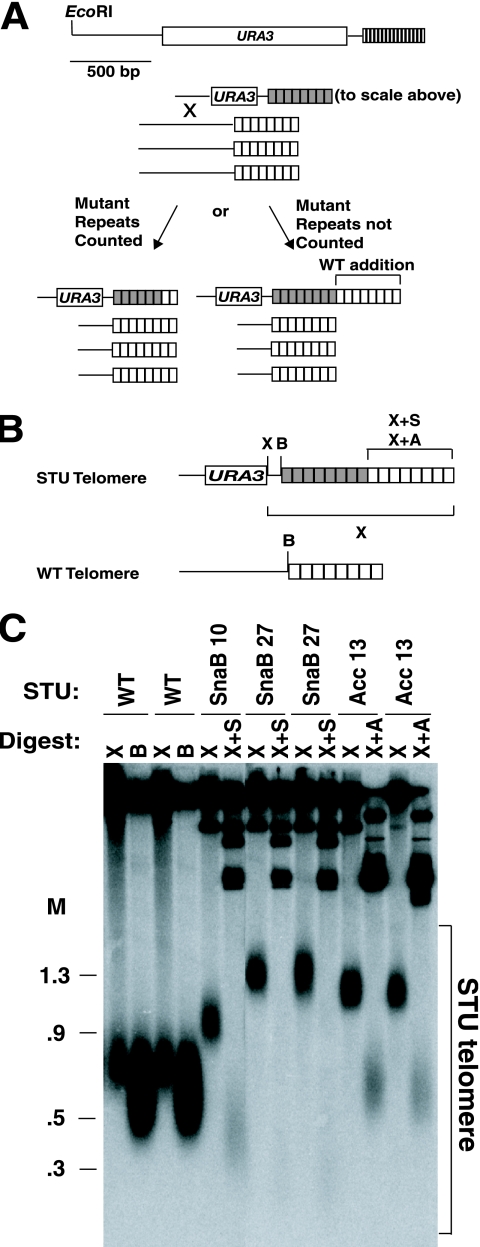
SnaB and Acc telomeric repeats are defective in regulating telomerase addition to their ends. (A) Diagram of the experimental method for replacing a native telomere with a mutant telomere (gray boxes represent mutant repeats, and white boxes represent wild-type repeats). Restriction fragments containing mutant telomeres were transformed into wild-type cells, where they each replaced a single native telomere by recombination between common subtelomeric sequences. Upon integration, the mutated telomeres acquire some number of terminal wild-type repeats (white boxes) from the resident wild-type telomerase. See text for details. A scale diagram of a STU telomeric fragment is shown at the top. (B) The STU telomeres have a unique XhoI (X) site at the end of the URA3 fragment. A BsrBI (B) site is located 3 bp upstream of the telomeric repeats that is present at 10 of 12 telomeres. The tagged repeats each have an Acc or SnaB (A or S) restriction site so that the wild-type (WT) addition onto them can be measured. The brackets represent fragments generated by particular digests. (C) Southern blot of SnaB and Acc telomeres. The leftmost four lanes show two independent wild-type STU telomere transformants cut by XhoI (X) or BsrBI (B). The band between 0.5 and 0.9 kb is the STU telomere in XhoI digests. The slightly smaller band in the BsrBI digests represents 10 of the 12 telomeres. The central six lanes show transformants that received a SnaB STU telomere with ∼10 SnaB repeats (SnaB 10) or ∼27 SnaB repeats (SnaB 27) cut by XhoI or by a double digest with XhoI and SnaBI (X+S). The rightmost lanes show XhoI and XhoI-AccI (X+A) digests of two transformants that received an Acc STU telomere with 13 Acc repeats. The wild-type addition in the different double-digest lanes can be seen as a light smear near the bottom of the gel. The bracket marks the range of positions of the STU telomere fragments. Markers (M) are shown in kilobases.
FIG. 3.
FIG. 3.
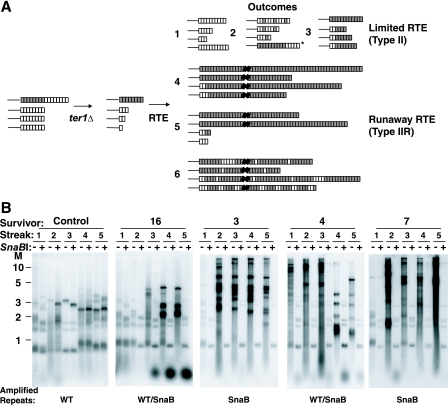
SnaB telomeric repeats can promote the formation of long, unstable telomeres through RTE. (A) Scheme for generating ter1-Δ cells containing mutant repeats. Cells containing a single STU telomere with mutant telomeric repeats (left drawing) were deleted for telomerase and allowed to senesce (middle drawing). The long size of the mutant telomere greatly enhances the likelihood that the mutant repeats will spread to all other chromosome ends during RTE. The drawings at the right show several possible outcomes for the telomere structures. Outcomes 1 to 3 depict typical moderate telomere lengthening seen in type II survivors with only wild-type repeats (outcome 1), interspersed wild-type and mutant repeats (outcome 2), or only amplification of mutant repeats (outcome 3). The asterisk depicts a different possibility that defective mutant repeats could be effectively “capped” by wild-type repeats. Outcomes 4 to 6 depict potential results with type IIR RTE generating very long telomeres. Outcome 4, all telomeres mutant and long. Outcome 5, mix of mutant long telomeres and shortened telomeres. Outcome 6, long mutant telomeres with some interspersed wild-type repeats. Gray and white boxes are mutant repeats and wild-type repeats, respectively. (B) Southern blot hybridized to a telomeric probe of ter1-Δ survivors with telomeres containing SnaB repeats. Each gel shows a separate SnaB survivor followed for five serial restreaks after senescence. The first gel is a control survivor that retained only wild-type (WT) repeats, while the other gels show examples of some of the spreading patterns. DNA from each sample was digested with EcoRI (−) and with EcoRI plus SnaBI (+). Underneath the gels is indicated the type of repeat primarily amplified. Markers (M) are shown in kilobases.
FIG. 4.
FIG. 4.
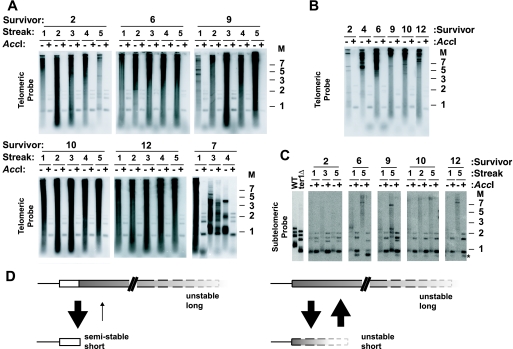
Acc survivors exhibit type IIR RTE after spreading but can have persistent short telomeres. (A) Southern blots of six independent Acc survivors. Each gel shows DNA from an independent survivor that was serially restreaked five times after survivor formation. Samples were digested with EcoRI (−) and EcoRI plus AccI (+). A telomeric probe was used for hybridization. (B) Southern blot of telomeres of Acc survivors after 10 streaks. The digests and probe are the same as for panel A. (C) Persistent short telomeres in Acc survivors. Southern blots of DNA from wild-type (WT) cells, ter1-Δ cells, and Acc survivors were hybridized to a subtelomeric sequence common to 11 of 12 telomeres. The dot indicates the position of a group of telomeric fragments when they contain only a small number of telomeric repeats. The signal in this band in the EcoRI-AccI digests represents the total amount of this group of telomeres and the signal in the EcoRI digests represents the fraction of the telomeres that are very short even without cleavage of the Acc repeats. The asterisk marks the position of subtelomeric fragments in EcoRI-AccI digests that have lost all detectable wild-type repeats and that consequently are not detectable with the telomeric probe. Molecular weight markers (M) are shown in kilobases. (D) Model for persistent short telomeres in early Acc survivors. In the case on the left, a telomere is shown with a basal region of wild-type repeats (white box) and a long terminal region of Acc repeats (gray region) that is unstable and, as a consequence, highly heterogeneous in length in a population of cells. Truncated forms of the telomere that retain only the basal wild-type repeats may confer a semistable state that is relatively resistant to being reelongated by recombination. However, in the situation on the right, an unstable long telomere with no basal wild-type repeats could be subject to a similarly high rate of truncation events but be unable to stabilize any particular short telomere.
FIG. 5.
FIG. 5.
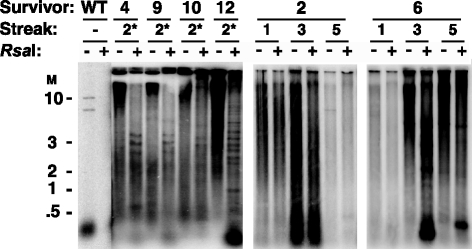
Acc survivors can contain wild-type repeats within their long tracts of Acc repeats. Southern blots show Acc survivors digested with BsrBI (−) or BsrBI plus RsaI (+) and hybridized to a telomeric probe. All survivor numbers correspond to those in Fig. 4. At left is a wild-type (WT) control where the telomeres are completely cut away by RsaI. The central and right gels show results from serial restreaks of Acc survivors 2 and 6. Asterisks with the survivor numbers indicate that the DNAs shown are from different subclones of the Acc survivors than are shown in Fig. 4. Markers (M) are shown in kilobases.
FIG. 6.
FIG. 6.
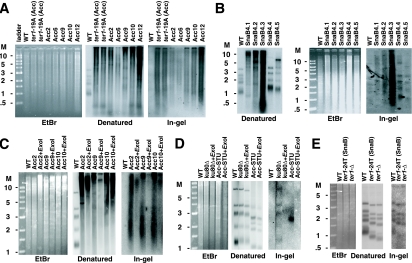
Telomeres in Acc and SnaB survivors have substantial amounts of single-stranded DNA. (A) Ethidium bromide-stained gel (EtBr), Southern blot, and in-gel hybridization of DNA from Acc survivors. The first lane in each is a wild-type (WT) control. The second and third lanes are two independent samples of ter1-19A(Acc) cells. The remaining lanes are the same survivors as shown in Fig. 4. (B) Ethidium bromide-stained gel, Southern blot, and in-gel hybridization of EcoRI-digested DNA from each of five streaks of SnaB survivor 4. The streak numbers are noted after the survivor number above the gel. Also shown is the wild-type strain 7B520. The Southern blot and in-gel hybridization only in panel B ran differently and therefore have different size markers. (C) Ethidium bromide-stained gel, Southern blot, and in-gel hybridization of EcoRI-digested and EcoRI- plus Exo I-digested DNAs of Acc survivors 2, 9, 10, and 12 along with those for wild-type strain CBS 2359. Both the Southern blot and in-gel hybridization were probed with a C-stranded telomeric oligonucleotide. (D) Ethidium bromide-stained gel, Southern blot, and in-gel hybridization of EcoRI-digested cells of the wild-type strain CBS 2359 and the EcoRI- and EcoRI- plus Exo I-digested DNAs of ku80Δ cells and senescent ter1-Δ cells containing an Acc-STU telomere that has not yet spread to other telomeres. (E) Ethidium bromide-stained gel, Southern blot, and in-gel hybridization of EcoRI-digested DNAs of the wild-type strain 7B520, a ter1-24T(SnaB) strain, and a ter1-Δ strain. Molecular weight markers (M) are shown in kilobases.

References

    1. Autexier, C., and N. F. Lue. 2006. The structure and function of telomerase reverse transcriptase. Annu. Rev. Biochem. 75493-517. - PubMed
    1. Baumann, P., and T. R. Cech. 2001. Pot1, the putative telomere end-binding protein in fission yeast and humans. Science 2921171-1175. - PubMed
    1. Beernink, H. T., K. Miller, A. Deshpande, P. Bucher, and J. P. Cooper. 2003. Telomere maintenance in fission yeast requires an Est1 ortholog. Curr. Biol. 13575-580. - PubMed
    1. Bertuch, A. A., and V. Lundblad. 2006. The maintenance and masking of chromosome termini. Curr. Opin. Cell Biol. 18247-253. - PubMed
    1. Boulton, S. J., and S. P. Jackson. 1998. Components of the Ku-dependent non-homologous end-joining pathway are involved in telomeric length maintenance and telomeric silencing. EMBO J. 171819-1828. - PMC - PubMed

Publication types

LinkOut - more resources