


Unresolved grief in a national sample of bereaved parents: impaired mental and physical health 4 to 9 years later
- PMID: 19029425
- PMCID: PMC2645112
- DOI: 10.1200/JCO.2007.14.6738
Unresolved grief in a national sample of bereaved parents: impaired mental and physical health 4 to 9 years later
Abstract
Purpose: To assess unresolved parental grief, the associated long-term impact on mental and physical health, and health service use.
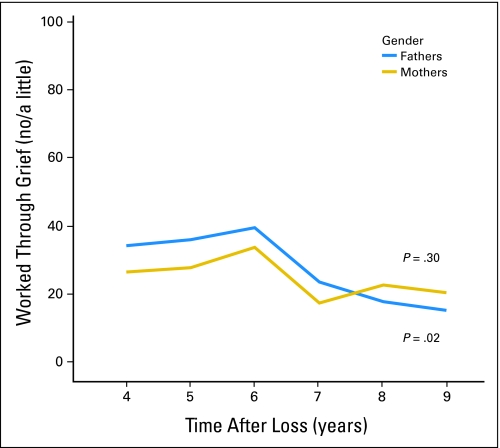
Patients and methods: This anonymous, mail-in questionnaire study was performed as a population-based investigation in Sweden between August 2001 and October 2001. Four hundred forty-nine parents who lost a child as a result of cancer 4 to 9 years earlier completed the survey (response rate, 80%). One hundred ninety-one (43%) of the bereaved parents were fathers, and 251 (56%) were mothers. Bereaved parents were asked whether or not, and to what extent, they had worked through their grief. They were also asked about their physical and psychological well-being. For outcomes of interest, we report relative risk (RR) with 95% CIs as well as unadjusted odds ratios and adjusted odds ratios.
Results: Parents with unresolved grief reported significantly worsening psychological health (fathers: RR, 3.6; 95% CI, 2.0 to 6.4; mothers: RR, 2.9; 95% CI, 1.9 to 4.4) and physical health (fathers: RR, 2.8; 95% CI, 1.8 to 4.4; mothers: RR, 2.3; 95% CI, 1.6 to 3.3) compared with those who had worked through their grief. Fathers with unresolved grief also displayed a significantly higher risk of sleep difficulties (RR, 6.7; 95% CI, 2.5 to 17.8). Mothers, however, reported increased visits with physicians during the previous 5 years (RR, 1.7; 95% CI, 1.1 to 2.6) as well as a greater likelihood of taking sick leave when they had not worked through their grief (RR, 2.1; 95% CI, 1.2 to 3.5).
Conclusion: Parents who have not worked through their grief are at increased risk of long-term mental and physical morbidity, increased health service use, and increased sick leave.
Figures
References
-
- Holmes TH, Rahe RH: The Social Readjustment Rating Scale. J Psychosom Res 11:213-218, 1967 - PubMed
-
- Osterwers M, Solomon F, Green M: Bereavement Reactions, Consequences, and Care: Committee for the Study of Health Consequences of the Stress of Bereavement. Washington, DC, National Academy Press, 1984 - PubMed
-
- Kreicbergs UC, Lannen P, Onelov E, et al: Parental grief after losing a child to cancer: Impact of professional and social support on long-term outcomes. J Clin Oncol 25:3307-3312, 2007 - PubMed
-
- Maciejewski PK, Zhang B, Block SD, et al: An empirical examination of the stage theory of grief. JAMA 297:716-723, 2007 - PubMed
-
- Rando TA: Parental Loss of a Child. Champaign, IL, Research Press Co, 1986
Publication types
MeSH terms
Grants and funding
LinkOut - more resources
Full Text Sources
Medical
