


Cognitive profiles in dementia: Alzheimer disease vs healthy brain aging
- PMID: 19029518
- PMCID: PMC2676971
- DOI: 10.1212/01.wnl.0000335972.35970.70
Cognitive profiles in dementia: Alzheimer disease vs healthy brain aging
Abstract
Objective: To re-examine proposed models of cognitive test performance that concluded separate factor structures were required for people with Alzheimer disease (AD) and older adults without dementia.
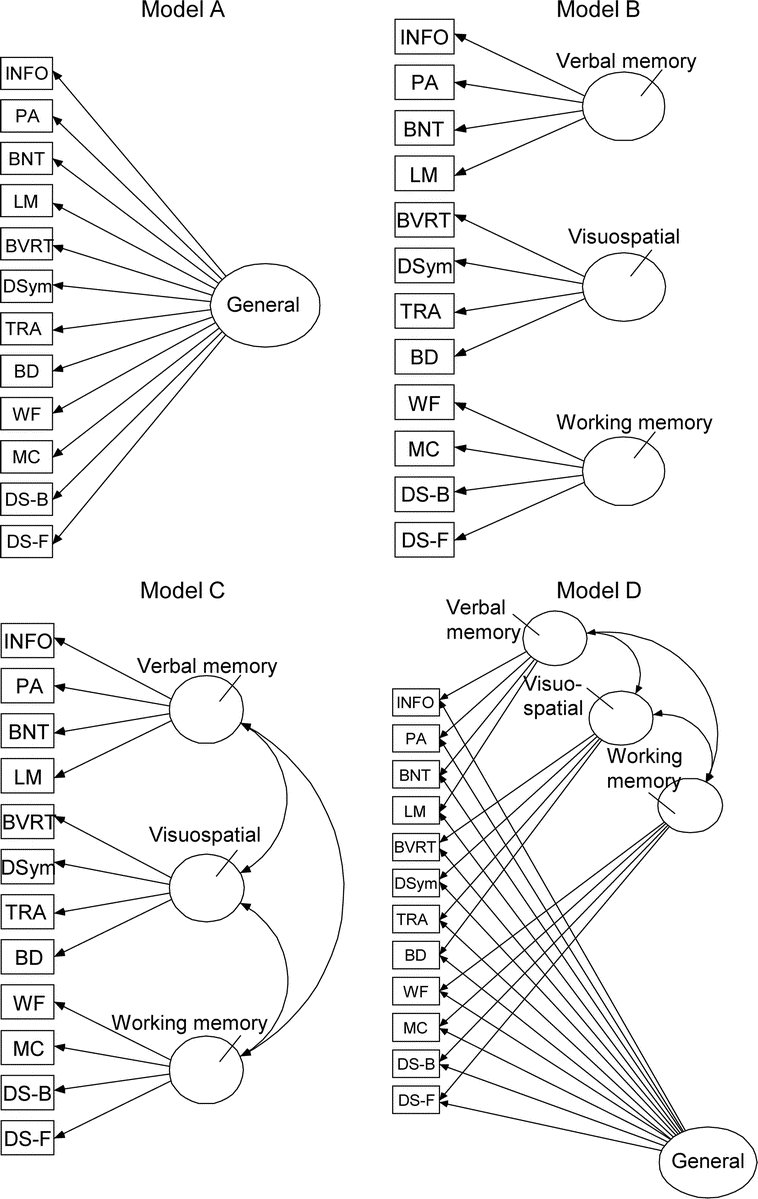
Methods: Five models of cognitive test performance were compared using multistep confirmatory factor analysis in 115 individuals with autopsy-confirmed AD and 191 research participants without clinical dementia from longitudinal studies at the Washington University AD Research Center. The models were then cross-validated using independent samples of 323 people with clinically diagnosed dementia of the Alzheimer type and 212 cognitively healthy older adults.
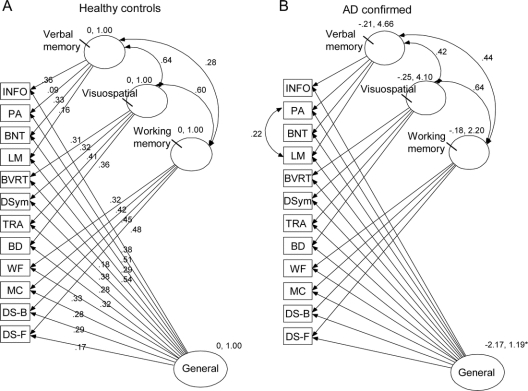
Results: After controlling for Alzheimer-specific changes in episodic memory, performance on the battery of tests used here was best represented in people both with and without dementia by a single model of one general factor and three specific factors (verbal memory, visuospatial ability, and working memory). Performance by people with dementia was lower on the general factor than it was by those without dementia. Larger variances associated with the specific factors in the group with dementia indicated greater individual differences in the pattern of cognitive deficits in the stage of AD.
Conclusions: A hybrid model of general and specific cognitive domains simplifies cognitive research by allowing direct comparison of normal aging and Alzheimer disease performance. The presence of a general factor maximizes detection of the dementia, whereas the specific factors reveal the heterogeneity of dementia's associated cognitive deficits.
Figures
References
-
- Kanne SM, Balota DA, Storandt M, McKeel DW Jr., Morris JC. Relating anatomy to function in Alzheimer’s disease: neuropsychological profiles predict regional neuropathology 5 years later. Neurology 1998;50:979–985. - PubMed
-
- Stopford CL, Snowden JS, Thompson JC, Neary D. Distinct memory profiles in Alzheimer’s disease. Cortex 2007;43:846–857. - PubMed
-
- Voss SE, Bullock RA. Executive function: the core feature of dementia? Dement Geriatr Cogn Disord 2004;18:207–216. - PubMed
-
- Wilson RS, Gilley DW, Bennett DA, Beckett LA, Evans DA. Person-specific paths of cognitive decline in Alzheimer’s disease and their relation to age. Psychol Aging 2000;15:18–28. - PubMed
-
- Jones SN, Ayers CR. Psychometric properties and factor structure of an expanded CERAD neuropsychological battery in an elderly VA sample. Arch Clin Neuropsychol 2006;21:359–365. - PubMed
Publication types
MeSH terms
Grants and funding
LinkOut - more resources
Full Text Sources
Other Literature Sources
Medical
