


Working together and apart: the twisted relationship of the Mre11 complex and Chk2 in apoptosis and tumor suppression
- PMID: 19029802
- PMCID: PMC2994099
- DOI: 10.4161/cc.7.23.7064
Working together and apart: the twisted relationship of the Mre11 complex and Chk2 in apoptosis and tumor suppression
Abstract
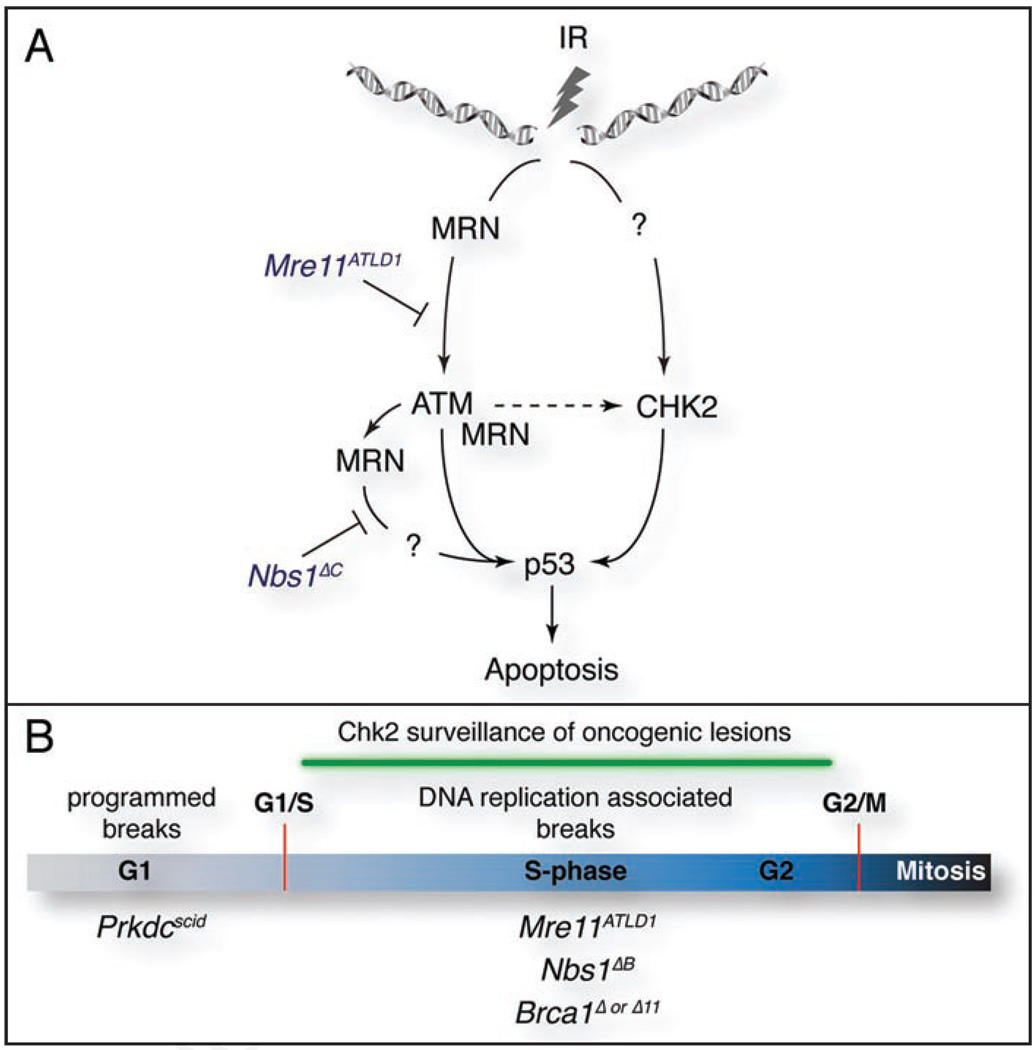
Central to the DNA damage response (DDR) is the highly conserved Mre11 complex consisting of Mre11, Rad50 and Nbs1. The Mre11 complex acts as a sensor of DNA double-strand breaks (DSBs) and regulates the signal transduction cascades that are triggered following damage detection.(1) Rare human genetic instability syndromes such as Ataxia-telangiectasia (A-T) and Nijmegen Breakage Syndrome (NBS) have underscored the importance of the DSB response in the suppression of tumorigenesis, as well as other severe pathologies affecting the development of both the immune system and the central nervous system. Using murine models of the human diseases, we have investigated the role of the Mre11 complex, and other modulators of the DSB response, in tumor suppression.(2,3) We found that the checkpoint kinase Chk2 is crucial for the suppression of a diverse array of tumor types in Mre11 complex mutants and uncovered multiple roles for the Mre11 complex in apoptotic signaling in parallel to Chk2.(4,5).
Figures
References
-
- Stracker TH, Theunissen JW, Morales M, Petrini JH. The Mre11 complex and the metabolism of chromosome breaks: the importance of communicating and holding things together. DNA Repair (Amst) 2004;3:845–854. - PubMed
-
- Williams BR, Mirzoeva OK, Morgan WF, Lin J, Dunnick W, Petrini JH. A murine model of nijmegen breakage syndrome. Curr Biol. 2002;12:648–653. - PubMed
-
- Theunissen JW, Kaplan MI, Hunt PA, Williams BR, Ferguson DO, Alt FW, Petrini JH. Checkpoint failure and chromosomal instability without lymphomagenesis in Mre11(ATLD1/ATLD1) mice. Mol Cell. 2003;12:1511–1523. - PubMed
MeSH terms
Substances
Grants and funding
LinkOut - more resources
Full Text Sources
Research Materials
Miscellaneous
