


Par complex in cancer: a regulator of normal cell polarity joins the dark side
- PMID: 19029931
- PMCID: PMC3017320
- DOI: 10.1038/onc.2008.340
Par complex in cancer: a regulator of normal cell polarity joins the dark side
Abstract
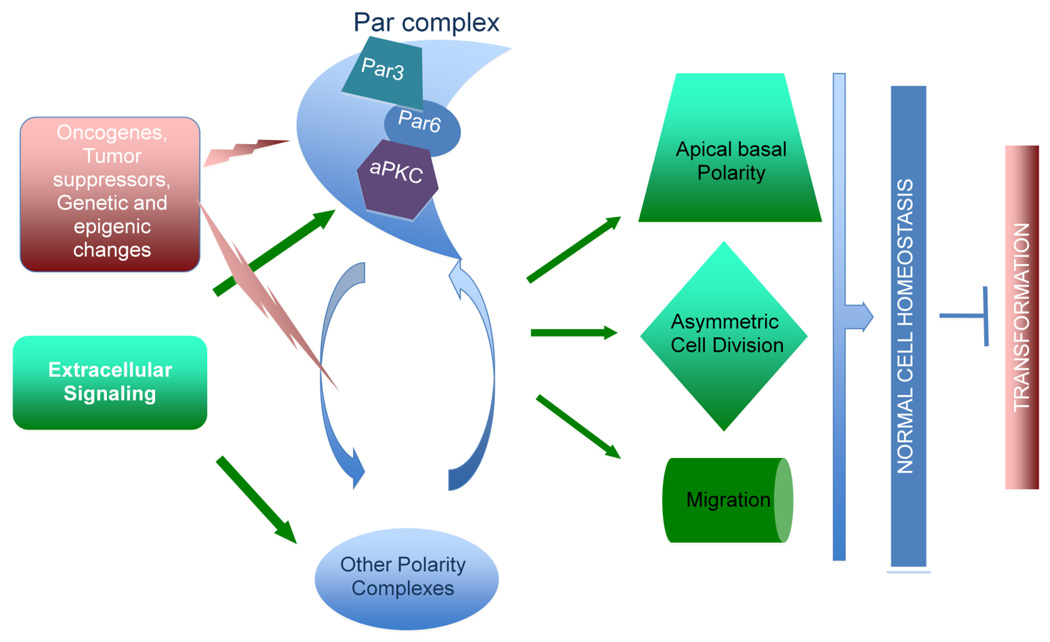
In the past 20 years, the discovery and characterization of the molecular machinery that controls cellular polarization have enabled us to achieve a better understanding of many biological processes. Spatial asymmetry or establishment of cell polarity during embryogenesis, epithelial morphogenesis, neuronal differentiation, and migration of fibroblasts and T cells are thought to rely on a small number of evolutionarily conserved proteins and pathways. Correct polarization is crucial for normal cell physiology and tissue homeostasis, and is lost in cancer. Thus, cell polarity signaling is likely to have an important function in tumor progression. Recent findings have identified a regulator of cell polarity, the Par complex, as an important signaling node in tumorigenesis. In normal cell types, the Par complex is part of the molecular machinery that regulates cell polarity and maintains normal cell homeostasis. As such, the polarity regulators are proposed to have a tumor suppressor function, consistent with the loss of polarity genes associated with hyperproliferation in Drosophila melanogaster. However, recent studies showing that some members of this complex also display pro-oncogenic activities suggest a more complex regulation of the polarity machinery during cellular transformation. Here, we examine the existing data about the different functions of the Par complex. We discuss how spatial restriction, binding partners and substrate specificity determine the signaling properties of Par complex proteins. A better understanding of these processes will very likely shed some light on how the Par complex can switch from a normal polarity regulation function to promotion of transformation downstream of oncogenes.
Figures
References
-
- Aranda V, Haire T, Nolan ME, Calarco JP, Rosenberg AZ, Fawcett JP, et al. Par6-aPKC uncouples ErbB2 induced disruption of polarized epithelial organization from proliferation control. Nat Cell Biol. 2006;8:1235–1245. - PubMed
-
- Assémat E, Bazellières E, Pallesi-Pocachard E, Le Bivic A, Massey-Harroche D. Polarity complex proteins. Biochim Biophys Acta. 2008;1778:614–630. - PubMed
-
- Bachmann A, Schneider M, Theilenberg E, Grawe F, Knust E. Drosophila Stardust is a partner of Crumbs in the control of epithelial cell polarity. Nature. 2001;414:638–643. - PubMed
-
- Betschinger J, Eisenhaber F, Knoblich JA. Phosphorylation-induced autoinhibition regulates the cytoskeletal protein Lethal (2) giant larvae. Curr Biol. 2005;15:276–282. - PubMed
Publication types
MeSH terms
Substances
Grants and funding
LinkOut - more resources
Full Text Sources
Research Materials
Miscellaneous
