. 2009 Feb;46(2):210-9.
doi: 10.1016/j.fgb.2008.10.012. Epub 2008 Nov 6.

Genome-wide analysis of Candida albicans gene expression patterns during infection of the mammalian kidney

Affiliations

Genome-wide analysis of Candida albicans gene expression patterns during infection of the mammalian kidney

Louise A Walker et al. Fungal Genet Biol. 2009 Feb.

Abstract

Global analysis of the molecular responses of microbial pathogens to their mammalian hosts represents a major challenge. To date few microarray studies have been performed on Candida albicans cells derived from infected tissues. In this study we examined the C. albicans SC5314 transcriptome from renal infections in the rabbit. Genes involved in adhesion, stress adaptation and the assimilation of alternative carbon sources were up-regulated in these cells compared with control cells grown in RPMI 1640, whereas genes involved in morphogenesis, fermentation and translation were down-regulated. When we compared the congenic virulent C. albicans strains NGY152 and SC5314, there was minimal overlap between their transcriptomes during kidney infections. This suggests that much of the gene regulation observed during infections is not essential for virulence. Indeed, we observed a poor correlation between the transcriptome and phenome for those genes that were regulated during kidney infection and that have been virulence tested.


Figures
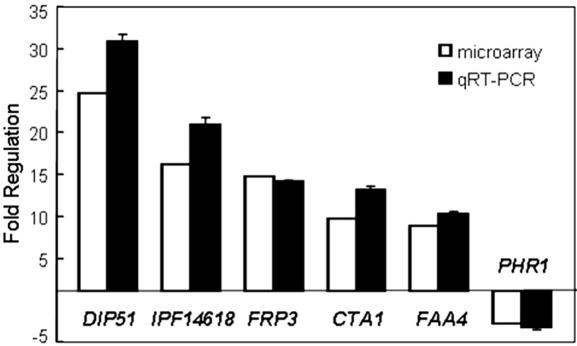
Fig. 1
Fig. 1
Comparison of qRT-PCR and microarray measurements of fold-regulation for six C. albicans SC5314 genes.
Fig. 2
Fig. 2
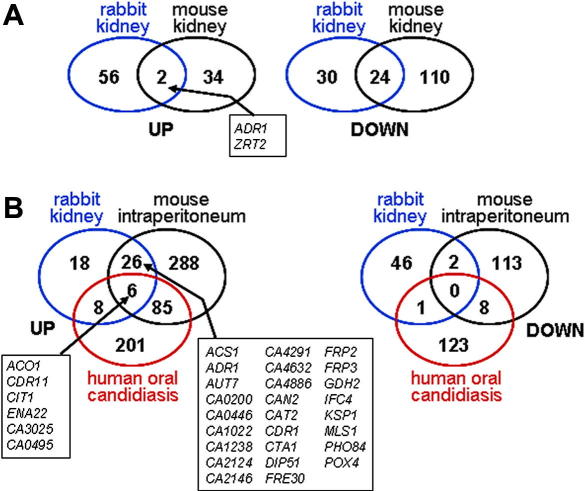
Comparison of the renal C. albicans SC5314 transcriptome with other in vivo microarray studies. The numbers of genes displaying >2-fold regulation in each study are illustrated in the Venn diagrams. (A) This rabbit renal study compared with the mouse kidney study of Andes and co-workers (2005). (B) This rabbit renal study compared with the mouse intraperitoneal study of Thewes et al. (2007) and the human oral candidiasis study of Zakikhany et al. (2007).
Fig. 3
Fig. 3
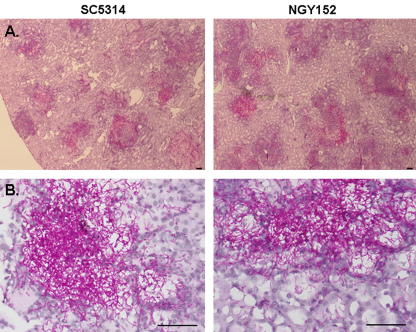
Histological analyses indicate that C. albicans SC5314 and NGY152 generate equivalent sizes of lesions and display similar cell morphologies in rabbit renal infections. Scale bars = 50 μm. (A) Low magnification. (B) Higher magnification.
Fig. 4
Fig. 4
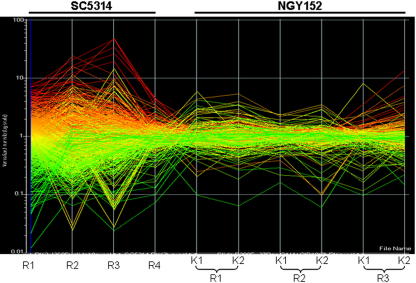
Comparison of the replicate microarray experiments for the C. albicans SC5314 and NGY152 renal infections. Each line represents a single gene, and each line is colour-coded on the basis of whether the corresponding gene was up- (red) or down-regulated (green) in the first SC5314 experiment: R1–R4, rabbits 1–4; K1–K2, kidneys 1–2. (For interpretation of colour mentioned in this figure the reader is referred to the web version of the article.)
Fig. 5
Fig. 5
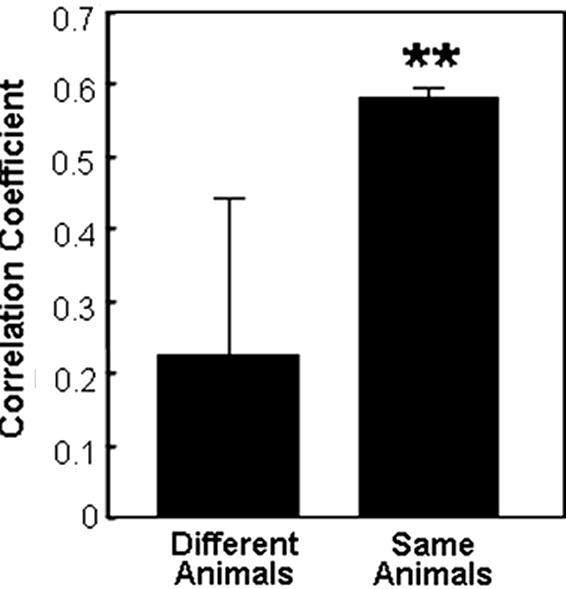
Comparison of genome-wide expression patterns for C. albicans NGY152 from different kidneys from the same animal versus kidneys from different animals. Mean correlation coefficients (±SD) for the pairwise comparisons of kidney infections using the whole microarray dataset for each kidney: **, significant at p < 0.01.
Fig. 6
Fig. 6
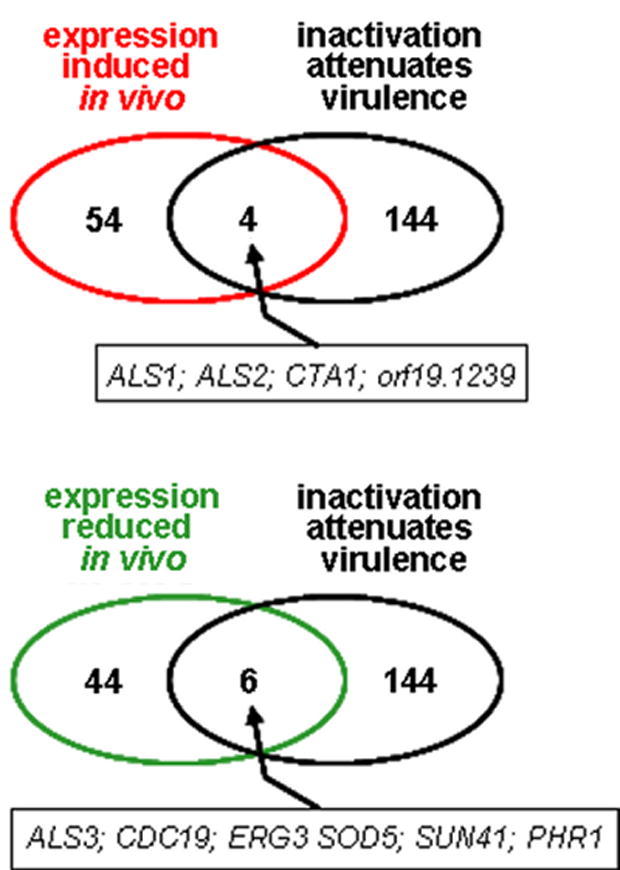
Comparison of the in vivo transcriptome (i.e. the subset of C. albicans SC5314 genes that were regulated during renal infections) with the in vivo phenome (i.e. the subset of C. albicans genes that affect the virulence of C. albicans, as defined by the Candida Genome Database @ August 2007) (Supplementary data).

References

    1. Andes D., Lepak A., Pitula A., Marchillo K., Clark J. A simple approach for estimating gene expression in Candida albicans directly from a systemic infection site. J. Infect. Dis. 2005;192:893–900. - PubMed
    1. Argimón S., Wishart J.A., Leng R., Macaskill S., Mavor A., Alexandris T., Nicholls S., Knight A.W., Enjalbert B., Walmsley R., Odds F.C., Gow N.A.R., Brown A.J.P. Developmental regulation of an adhesin gene during cellular morphogenesis in the fungal pathogen Candida albicans. Eukaryotic Cell. 2007;6:682–692. - PMC - PubMed
    1. Bailey D.A., Feldmann P.J.F., Bovey M., Gow N.A.R., Brown A.J.P. The Candida albicans HYR1 gene, which is activated in response to hyphal development, belongs to a gene family encoding yeast cell wall proteins. J. Bacteriol. 1996;178:5353–5360. - PMC - PubMed
    1. Barelle C.J., Priest C.L., MacCallum D.M., Gow N.A.R., Odds F.C., Brown A.J.P. Niche-specific regulation of central metabolic pathways in a fungal pathogen. Cell. Microbiol. 2006;8:961–971. - PMC - PubMed
    1. Barelle C.J., Duncan V.S., Brown A.J.P., Gow N.A.R., Odds F.C. Azole antifungals induce upregulations of SAP4, SAP5 and SAP6 secreted proteinase genes in filamentous Candida albicans cells in vitro and in vivo. J. Antimicrob. Chemother. 2008;61:315–322. - PubMed

Publication types

Substances