Comparative Study
. 2009 Feb;181(2):721-36.
doi: 10.1534/genetics.108.093419. Epub 2008 Nov 24.

Genetic changes accompanying the evolution of host specialization in Drosophila sechellia

Affiliations
Comparative Study

Genetic changes accompanying the evolution of host specialization in Drosophila sechellia

Ian Dworkin et al. Genetics. 2009 Feb.

Abstract

Changes in host specialization contribute to the diversification of phytophagous insects. When shifting to a new host, insects evolve new physiological, morphological, and behavioral adaptations. Our understanding of the genetic changes responsible for these adaptations is limited. For instance, we do not know how often host shifts involve gain-of-function vs. loss-of-function alleles. Recent work suggests that some genes involved in odor recognition are lost in specialists. Here we show that genes involved in detoxification and metabolism, as well as those affecting olfaction, have reduced gene expression in Drosophila sechellia-a specialist on the fruit of Morinda citrifolia. We screened for genes that differ in expression between D. sechellia and its generalist sister species, D. simulans. We also screened for genes that are differentially expressed in D. sechellia when these flies chose their preferred host vs. when they were forced onto other food. D. sechellia increases expression of genes involved with oogenesis and fatty acid metabolism when on its host. The majority of differentially expressed genes, however, appear downregulated in D. sechellia. For several functionally related genes, this decrease in expression is associated with apparent loss-of-function alleles. For example, the D. sechellia allele of Odorant binding protein 56e (Obp56e) harbors a premature stop codon. We show that knockdown of Obp56e activity significantly reduces the avoidance response of D. melanogaster toward M. citrifolia. We argue that apparent loss-of-function alleles like Obp56e potentially contributed to the initial adaptation of D. sechellia to its host. Our results suggest that a subset of genes reduce or lose function as a consequence of host specialization, which may explain why, in general, specialist insects tend to shift to chemically similar hosts.


Figures

F<sc>igure</sc> 1.—
Figure 1.—
Experimental design for DGRC arrays. Red indicates “Morinda medium”; green indicates “standard medium.” A balanced incomplete block design was used, in a full-loop configuration with dye swapping. This design avoids confounding any variables with dye effects. For the RNA from both the heads and the bodies, 12 two-channel hybridizations were performed, resulting in 6 replicate hybridizations per treatment (3 per treatment per dye). We contrasted gene expression in D. sechellia when these flies were allowed to choose preferred Morinda medium vs. D. sechellia that were forced to use standard medium. We performed a parallel experiment with D. simulans as a control. We expect almost no genes will differ between treatments in D. simulans, although it is possible that the odors from the Morinda medium could cause some minor changes in expression. (Forcing D. simulans on the Morinda medium is problematic because it is toxic to these flies.)
F<sc>igure</sc> 2.—
Figure 2.—
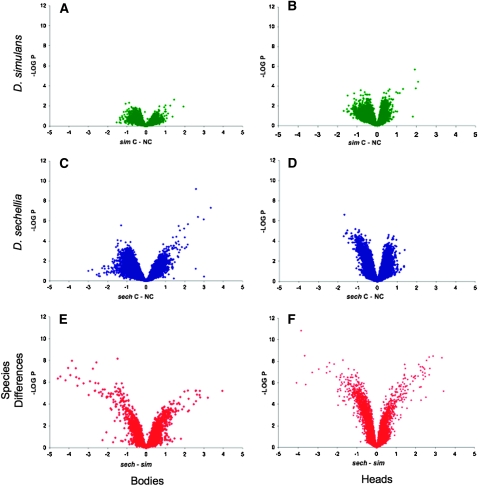
Volcano plot showing differences in transcriptional profiles between D. simulans and D. sechellia and in preference assays for each species. (A, C, and E) Data from bodies; (B, D, and F) data from heads. FDR q-value = 0.02 for the between-treatment analysis; FDR q-value = 0.01 for the between-species analysis. As expected, virtually no genes are differentially expressed between the choice (“C”) and no-choice (“NC”) preference assays for D. simulans, which prefers standard media (A and B, green). In contrast, many genes appear to be differentially expressed between the choice and no-choice assays in D. sechellia, which shows a strong preference for the media containing compounds from its host plant Morinda (C and D, blue). (E and F) (red) show differences in gene expression between the two species that are not the results of choice treatments. Heads show more expression changes than bodies. There are substantial expression changes between species. On average, genes are slightly more highly expressed in D. sechellia relative to D. simulans. Despite this, many more genes are strongly downregulated in D. sechellia relative to D. simulans. On the x-axis the difference in log2 expression between factor levels is noted below the axis. The y-axis displays the log10 of the P-value of those differences from the linear mixed model.
F<sc>igure</sc> 3.—
Figure 3.—
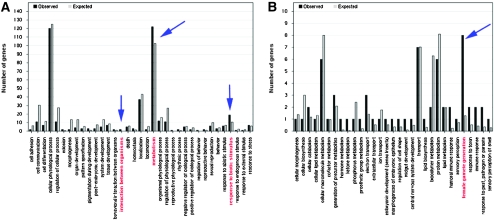
Genes involved with biotic interactions, metabolism, and oogenesis are differentially regulated in D. sechellia on media containing compounds from its host plant Morinda. (A) Genes involved in biotic interactions and metabolism are differentially regulated between the choice–no-choice preference assays in the head of D. sechellia. In addition, arrows indicate GO categories that show significant overrepresentation. (B) As suggested by overrepresentation of differentially expressed genes in Gene Ontology (GO) categories, genes involved with oogenesis are upregulated in the bodies of D. sechellia on the media containing Morinda compounds, which is consistent with previously described upregulation of egg production.
F<sc>igure</sc> 4.—
Figure 4.—
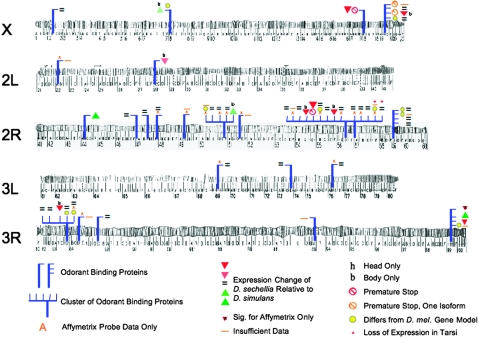
Location, expression, and functional status of odorant binding proteins (Obps) in D. sechellia. The definitions of the symbols are at the bottom. Additional details can be found in Table 3. All genes were assayed using both the DGRC array and the Affymetrix GeneChip, unless otherwise indicated. With the exception of Obp99a and Obp99c, the gene expression differences were consistent between the DGRC and GeneChip. Gene models with minor differences among species are marked in yellow. Half of these differences from D. melanogaster are shared between D. simulans and D. sechellia, half are specific to D. sechellia, and none are specific to D. simulans. Among Obps, more than twice as many are less expressed in D. sechellia (nine) than in D. simulans (four) and several appear nonfunctional in D. sechellia. Chromosome images are from Lindsey and Zimm (1992).

References

    1. Amlou, M., B. Moreteau and J. R. David, 1998. a Genetic analysis of Drosophila sechellia specialization: oviposition behavior toward the major aliphatic acids of its host plant. Behav. Genet. 28 455–464. - PubMed
    1. Amlou, M., B. Moreteau and J. R. David, 1998. b Larval tolerance in the Drosophila melanogaster species complex toward the two toxic acids of the D. sechellia host plant. Hereditas 129 7–14. - PubMed
    1. Anholt, R. R. H., and T. F. C. Mackay, 2001. The genetic architecture of odor-guided behavior in Drosophila melanogaster. Behav. Genet. 31 17–27. - PubMed
    1. Barker, J. S., W. T. Starmer and J. C. Fogleman, 1994. Genotype-specific habitat selection for oviposition sites in the cactophilic species Drosophila buzzatii. Heredity 72 384–395. - PubMed
    1. Begun, D. J., A. K. Holloway, K. Stevens, L. W. Hillier, Y. P. Poh et al., 2007. Population genomics: whole-genome analysis of polymorphism and divergence in Drosophila simulans. PLoS Biol. 5 e310. - PMC - PubMed

Publication types

MeSH terms