


The elusive link between conflict and conflict adaptation
- PMID: 19034501
- PMCID: PMC4476291
- DOI: 10.1007/s00426-008-0191-1
The elusive link between conflict and conflict adaptation
Abstract
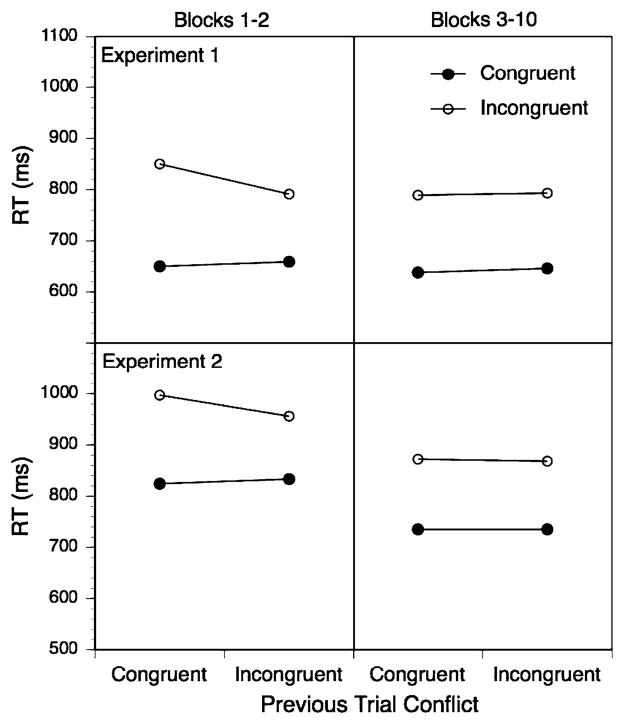
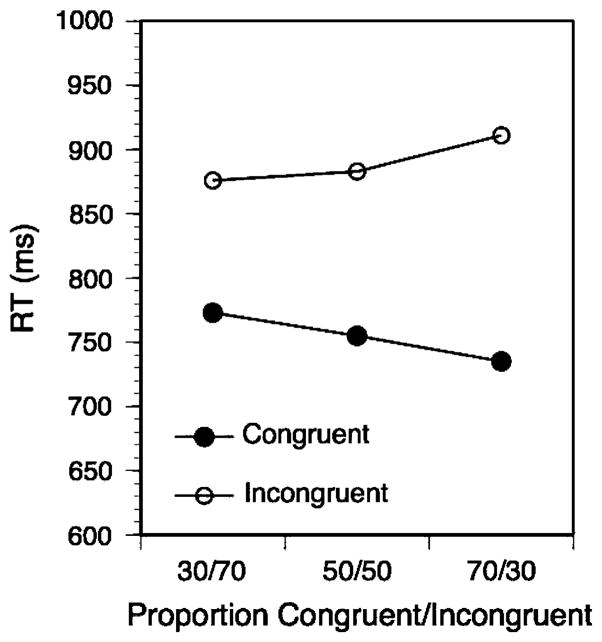
A core tenet of the original conflict-monitoring model is that regulation is triggered automatically when conflict is present and that the same regulation mechanism explains both trial-to-trial adaptation effects as well as effects of block-wise conflict manipulations. We present here results from two experiments using the Stroop task that show (a) that adaptation effects in the absence of response repetitions may occur only at the beginning of testing and that (b) robust block-wise effects can be found even in the absence of trial-by-trial effects. Furthermore, we show that the failure to eliminate target-to-distractor repetitions can produce artificial trial-to-trial adaptation effects. Based on the evidence of a weak link between conflict and conflict adaptation, we argue that a wider range of possible reasons for conflict adaptation effects needs to be taken into consideration.
Figures
References
-
- Awh E, Sgarlata AM, Kliestik J. Resolving visual interference during covert spatial orienting: online attentional control through static records of prior visual experience. Journal of Experimental Psychology: General. 2005;134(2):192–206. - PubMed
-
- Botvinick MM, Braver TS, Barch DM, Carter CS, Cohen JD. Conflict monitoring and cognitive control. Psychological Review. 2001;108:624–652. - PubMed
-
- Blais C, Dobidoux S, Risko EF, Besner D. Item-specific adaptation and the conflict-monitoring hypothesis: A computational model. Psychological Review. 2007;114:1076–1086. - PubMed
-
- Bryck RL, Mayr U. Task selection cost asymmetry without task switching. Psychological Bulletin and Review in press. - PubMed
-
- Cohen JD, Dunbar K, McClelland JL. On the control of automatic processes: A parallel distributed processing model of the Stroop effect. Psychological Review. 1990;97:332–361. - PubMed
MeSH terms
Grants and funding
LinkOut - more resources
Full Text Sources
