. 2008 Dec 17;27(24):3221-34.
doi: 10.1038/emboj.2008.248. Epub 2008 Nov 27.

VAC14 nucleates a protein complex essential for the acute interconversion of PI3P and PI(3,5)P(2) in yeast and mouse

Affiliations

VAC14 nucleates a protein complex essential for the acute interconversion of PI3P and PI(3,5)P(2) in yeast and mouse

Natsuko Jin et al. EMBO J. .

Abstract

The signalling lipid PI(3,5)P(2) is generated on endosomes and regulates retrograde traffic to the trans-Golgi network. Physiological signals regulate rapid, transient changes in PI(3,5)P(2) levels. Mutations that lower PI(3,5)P(2) cause neurodegeneration in human patients and mice. The function of Vac14 in the regulation of PI(3,5)P(2) was uncharacterized previously. Here, we predict that yeast and mammalian Vac14 are composed entirely of HEAT repeats and demonstrate that Vac14 exerts an effect as a scaffold for the PI(3,5)P(2) regulatory complex by direct contact with the known regulators of PI(3,5)P(2): Fig4, Fab1, Vac7 and Atg18. We also report that the mouse mutant ingls (infantile gliosis) results from a missense mutation in Vac14 that prevents the association of Vac14 with Fab1, generating a partial complex. Analysis of ingls and two additional mutants provides insight into the organization of the PI(3,5)P(2) regulatory complex and indicates that Vac14 mediates three distinct mechanisms for the rapid interconversion of PI3P and PI(3,5)P(2). Moreover, these studies show that the association of Fab1 with the complex is essential for viability in the mouse.


Figures
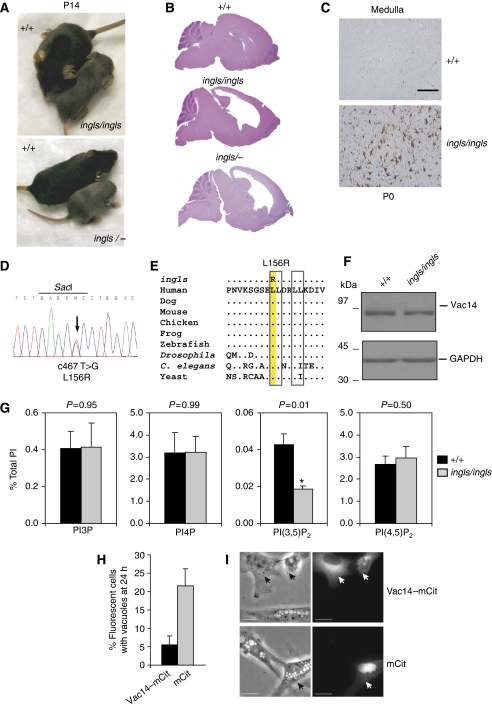
Figure 1
Figure 1
ingls is caused by the missense mutation Vac14–L156R. (A) ingls homozygous mice at postnatal day 14 (P14) display reduced body weight and diluted coat colour. ingls/Vac14 compound heterozygotes at P14 are similar in appearance. (B) Severe hydrocephalus and enlarged ventricles in ingls homozygote (P16) and ingls/Vac14 compound heterozygotes (P14) (H&E staining). (C) GFAP-stained astrocytes in neonatal ingls- and Vac14-null mice. (D) Sequence chromatogram from exon 4 of an ingls/+ heterozygote demonstrates the c467 T>G nucleotide substitution. (E) The ingls mutation changes leucine 156 to arginine. Leucine 156 is evolutionarily invariant from yeast to mammals. Dots indicate amino-acid identity with human Vac14. (F) Western blot of Vac14 protein in brain extracts of wild-type and ingls mice. Loading control, GAPDH. (G) Reduced levels of PI(3,5)P2 in cultured fibroblasts from ingls mice. (H, I) Rescue of vacuole formation by wild-type human Vac14 cDNA. Primary fibroblasts from ingls mice transfected with the indicated plasmids. At 24 h, cells were fixed with 4% paraformaldehyde in PBS for 10 min, room temperature. (H). Fluorescent cells were scored for the presence of vacuoles. Mean±s.d. for three independent experiments, >100 cells per experiment. (I) Representative cells are shown; arrows mark transfected cells. Bar, 20 μm.
Figure 2
Figure 2
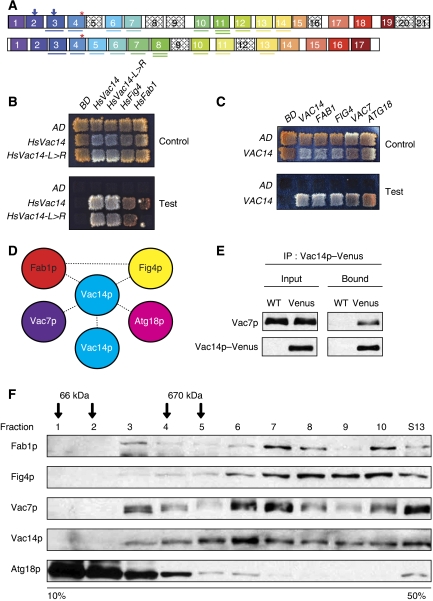
Vac14 nucleates the Fab1 complex. (A) Vac14 contains 21 and 17 HEAT repeats in S. cerevisiae (top) and mammalian Vac14 (bottom), respectively. Identical colours indicate homologous repeats between S. cerevisiae and mammalian Vac14. Red asterisk and blue arrows indicate ingls and vac14-2 mutations, respectively. Underlines: HEAT repeats identified by REP with a confidence threshold better than at Pθ<1e−6. (B) Yeast two-hybrid test of human Vac14 (HsVac14) or human Vac14–L156R (HsVac14-L>R), fused with the GAL4-activation domain (AD), interaction with itself, residues 346–1134 of human Fab1 or full-length Fig4, fused with the GAL4-binding domain (BD). Plasmids were cotransformed into the yeast cells and transformants were plated onto the SC-LEU-TRP plate and replica-plated onto SC-LEU-TRP (control) or SC-LEU-TRP-ADE-HIS plate (test). Plates were incubated at 24°C for 10 days. Growth on the test plate indicates protein–protein interaction. (C) Yeast two-hybrid test of Gal4-AD fused with yeast Vac14p tested with Gal4-BD fused with either Fab1p, Fig4p, Vac7p, Atg18p or Vac14p. Transformants were plated onto SC-LEU-TRP and replica-plated onto SC-LEU-TRP (control) or SC-LEU-TRP-ADE-HIS+3AT (test). Plates were incubated at 24°C for 7 days. (D) Schematic of interactions between Fab1 and Fab1 regulators. (E) Vac14p–Venus coprecipitated Vac7p. Wild-type or VAC14–Venus cells were used. (F) Analysis on glycerol gradients (10–50%) indicate that Fab1p and regulators form a complex >670 kDa. Molecular weight markers bovine serum albumin, 66 kDa, and thyroglobulin, 670 kDa, run in an adjacent tube. Representative profile of two independent gradients. vac14Δ/fig4Δ/ATG18–Venus cells expressing pRS413–VAC14–V5 and pRS415–FIG4–Myc were used.
Figure 3
Figure 3
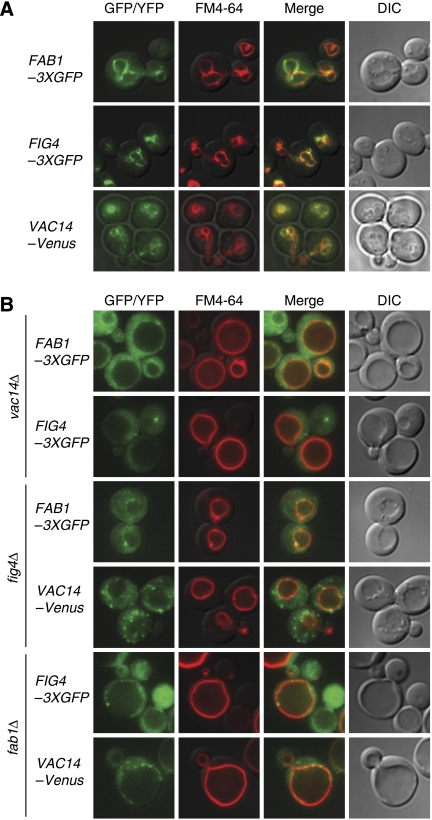
The localization of Fab1p, Fig4p, and Vac14p to the vacuole membrane requires the presence of all three proteins. Cells labelled with FM4-64 (red) to visualize the vacuole membrane. (A) Wild-type strains with FAB1–3xGFP, FIG4–3xGFP, or VAC14–Venus integrated at the proper chromosomal locus. (B) FAB1–3xGFP or FIG4–3xGFP/vac14Δ cells, FAB1–3xGFP or VAC14–Venus/fig4Δ cells and FIG4–3xGFP or VAC14–Venus/fab1Δ cells.
Figure 4
Figure 4
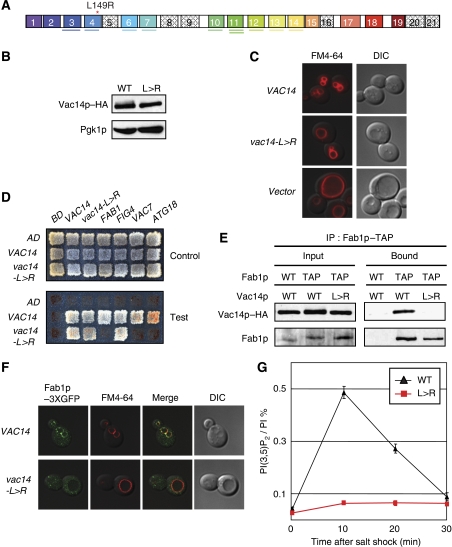
The vac14–L149R mutant is defective in its association with Fab1p. (A) Schematic of the vac14–L149R mutant. Red asterisk: mutation site. (B) vac14–L149R protein is stable. Cell lysates from a vac14Δ strain expressing pRS413–VAC14-HA or pRS413–vac14–L149R–HA (L>R) analysed by western blot. Vac14p detected with anti-HA antibody. Loading control: Pgk1. (C) vac14–L149R mutant retains partial function. Vacuoles in the vac14–L149R mutant are intermediate in size between vac14Δ and wild-type vacuoles. Vacuoles visualized with FM4-64 (red). vac14Δ strain transformed with pRS413–VAC14, pRS413–vac14–L149R (vac14-L>R), or pRS413 (vector). (D) Yeast two-hybrid test of Vac14p or vac14p–L149R interaction with itself, Fab1p, Fig4p, Vac7p, and Atg18p. Full-length Vac14p or vac14p–L149R (vac14-L>R) fused with Gal4-AD and Gal4-BD. Full-length Fig4p; Atg18p; amino acids 394–918 of Vac7p, amino acids 538–1085 of Fab1p, fused with Gal4-BD. Upper panel, SC-LEU-TRP (control); lower panel, SD-LEU-TRP-ADE-HIS+3AT (test). (E) Pull-down of Fab1p–TAP coprecipitates wild-type Vac14p, but not vac14p–L149R. Detergent-solubilized extracts from a vac14Δ or vac14Δ/FAB1–TAP strain expressing pRS413–VAC14–HA (WT), or pRS413–vac14–L149R–HA (L>R). Vac14p but not vac14p–L149R binds Fab1p–TAP IgG beads. (F) Fab1p localization is defective in the vac14p–L149R mutant. A vac14Δ/FAB1–3XGFP strain transformed with pRS413–VAC14 or pRS413–vac14–L149R (vac14-L>R). FM4-64 (red), Fab1p–3xGFP (green). (G) The vac14–L149R mutant does not increase its levels of PI(3,5)P2 in response to hyperosmotic stress. vac14Δ cells expressing pRS413–VAC14 or pRS413–vac14–L149R were labelled with [3H]inositol for 16 h and exposed to 0.9 M NaCl for times indicated. Values are the percentage of total extracted [3H]PI. Error bars: s.d. (n=3).
Figure 5
Figure 5
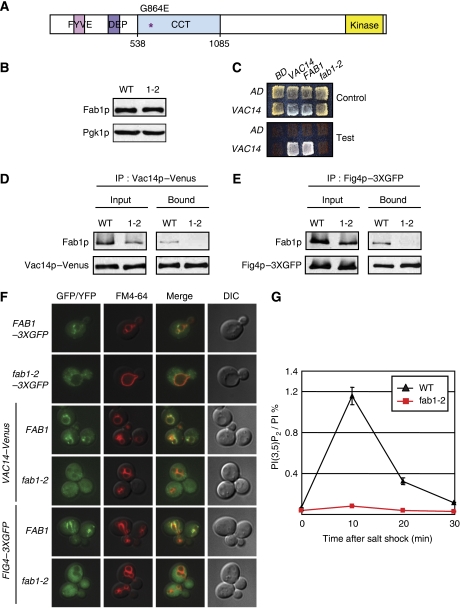
Formation of a ternary complex of Fab1p, Vac14p, and Fig4p is required for Fab1p kinase activity in vivo. (A) Schematic of the fab1-2 allele; purple asterisk, the G864E mutation. (B) Fab1-2 protein is present at wild-type levels. Cell lysates analysed by western blot analysis from fab1Δ cells expressing pRS416–FAB1 or pRS416–fab1-2. Equal protein loaded. (C) VAC14 interacts with FAB1, but not fab1-2. Yeast two-hybrid test of FAB1 or fab1-2 interaction with VAC14. Full-length VAC14 fused with Gal4-AD. FAB1 or fab1-2, amino acids 538-1085. fused with Gal4-BD. Upper panel, SC-LEU -TRP (control); lower panel, SC-LEU-TRP-ADE-HIS+3AT (test). Plates incubated at 24°C for 4 days. (DE) fab1-2 does not form a complex with Vac14p and Fig4p. (D) Vac14p–Venus does not coprecipitate fab1-2. pRS416–FAB1 or pRS416–fab1-2 expressed in a fab1Δ/VAC14–Venus strain. (E) fig4p–3xGFP does not coprecipitate fab1-2. pRS416–FAB1 or pRS416–fab1-2 expressed in a fab1Δ/FIG4–3xGFP strain. (F) fab1-2, Vac14p and Fig4p in a fab1-2 mutant do not localize to the vacuole membrane. pRS416–FAB1–3xGFP or pRS416–fab1-2–3xGFP expressed in fab1Δ, or fab1Δ/VAC14–Venus or fab1Δ/FIG4–3xGFP. Cells labelled with FM4-64 (red). (G) The fab1-2 mutant does not transiently increase its levels of PI(3,5)P2 in response to hyperosmotic stress. fab1Δ cells expressing pRS416–FAB1 or pRS416–fab1-2 measured as described in Figure 4. Error bars: s.d. (n=3).
Figure 6
Figure 6
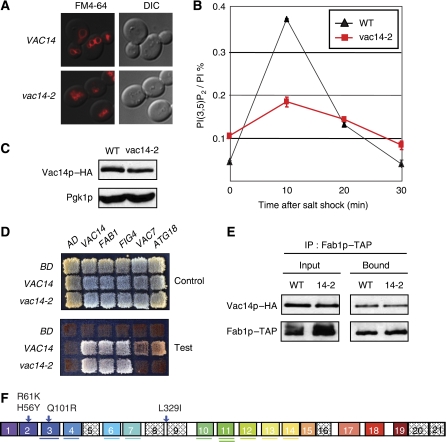
Vac7p and Atg18p function through Vac14p. (A) vac14-2 has smaller than normal vacuoles, consistent with elevated basal levels of PI(3,5)P2. vac14Δ cells expressing pRS416–VAC14 or pRS416–vac14-2 labelled with FM4-64. (B) vac14-2 has higher basal levels of PI(3,5)P2, but does not elevate or turnover PI(3,5)P2 during osmotic stress. PI(3,5)P2 levels in vac14Δ cells expressing pRS416–VAC14 or pRS416–vac14-2 measured as described in Figure 4. Error bars: s.d. (n=3). (C) vac14-2 protein is present at wild-type levels. Cell lysates analysed by western blot analysis from vac14Δ cells expressing pRS413–VAC14–HA (WT) or pRS413–vac14-2–HA(14-2). Pgk1p: loading control. (D) Vac14-2 is defective in binding Vac7p and Atg18p. Yeast two-hybrid test of VAC14 or vac14-2, fused with Gal4-AD, interaction with FAB1, FIG4, VAC7, ATG18, fused with Gal4-BD. Upper panel, SC-LEU-TRP (control); lower panel: SC-LEU-TRP-ADE-HIS +3AT (test). Plates incubated at 24°C, 7 days. (E) Fab1p coprecipitates vac14-2. Detergent-solubilized extracts from a vac14Δ or vac14Δ/FAB1–TAP strain expressing pRS413–VAC14–HA (WT), or pRS413–vac14-2–HA (14-2). (F) Schematic of the vac14-2 allele; blue arrows indicate the mutation sites.
Figure 7
Figure 7
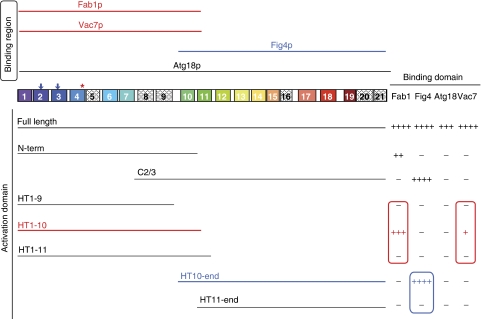
Yeast two-hybrid analysis of the minimal region of Vac14p required for interaction with Fab1p, Fig4p, Vac7p, and Atg18p. Lines above the schematic indicate the minimal region of Vac14p required for binding with each protein. Full-length VAC14 or truncated VAC14 was fused with Gal4-AD. FAB1 encoding amino acids 538–1085, VAC7 encoding amino acids 394–918: full-length ATG18 or FIG4 was fused with the BD. Lines below the schematic indicate the regions of Vac14p tested.
Figure 8
Figure 8
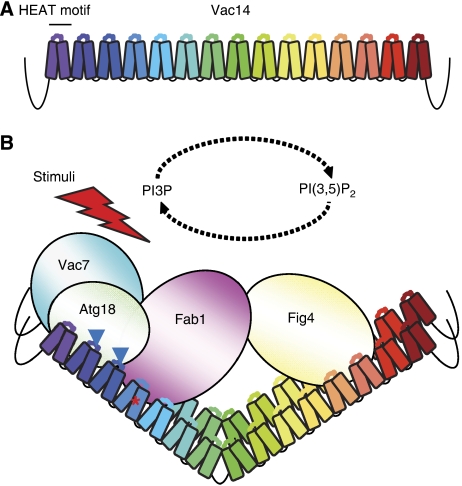
Model of the Vac14 complex. (A) Schematic Vac14. (B) Vac14p binds to both Fab1p and Fig4p and may undergo a conformational change that brings Fab1p into contact with Fig4p. Fig4p functions as both an activator of Fab1p and a PI(3,5)P2 5-phosphatase. Fig4p and Fab1p bind to distinct regions on Vac14p. The Fab1p-binding site significantly overlaps with Vac7p- and Atg18p-binding sites. Blue arrowheads indicate the vac14-2 mutations sites, the arrow to the left indicates the location of H56Y and R61K, the arrow to the right marks Q101R. These arrows show the region of Vac14p that contacts Vac7p and Atg18p. Red asterisk indicates the vac14-ingls mutation, which disrupts interaction with Fab1p, Vac7p, and Atg18p.

Comment in

References

    1. Andrade MA, Ponting CP, Gibson TJ, Bork P (2000) Homology-based method for identification of protein repeats using statistical significance estimates. J Mol Biol 298: 521–537 - PubMed
    1. Behnia R, Munro S (2005) Organelle identity and the signposts for membrane traffic. Nature 438: 597–604 - PubMed
    1. Bolis A, Zordan P, Coviello S, Bolino A (2007) Myotubularin-related (MTMR) phospholipid phosphatase proteins in the peripheral nervous system. Mol Neurobiol 35: 308–316 - PubMed
    1. Bonangelino CJ, Catlett NL, Weisman LS (1997) Vac7p, a novel vacuolar protein, is required for normal vacuole inheritance and morphology. Mol Cell Biol 17: 6847–6858 - PMC - PubMed
    1. Bonangelino CJ, Nau JJ, Duex JE, Brinkman M, Wurmser AE, Gary JD, Emr SD, Weisman LS (2002) Osmotic stress-induced increase of phosphatidylinositol 3,5-bisphosphate requires Vac14p, an activator of the lipid kinase Fab1p. J Cell Biol 156: 1015–1028 - PMC - PubMed

Publication types

MeSH terms

Substances