


Neurotransmitter alterations in embryonic succinate semialdehyde dehydrogenase (SSADH) deficiency suggest a heightened excitatory state during development
- PMID: 19040727
- PMCID: PMC2642797
- DOI: 10.1186/1471-213X-8-112
Neurotransmitter alterations in embryonic succinate semialdehyde dehydrogenase (SSADH) deficiency suggest a heightened excitatory state during development
Abstract
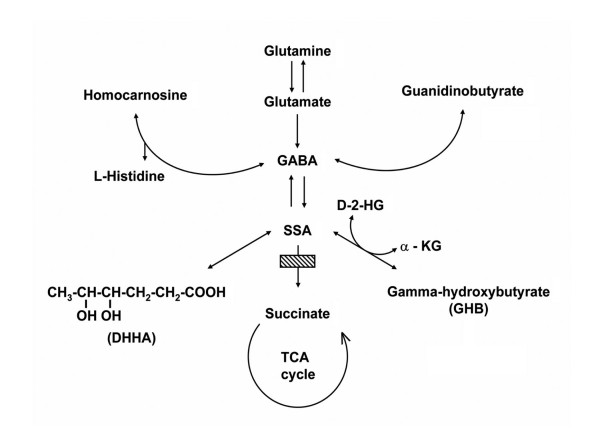
Background: SSADH (aldehyde dehydrogenase 5a1 (Aldh5a1); gamma-hydroxybutyric (GHB) aciduria) deficiency is a defect of GABA degradation in which the neuromodulators GABA and GHB accumulate. The human phenotype is that of nonprogressive encephalopathy with prominent bilateral discoloration of the globi pallidi and variable seizures, the latter displayed prominently in Aldh5a1-/- mice with lethal convulsions. Metabolic studies in murine neural tissue have revealed elevated GABA [and its derivatives succinate semialdehyde (SSA), homocarnosine (HC), 4,5-dihydroxyhexanoic acid (DHHA) and guanidinobutyrate (GB)] and GHB [and its analogue D-2-hydroxyglutarate (D-2-HG)] at birth. Because of early onset seizures and the neurostructural anomalies observed in patients, we examined metabolite features during Aldh5a1-/- embryo development.
Methods: Embryos were obtained from pregnant dams sacrificed at E (embryo day of life) 10-13, 14-15, 16-17, 18-19 and newborn mice. Intact embryos were extracted and metabolites quantified by isotope dilution mass spectrometry (n = 5-15 subjects, Aldh5a1+/+ and Aldh5a1-/-) for each gestational age group. Data was evaluated using the t test and one-way ANOVA with Tukey post hoc analysis. Significance was set at the 95th centile.
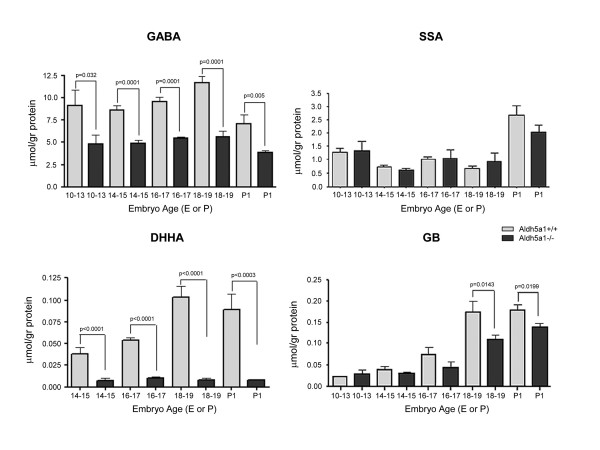
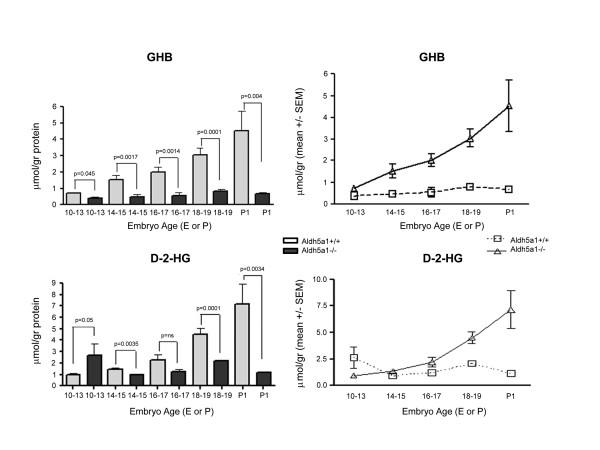
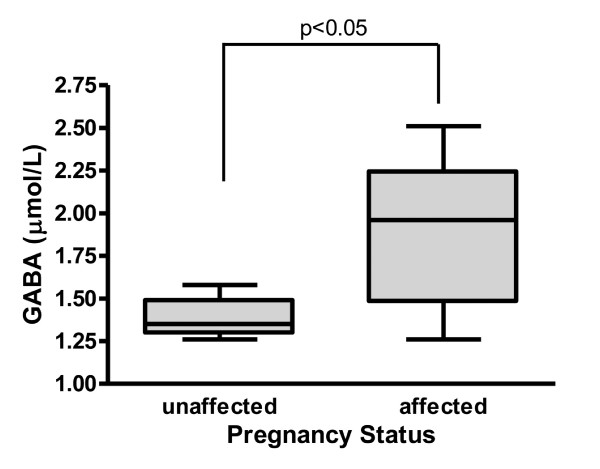
Results: GABA and DHHA were significantly elevated at all gestational ages in Aldh5a1-/- mice, while GB was increased only late in gestation; SSA was not elevated at any time point. GHB and D-2-HG increased in an approximately linear fashion with gestational age. Correlative studies in human amniotic fluid from SSADH-deficient pregnancies (n = 5) also revealed significantly increased GABA.
Conclusion: Our findings indicate early GABAergic alterations in Aldh5a1-/- mice, possibly exacerbated by other metabolites, which likely induce a heightened excitatory state that may predispose neural networks to epilepsy in these animals.
Figures
References
-
- Knerr I, Pearl PL, Bottiglieri T, Snead OC, Jakobs C, Gibson KM. Therapeutic concepts in succinate semialdehyde dehydrogenase (SSADH; ALDH5a1) deficiency (gamma-hydroxybutyric aciduria). Hypotheses evolved from 25 years of patient evaluation, studies in Aldh5a1-/- mice and characterization of gamma-hydroxybutyric acid pharmacology. J Inherit Metab Dis. 2007;30:279–294. doi: 10.1007/s10545-007-0574-2. - DOI - PubMed
Publication types
MeSH terms
Substances
Grants and funding
LinkOut - more resources
Full Text Sources
Molecular Biology Databases
Research Materials
